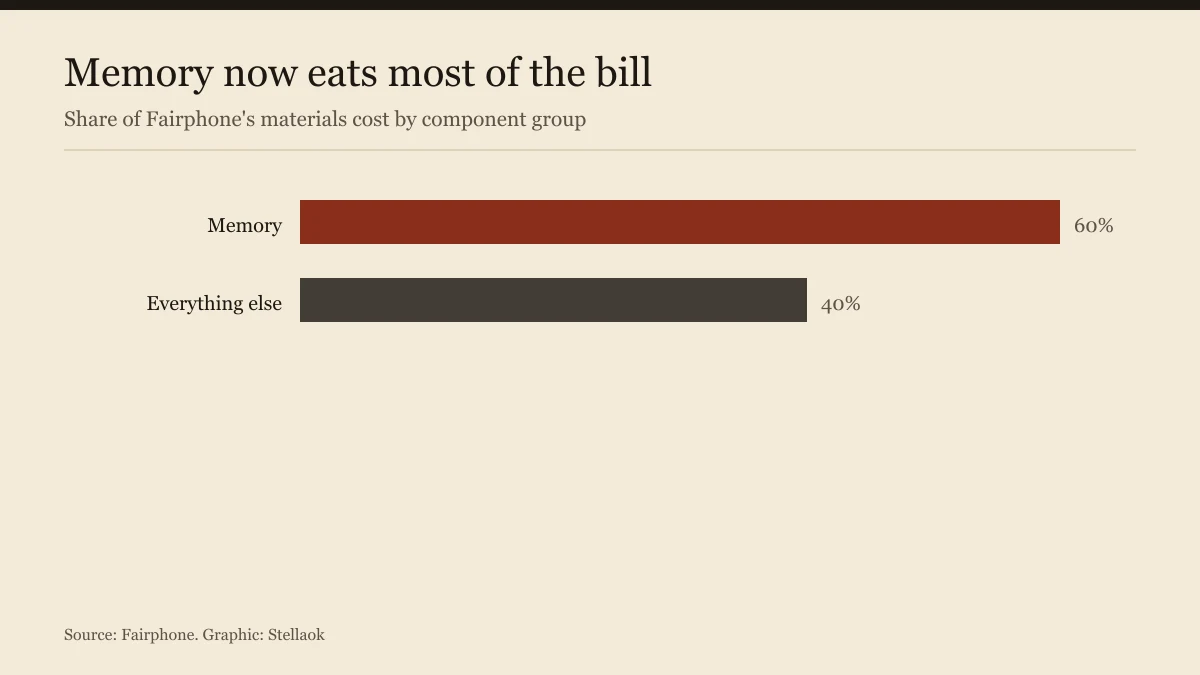
The memory shortage tied to AI data centers is changing how smaller phone and laptop makers design products. Fairphone said RAM now accounts for 60 percent of its materials cost.
Limited supply is the bigger headache. Companies are redrawing motherboards, rewriting procurement, and testing chips to make sure they are not counterfeit.
Memory ate the bill of materials
Fairphone built a brand on repairable phones and a bill of materials you could at least talk about in public. A 60 percent memory share is a snapshot of how warped that bill has become. RAM used to be a line item. It is now the line item.
Rising prices are only half the story, Tom's Hardware noted. Availability is forcing design changes that used to be optional. Smaller manufacturers do not have the long-term contracts that insulate a giant. They redesign around whatever capacities they can actually buy.
That can mean less RAM on the spec sheet. It can mean a board that can take more than one supplier's parts. It can mean delaying a refresh because the chips on the drawing are fictional.
Apple and Google can wait a quarter and still fill stores. The iPhone 18 Pro versus Pixel 11 Pro fight is a $100 price bump among companies that still get allocations. Fairphone is not in that meeting.
Fake chips follow a shortage
When memory is scarce, fake parts show up. Brands that cannot buy like Apple have to inspect what they get. Testing for counterfeit DRAM is grim, practical work. It is also a cost that never appears in a launch keynote.
The 2024-2026 squeeze started as an HBM story. Training clusters paid up for stacked memory on GPUs. Commodity DDR and LPDDR then got tighter because the same three suppliers were choosing where wafers went. Smaller laptop and phone makers felt it as empty reels, not as a data-center infographic.
Motherboard respins are slow. Tooling is slow. A company that sells a fair, repairable device cannot quietly swap a module every month without breaking the promise that you can open the thing. Fairphone's problem is not only price. It is identity. A modular phone that cannot source the module is a lecture with a hole in it.
Valve engineers talking about Steam Frame already warned that memory and storage costs would show up as sticker shock on a headset. Same shortage. Different product. The little phone brand cannot hide the line item in a luxury SKU.
What a small manufacturer can still ship
Do not expect Fairphone to outbid a hyperscaler. Do expect spec sheets to get more honest, or more vague, depending on the week. If a listing still promises a fat RAM number, ask when the unit in the warehouse was built.
Procurement teams at small OEMs should be dual-sourcing boards and paying for incoming inspection. That is not optional while fakes ride the shortage. Design teams should be laying out footprints that can take more than one vendor's package. That used to be nice engineering. It is now how you ship.
I do not buy the idea that this is a short blip that spare capacity will fix before Christmas. AI demand is still the buyer with the fattest wallet. The people paying for it, in this account, are the little brands.
Robotaxis and other compute-heavy bets keep pulling silicon into fleets. Phones are leftover demand. Fairphone said the quiet part with a percentage.
The next Fairphone bill of materials, if the company keeps publishing one, will show whether 60 percent was a peak or a new floor. Holiday laptop configs from second-tier OEMs will show it in the cart. If base RAM steps down a tier, this shortage has left the data center.
Repairability was supposed to be Fairphone's insulation from throwaway hardware. Spare parts, screws you can actually turn, a battery you can swap. None of that helps if the DIMM or the package on the board cannot be bought at a sane cost, or if the part in the spare bin is a counterfeit with a convincing label.
Small laptop houses face an uglier version of the same week. A 14-inch board respin to accept two vendors' memory is a quarter of engineering time. Skipping the respin and shipping whatever arrived in the reel is how fake chips get into the wild. Fairphone saying it has to test is the industry admitting the inspection step is no longer optional for anyone outside the top three phone brands.