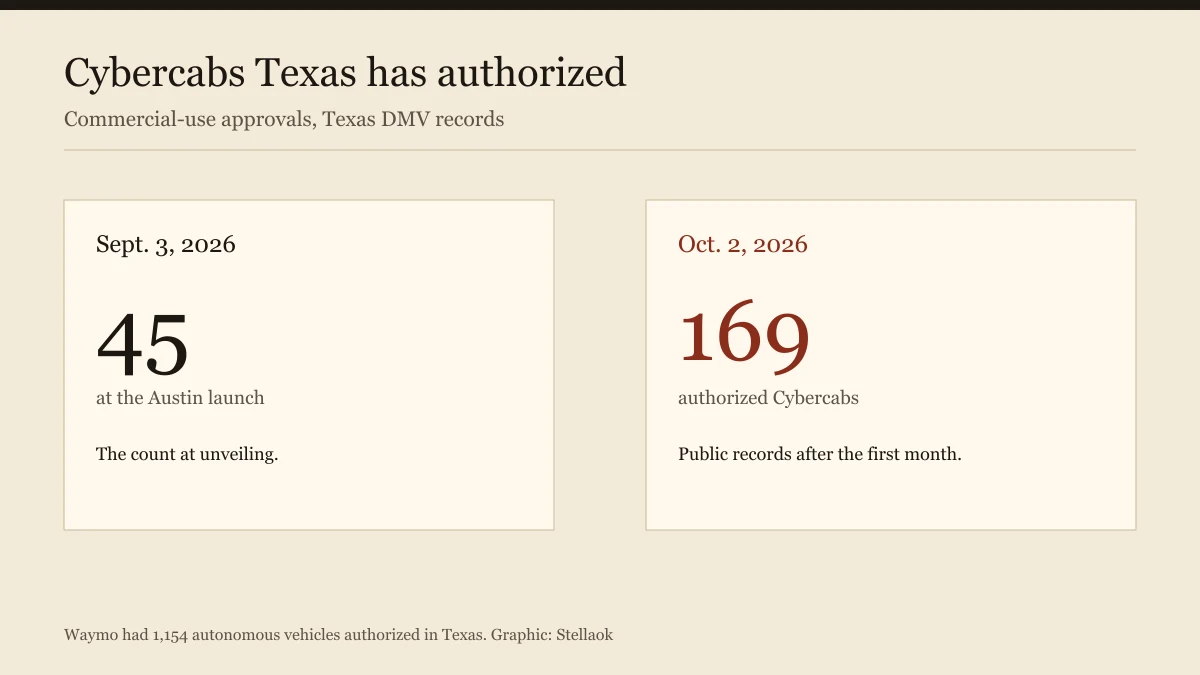
Texas has authorized 169 Tesla Cybercabs for commercial use, up from 45 at the Austin unveiling. The later count is from Texas DMV public records as of Friday. The launch was September 3, 2026.
CNBC's account of the first month puts 124 more of the two-seaters on the authorized list. The cars have no steering wheel, no pedals, no mirrors, and no outside door handles. Paying riders have posted long waits, pickups in the wrong place, and butterfly doors or trunks that did not shut. No significant collision in Austin has been tied to a Cybercab since the commercial debut. Tesla's shares are down 18% this year. Friday's delivery print lifted the stock almost 5% and still showed a 2% drop from a year earlier.
Waymo's Texas list is 1,154 vehicles
Waymo had 1,154 autonomous vehicles authorized for commercial use in Texas as of Friday, including 359 of its Ojai models. The company says it is doing more than 500,000 paid rides a week, has driven 270 million fully autonomous commercial miles in the U.S., and has over 4,000 driverless vehicles in commercial service. It lists 15 U.S. markets, with 15 more planned, plus London, Tokyo, and Munich. Waymo has already said Singapore riders will not pay a fare until 2028.
Tesla's Robotaxi fleet in Texas also includes 420 Model Y vehicles with the company's automated system. Those are not the Cybercab, and buyers still cannot order that system for their own cars. Austin is the only city where the Cybercab is in the driverless ride-hail service. Amazon's Zoox is testing there too. Tesla's car business is still the one trying to sell into markets like Vietnam, where a local maker holds most of the share.
The safety agency moved its deadline
NHTSA opened an audit query after the launch. It first wanted answers by September 30, 2026. A spokesperson told CNBC the company received an extension. Austin Fire Captain Matt McElearney said Tesla has given emergency guides and training, and that he wants a way for public-safety crews to move, steer, or shut down a car that has no wheel. He also wants the vehicles retested across their life, not once at the start.
Ethan McKanna, a 20-year-old former Tesla intern in Austin, told CNBC he has taken about 30 Cybercab rides. Early waits ran to 45 minutes. He likes the screen and calls the ride smooth. He calls the doors less convenient than a slider, and Waymo more mature on support. A September 2026 survey by Slingshot Strategies found 50% of U.S. respondents uncomfortable riding in a robotaxi with no wheel or pedals. After hearing about the NHTSA inquiry, 70% wanted Tesla to pause the rides.
Musk said in Davos in January that robotaxis would be very widespread in the U.S. by the end of 2026. That has not happened. California still has not given Tesla a permit to run on public roads with no one at the wheel. Cantor, writing after Friday's delivery figures, said management has described the Cybercab as the vehicle that would eventually lead the lineup once production ramps. The cities named for the next step are San Antonio and Dallas, then Nevada and Florida, where the weather is warm and the state rules are friendly to autonomous cars.
McKanna built a site, RobotaxiTracker.com, that reads traffic cameras and public records. He is a sophomore in computer science at Texas A&M. His comparison is maturity: Waymo has run commercial service longer, including a rough early period in Austin in 2024 when braking was harsh. The Cybercab's doors swing out. A sliding door, he said, is easier at the curb. Captain McElearney wants a control that is not a steering wheel, because the performance changes when the software does. He called the remedy a dynamic certification, a test repeated over the life of the car rather than once at approval.