Tesla will stop building the Cybertruck at Gigafactory Texas around the middle of next year and use the space for the Cybercab, Elon Musk said on X on Friday. The truck was introduced in 2019 with pyrotechnics, a shattered "armor glass" window and a promise from Musk that it would be the company's best product ever. It ends as a niche vehicle with a $92,490 starting price and eleven recalls.
Musk did not say whether the Cybertruck would be built anywhere else. When a user called the announcement the end of an era, he agreed and added that "the Cybertruck fleet will be around for a long time," which leaves owners without a clear answer on how long inventory and spare parts will be supplied.
A $39,900 pitch that became a $92,490 truck
The price history is the clearest measure of how the project drifted. Tesla advertised a starting price of $39,900 when the truck was unveiled in 2019. When deliveries finally began in 2023, two years later than promised, the advertised entry version was $60,990. This month Tesla raised prices again and stopped taking orders for the cheapest Dual Motor AWD model, so the entry point is now $92,490, up from $84,990 in August. A rear-wheel-drive version launched in 2025 and was pulled from the lineup months later.
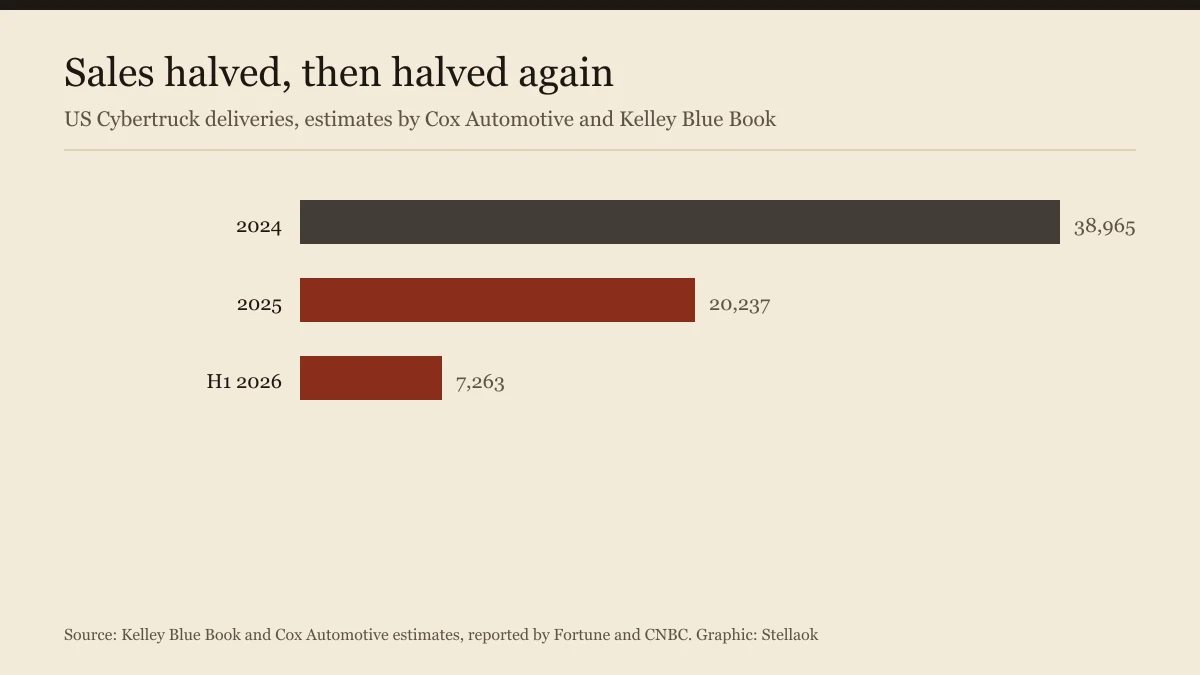
Volume never arrived either. Musk predicted eventual annual production of 250,000 to 500,000. Kelley Blue Book estimates put U.S. sales at 38,965 in 2024 and 20,237 in 2025, a 48 percent drop, with 7,263 in the first half of this year. Tesla does not break out Cybertruck sales in its filings, so every one of those numbers is an estimate.
One buyer did show up in volume: SpaceX, Musk's rocket company, spent $131 million buying Cybertrucks at retail price last year, according to a SpaceX financial filing reported by CNBC. That is a related-party transaction worth noting for anyone reading Tesla's demand as a market signal.
The Cybercab has its own problem
The Cybercab that takes the line's place is a two-seater with no steering wheel and no pedals. The first units reached Austin roads in September, and Tesla runs a separate robotaxi service with the Model Y in Houston, Dallas, Fort Worth, Miami, Orlando and Tampa.
Federal regulators are still working through whether the vehicle is legal as certified. In September the National Highway Traffic Safety Administration opened an investigation into whether Tesla properly certified that the Cybercab meets federal safety standards. Tesla answered the agency's questions at the end of October but asked that the responses stay sealed as confidential business information, and NHTSA has not ruled on that request, according to Electrek.
The competitive picture is not flattering. Waymo operates in 15 U.S. cities and said earlier this year that it provides 500,000 rides a week. Texas has been authorizing Cybercabs at a much smaller scale: 169 were approved by early October, up from 45, a count we covered when the state's permits were still in double digits. Cities have meanwhile been writing their own robotaxi rules while a federal framework stays stalled, which means Tesla's expansion depends on a patchwork it cannot control.
What the switch is really about
Tesla's EV business has been shrinking since the federal EV tax credit ended last year, and the company has spent 2026 arguing that autonomy, not vehicle sales, is where its future value sits. Killing the Cybertruck is consistent with that story: it frees floor space and engineering attention for a product the company needs to be real.
The financial logic is harder. The Cybertruck was the most expensive vehicle Tesla sold at volume, and dropping it removes revenue from a business that already has fewer buyers than it did two years ago. Musk's argument is that the Cybercab will be cheaper to build and will earn money per mile rather than per unit. That only works if regulators approve it and riders use it, and both are behind schedule.
For the roughly 66,000 buyers counted in those estimates, the practical question is parts and software support, not strategy. Musk's answer, that the fleet will be around for a long time, is a promise rather than a policy. For investors, the useful comparison is not Cybertruck to Cybercab but Tesla's robotaxi count to Waymo's, and on that measure the gap is still measured in cities.