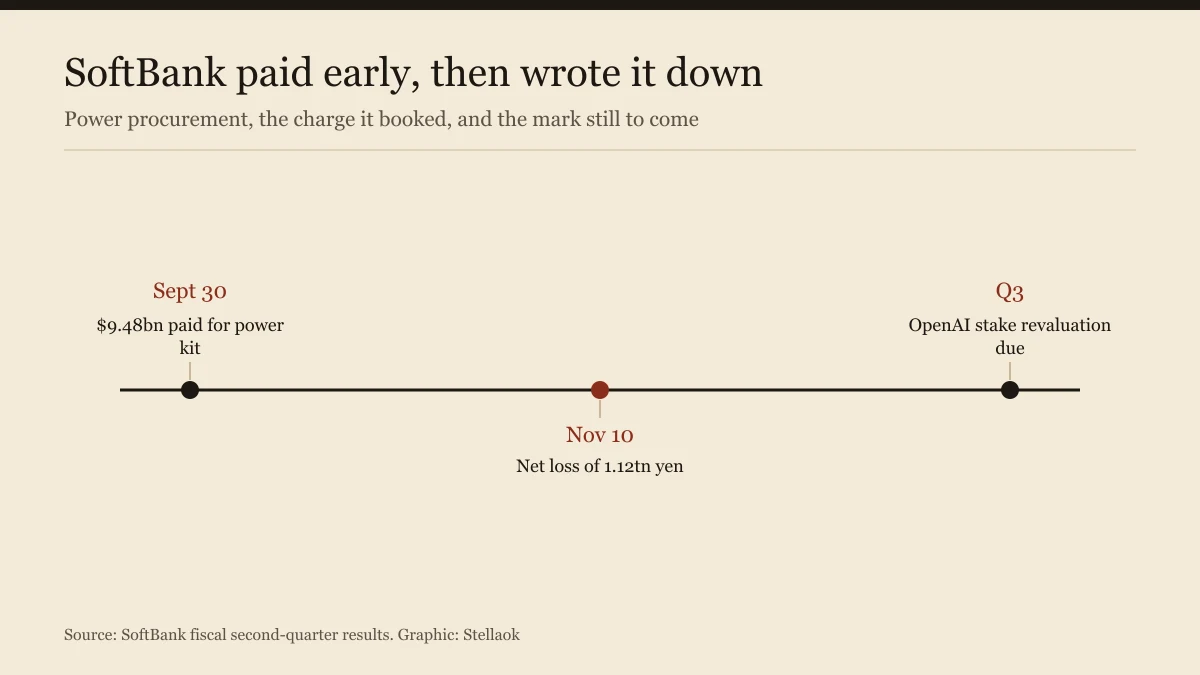
SoftBank reported a net loss of ¥1.12 trillion ($7 billion) for its fiscal second quarter on Tuesday, driven by a write-down on power generation equipment ordered for US AI data center projects and a decline in the value of its Intel shares.
The charge is unusually specific. SoftBank recorded a ¥597.2 billion ($3.7 billion) loss for the six months to September 30 after changing its procurement plans for generation equipment. It had paid up front to secure the kit, in the expectation of shortages and long lead times, and had cumulatively committed $9.48 billion to power equipment for US campuses including the PORTS-Pike Technology Campus in Pike County, Ohio, by the end of September. "We made bridge investments in advance to secure power generation equipment in anticipation of shortage," an executive said on the earnings call.
Power is now the expensive part of the buildout
Electricity has become the binding constraint on AI construction, with grids swamped by applications from large users. Buying turbines early is a rational hedge, and it is also a bet that the schedule will hold. When the schedule changes, the equipment is already bought, and the write-down is the price of having moved first.
SoftBank's other numbers show the same exposure from a different angle. Revenue rose 13.3% in the six months, helped by telecoms and AI computing. The Vision Fund segment swung to a ¥81.58 billion loss in the quarter, against a ¥2.38 trillion profit a year earlier. Vision Fund 1 lost $20 million on investments despite a $1.3 billion gain on ByteDance, as Coupang and Grab fell. Its stake in OpenAI stands at $54.6 billion of cost against a fair value of $99.6 billion, a $45 billion paper gain that has not been marked up for a new funding round.
The part that is still working
SoftBank's shares closed 13.9% higher on the day, tracking a rebound in Asian technology stocks rather than the loss. The company also has a 20-year lease with OpenAI for eight gigawatts of IT capacity at its Ohio project, and said it will use a closed-loop air-cooled system at its Texas campus to cut water use. On Monday it announced a $1.85 billion commitment with Grab and Malaysia's PETROS to develop AI infrastructure in Malaysia, targeting at least five gigawatts.
The pattern across the sector is that debt-funded capacity keeps getting repriced. CoreWeave has spent the quarter arguing its $35 billion of debt is serviceable while data center construction runs at an $85 billion annual pace. SoftBank's difference is that it is buying the parts nobody else can get, which makes its balance sheet a leading indicator for everyone building behind it.
Two more numbers frame the quarter. The Vision Funds segment booked ¥85.45 billion of investment gains in the six months, against ¥2.81 trillion a year earlier, with Vision Fund 2 contributing ¥89.26 billion and Vision Fund 1 a loss of ¥3.86 billion. The group's own telecoms arm kept growing, which is why revenue rose despite everything above.
The next mark is the third quarter, when the OpenAI valuation update may finally be booked. A higher number there improves the group's loan-to-value ratio without a dollar of new cash, which is the kind of gain that fixes a balance sheet on paper and changes nothing about the power bills behind it.
Source: CNBC