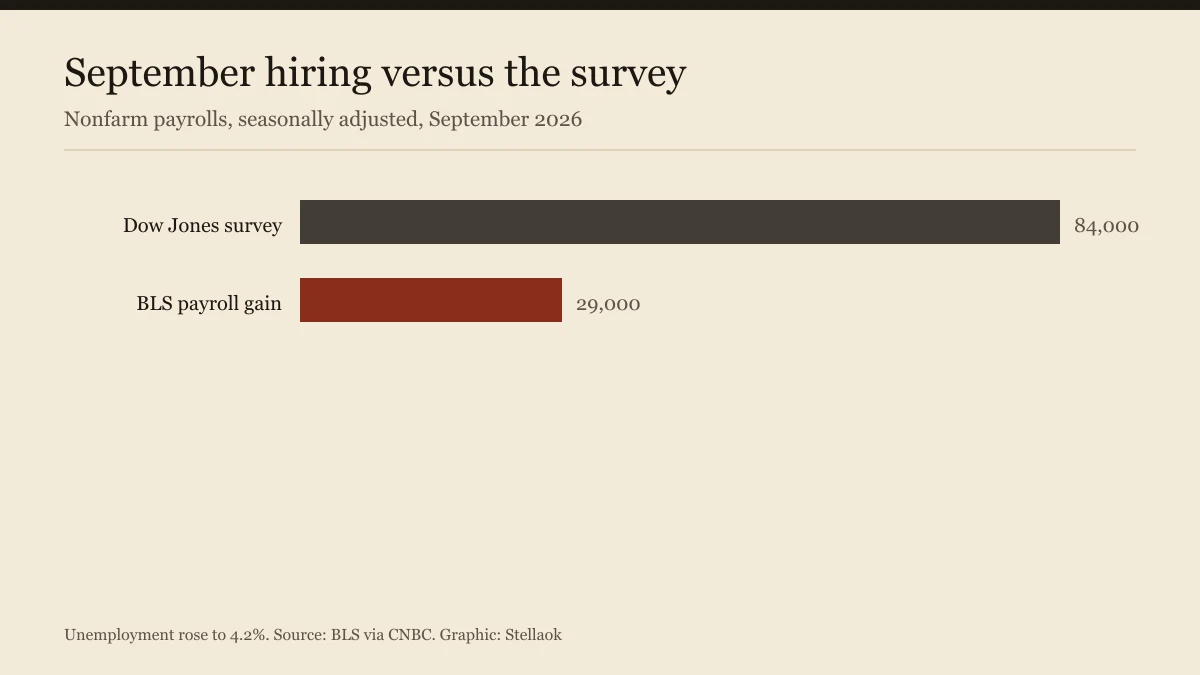
U.S. employers added 29,000 jobs in September 2026. Economists surveyed by Dow Jones had expected 84,000. The unemployment rate rose to 4.2%, from a survey that had it at 4.1%.
CNBC's report of the Bureau of Labor Statistics release puts the miss at the center of the Friday print. The gap between those two payroll figures is 55,000 jobs. August was revised down to a gain of 133,000. July flipped from a gain to a loss of 10,000. The two revisions together removed 60,000 jobs from earlier tallies.
The miss is larger than a rounding error
A 29,000 gain is a soft month on its own. Set beside the 84,000 the survey had written down, it is about a third of the hiring Wall Street walked in expecting. Thomas Simons, chief U.S. economist at Jefferies, had thought August's rebound would carry into September, because weekly jobless claims had been historically low. His note after the release called the August jump a bounce off weak hiring in June and July, and called this print the end of the case for an October rate increase.
The Federal Reserve raised its benchmark a quarter point in September. Policymakers have treated inflation as the larger threat. The latest reading of the Fed's preferred core gauge is a 3% annual rate, against a 2% target. Weekly claims have stayed low, and one layoff indicator is at its lowest in four years. That was the "low-hire, low-fire" picture going into Friday. The establishment survey broke the hire side of it.
Household employment rose by 406,000
The household survey, which produces the unemployment rate, moved the other way. Household employment rose by 406,000. The labor force grew by 485,000. The participation rate rose 0.2 point to 61.8%, the highest since May. A broader jobless measure, counting discouraged workers and people in part-time jobs for economic reasons, edged down to 7.6%, the lowest since January 2025.
Those household figures and the 29,000 payroll gain come from different surveys. The Fed watches the unemployment rate more closely than the headline payroll number, which is why a 4.2% rate can matter more inside the building than a single weak establishment month. Futures traders treated the soft payrolls as a reason to fade an October hike. Stock futures rose sharply. Treasury yields fell, after a climb that had taken them to levels last seen early in the century.
Three industries did the hiring
Healthcare added 17,000 jobs, construction 11,000, and manufacturing 9,000. Those three gains add to 37,000. Government employment fell by 17,000. Temporary help fell by 11,000. Information services lost 10,000, which the report places amid worry about artificial intelligence and the jobs mix. Financial activities lost 7,000. Those four declines add to 45,000. The leftover, which gets the monthly total to a gain of 29,000, sits in industries the release did not itemize.
A Pew survey already had publics in most countries expecting AI to cut jobs. The information-sector loss of 10,000 is the line in this report that sits next to that worry. It is one industry's month, inside a payroll total that was weak for other reasons too.
Average hourly earnings rose 0.1% in September. Over twelve months they are up 3%, the lowest since May 2021. The survey had looked for 0.3% and 3.1%. The work week was unchanged at 34.6 hours. Heather Long, chief economist at Navy Federal Credit Union, said Americans are frustrated by the lack of opportunities, and that wage growth at a five-year low is being wiped out by inflation heading into the holidays. She still called the market stable.
Earlier in the week the Commerce Department revised first-quarter GDP growth to 2.5% and second-quarter growth to 2.2%. The Atlanta Fed is tracking third-quarter GDP at 3.7%. That tracker is a running estimate, and it is the growth number sitting beside a hiring print this soft.
Pay growth is back at 3%
Long's holiday line and the 3% wage figure land on the same number as core inflation. An earlier print had prices at 3.4% running ahead of 3.1% wage gains. September's earnings pace, at 3% over the year, is the new reading in that argument. The work week did not shrink to produce it. Hours stayed at 34.6.
The open argument is December. Market pricing, after recent remarks from policymakers, had already pushed the next increase out to December. Simons says the October 27-28, 2026 meeting should now be a hold. CME FedWatch put the odds of a steady rate at that meeting at 82.8% after the release. Long does not think the Fed will be talked out of a December hike. The payroll print settled October for the futures market. It left her December call standing.