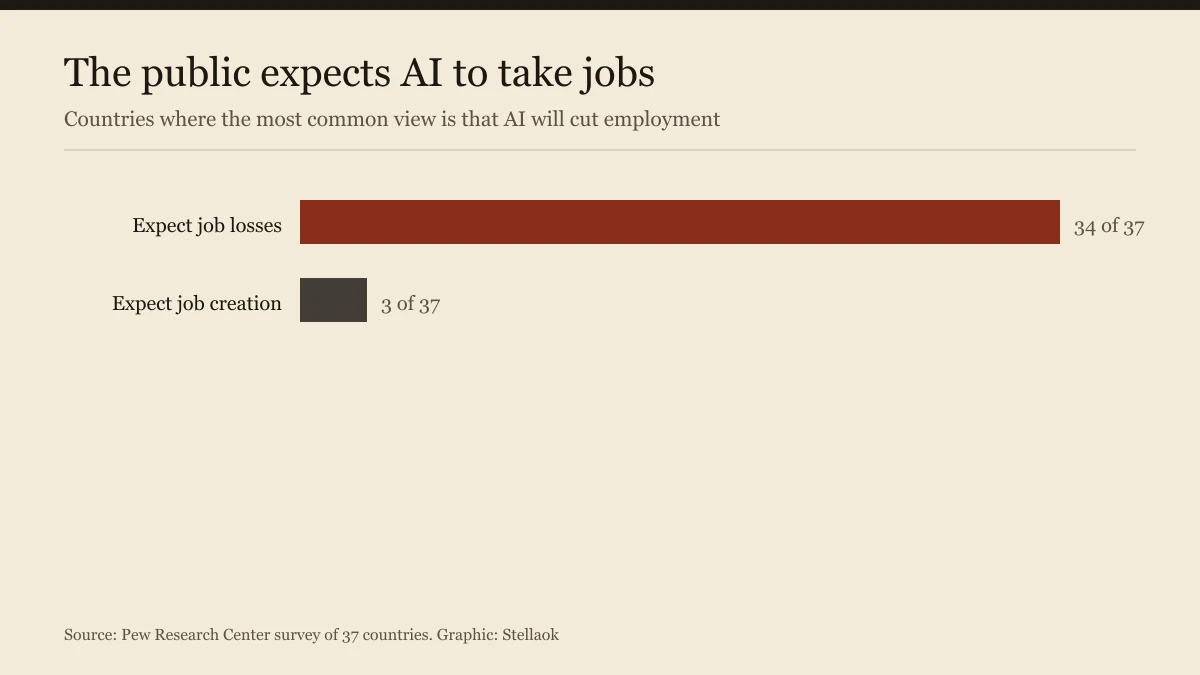
A global Pew Research Center poll released Thursday found that in 34 out of 37 countries, the most common answer about AI's effect on work was "fewer jobs." Across a 37-country median, 46 percent of respondents predicted fewer jobs.
Thirteen percent said it would not make much difference. Just 9 percent anticipated more jobs. Roughly a quarter said they were not sure.
Fewer jobs was the modal answer, almost everywhere
Pew has spent several years documenting that people are more anxious than excited about AI at work, at least in the United States. This wave goes wider. Thirty-four countries picking "fewer jobs" as the top choice is not a Silicon Valley comment thread. It is a public-opinion map.
Gizmodo carried the median that matters for a headline: 46 percent predict a net loss, 9 percent a net gain. That is not a proof of future employment. It is a measure of what people think the technology is for.
Companies are still selling productivity. Earnings calls still treat copilots as a way to do more with the same headcount, or the same work with less. A median in which nearly half of respondents predict destruction, and barely one in ten predict creation, means the sales deck and the public are not in the same meeting.
I would not hire off this poll. I would also not ignore it if I were running a rollout that needs worker trust. Tools that feel like a layoff machine get sandbagged, screenshotted, and unionized around.
Nigeria and Thailand did not follow the script
The only country where more people thought AI would create more jobs than it eliminates was Nigeria, 27 percent versus 26 percent. That is a one-point gap, not a boom narrative. It is still the exception Pew could point to.
Thailand broke the pattern a different way. "Not sure" beat "fewer jobs" there, 49 percent to 32 percent. Uncertainty as the winner is its own finding. A lot of people have not decided. The 37-country story flattened that into a gloom median.
Pew snapshots measure expectations. They do not count payrolls. Automation scares have been wrong before, and they have been late rather than wrong. The honest use of this table is as a political constraint. Governments hearing "fewer jobs" from a third of the planet's surveyed adults will write rules as if the fear were already a fact.
Security teams are living a parallel version of the same dread. Cisco's identity group talks about shadow agents already running in networks it inspects. The public hears job loss. IT hears software that acts without a name. Both are stories about control.
The productivity pitch has a trust problem
If you ship AI at work this year, assume colleagues read it as a headcount plan unless you say otherwise, in numbers, with a hiring plan attached. Vague augmentation language will bounce off a 46 percent median.
Robotaxis and other visible robots do not help the mood even when the jobs they touch are driving jobs in a different country. Headset launches and new OS ports look like toys next to a jobs poll. They still spend the same political oxygen.
The next Pew wave will show whether "not sure" shrinks as more people use the tools. Nigeria's slight create-more edge may be a blip. Corporate layoff memos that mention AI in the same paragraph as efficiency will be cited as if they were Pew, because Thursday's table already exists to be quoted.
Thursday's release is already being used as a vibe. Treat the 9 percent as the actual news inside the gloom. Almost nobody, in this median, thinks the machines are coming to hire them.
Pollsters have been asking versions of the automation question since factories started putting robots on the floor. The twist here is speed and visibility. Chatbots showed up on phones. Agents show up in offices. A 37-country instrument captures that mood before unemployment files do.
For a manager, the usable output is the 13 percent who said it would not matter much plus the quarter who would not guess. Those people can still be persuaded, or scared, by the next layoff memo. The 46 percent are already somewhere else. Talking past them with a productivity slide will sound like contempt, because Pew just showed you the median already picked "fewer jobs."