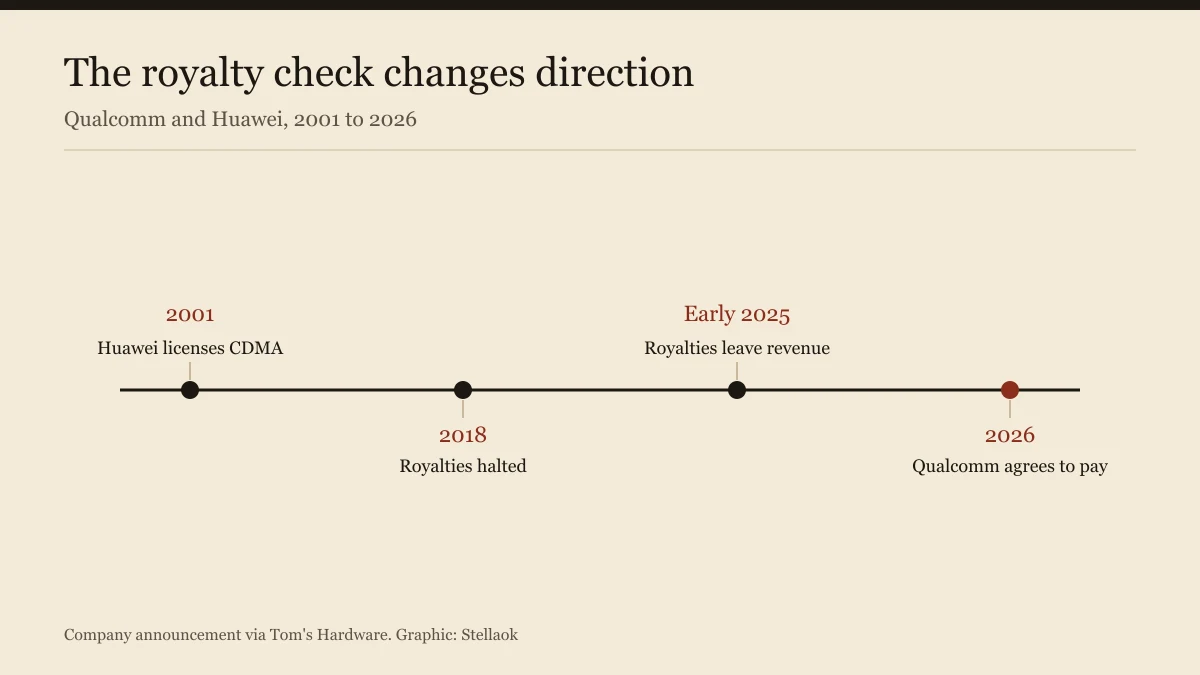
Qualcomm will pay Huawei for patent rights. The two companies announced a multi-year cross-license covering 5G and AI, plus compute and networking, and Qualcomm will buy some of Huawei's U.S. patents outright once regulators approve. Tom's Hardware says this is the first time the payment runs in that direction. Huawei began paying Qualcomm 25 years ago.
Huawei's own licensing business is the other ledger. From the first Motorola income in 2011 through this Qualcomm deal, it says contract value tops $6.9 billion. Since 2021 it says license income has exceeded what it pays out. The patent count it cites for 2025 is 165,000 active grants. The HP Wi-Fi cross-license signed in August 2026 is the recent precedent for a multi-year swap that is not a chip sale. MediaTek was on the other side of a 2024 enforcement suit. The FTC testimony in 2019 and the halted royalties in 2018 are the years Huawei spent arguing Qualcomm's terms. The 2026 announcement is the year those terms point the other direction, still without a published price.
The joint announcement is the turn. For twenty-five years the royalty check ran from Huawei to Qualcomm, starting with network equipment rather than phones. Qualcomm later supplied chips for some Huawei handsets, then stopped booking those royalties in early 2025 after the U.S. revoked a hardware license in 2024 and Huawei's license expired. The new paper points the other way, and it also lets Qualcomm buy a slice of Huawei's U.S. patents in compute, AI, networking, and what the announcement calls other technologies. Regulatory approval is the condition on that purchase. Huawei's line to the South China Morning Post is that nothing else is being cooperated on.
The Tom's Hardware account of the announcement starts the clock in 2001, when Huawei, then a telecom-equipment supplier, took a royalty-bearing license to build CDMA gear. Qualcomm once sold chips for some Huawei phones. It stopped counting Huawei royalties in its revenue in early 2025. The new agreement, both sides say, follows fair, reasonable, and non-discriminatory terms. Huawei told the South China Morning Post there is no other business cooperation, which the piece reads as no chip sales. A report counts 343 immersion lithography tools already inside China. This deal is paper, not a scanner shipment.
The fight in between lasted through a license revocation
Huawei stopped royalty payments to Qualcomm in 2018. Its general counsel testified for the Federal Trade Commission in the agency's 2019 antitrust trial about Qualcomm's licensing terms. A back-royalty dispute was settled in 2020. In 2024 the United States revoked Qualcomm's license to sell some hardware to Huawei. Huawei's own license expired by early 2025. In 2024 Huawei also sued MediaTek over patents. Huang has said Nvidia's chip sales will double next year. ## The announcement leaves the price off the page
Qualcomm's announcement does not attach a dollar figure to what it will pay, or say how many patents it is buying.
April 1, 2027 is the Apple date, not this one
Huawei says that with the Qualcomm deal, the value of its patent-licensing contracts will top $6.9 billion, counting from the first income it took from Motorola in 2011. Since 2021, it says, licensing has brought in more than the company pays other firms for their patents. As of 2025 it held 165,000 active granted patents. In August 2026 it signed a multi-year Wi-Fi cross-license with HP. The purchase from Qualcomm has no closing date. Qualcomm's fiscal year already ended, so the deal will miss the quarterly report expected next month. The company renewed its Apple license last month, effective April 1, 2027, after the current extension ends. Micron's profit is what the memory on these radios has been earning.
The announcement credits each portfolio and stops there. Twenty-five years after Huawei wrote royalty checks to build CDMA equipment, the company that wrote the standard is the one that pays.