The Pentagon has stood up a program called FORTRESS America, short for Federal Operations for Resilience, Troop Resources, Energy, Supply, and Survivability, with the goal of stockpiling enough critical minerals, fuel and munitions inside the United States to keep fighting a major war even if cyberattacks or sabotage take out factories and power grids. It was formally established on Sept. 30, and it sits behind the push for major bases to plan for 90 days without the grid.
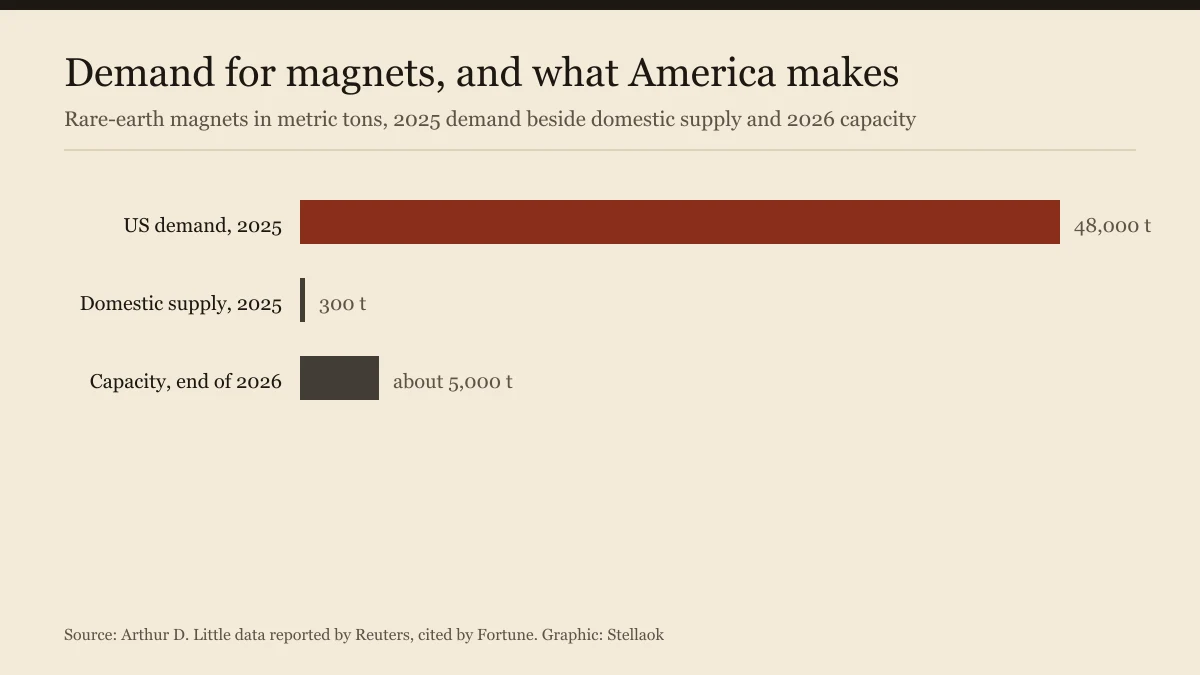
The minerals are the hard part. The United States produces less than 1 percent of the most common type of rare-earth magnet it uses, and China, which dominates processing of many critical minerals, has kept American buyers short even in peacetime.
Bryan Clark, a senior fellow at the Hudson Institute, told Fortune that stockpiling is normal for the U.S. military and that the difference here is scale and geography. During the Cold War the Pentagon stored as much or more war material overseas, near the battlefields it expected in Eastern Europe or Northeast Asia. FORTRESS keeps the reserves at home, on the assumption that American factories are themselves targets. Clark listed the ways that could happen: cyber operations, drones, electromagnetic warfare, or attacks by people already inside the country.
The threat model is not hypothetical
Europe has a recent case. On Dec. 29, 2025, cyberattacks hit about 30 renewable energy sites, a manufacturing company, and a heat and power plant serving nearly 500,000 customers in Poland. Polish officials linked the operation to Russia's Federal Security Service and said the attackers tried to destroy industrial systems; the country avoided a major outage.
Building reserves at that scale collides with an industrial base that does not produce the inputs. In 2025 the U.S. imported about $60 billion of critical minerals other than rare earths, including nickel, lithium, cobalt, graphite and tungsten, according to the Peterson Institute for International Economics. Domestic projects are moving, including the Arkansas brine that Exxon, Chevron and two startups are drilling for lithium, but the volumes are small next to demand.
Rare-earth magnets show the gap most clearly. U.S. demand for the most common type reached roughly 48,000 metric tons in 2025, while domestic sources supplied about 300 metric tons, according to Arthur D. Little data reported by Reuters. American companies are on track to have capacity for about 5,000 metric tons by the end of this year, roughly a tenth of last year's demand. The shortage has already stopped a production line: Ford idled its Chicago Explorer plant for a week in May 2025 when rare-earth supplies ran short.
Tungsten shows why contracts are not stockpiles
Tungsten is a priority for the program and a clean example of the delay between money and metal. The U.S. has not mined tungsten commercially since 2015, when cheaper imports undercut domestic output, and net import reliance exceeded 50 percent in 2025, according to the U.S. Geological Survey.
In September, tungsten maker The Elmet Group won a Defense Logistics Agency contract worth up to $2 billion to supply tungsten ores, concentrates and sodium tungstate to the National Defense Stockpile. Only $150 million of that is guaranteed. The Pentagon also committed $450 million to Elmet, including about $150 million earmarked to restart the Springer tungsten complex in Nevada.
Elmet has said it will not begin deliveries until additional supply exists. Rather than divert tungsten that American manufacturers already depend on, the company plans to wait for new production from its investments in Nevada, Australia and Spain. A contract that obligates up to $2 billion has therefore delivered nothing to a vault yet.
The bill is still being counted
Cost remains unresolved. A senior defense official said on Oct. 20 that officials were still assessing the total, and Air & Space Forces Magazine estimated the wider initiative could run to "scores of billions of dollars, if not hundreds of billions." The Pentagon is exploring public-private partnerships to carry part of it, according to Dale Marks, assistant secretary of defense for energy, installations and environment.
Clark's expectation is that the near-term goals will not be met, because stockpiling finished weapons and raw minerals at the same time is structurally difficult. Chris Berry, a minerals analyst, told Reuters it will take many more years to build the capacity to compete with China's supply chain.
A deadline with waivers
A deadline is already set. From Jan. 1, 2027, federal rules require defense contractors to stop buying rare earths, magnets and tungsten from China, Russia, Iran and North Korea. Washington has granted repeated waivers because domestic supply falls short, and the same tariff logic that reshaped other supply chains is already in force on Canadian goods. For the Pentagon, the difficulty is not announcing a stockpile. It is filling one.