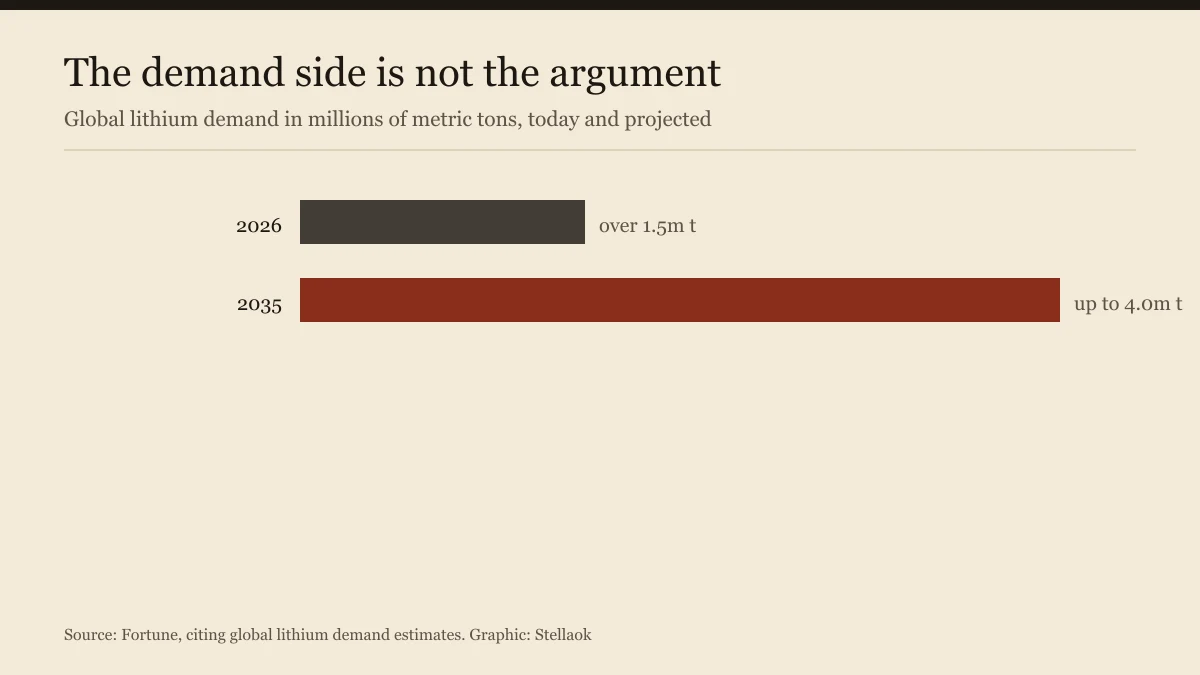
Global lithium demand has risen more than 400 percent this decade to over 1.5 million metric tons a year, and by 2035 it could approach 4 million tons. The United States produces a little over 1 percent of the world's supply, almost all of it from one mine in Nevada. The refining happens mostly in China.
About 1,500 miles east of that mine, in southern Arkansas and East Texas, an underground aquifer called the Smackover Formation holds lithium concentrations high enough that ExxonMobil, Chevron and two much smaller companies are all racing to pump it out. Oil was found there a century ago. French settlers named the area "Sumac Couvert," for the bushes covering it, and the name survived the industry that followed.
"It's a geologic freak with its very high lithium concentrations," David Park, chief executive of Standard Lithium, told Fortune. "We believe that our lands alone have the potential for over 150,000 tons per year of production."
A hundred years of oil, then a different ion
The Smackover matters because the U.S. lacks the geology that made Australia, Chile and Argentina the dominant producers. There are few hard-rock deposits worth open-pit mining and few places where evaporation ponds make economic sense. What Arkansas has is brine, and brine needs a different process.
Standard Lithium plans to authorize its South West Arkansas project late this year and begin construction on a first 22,500-ton phase in the first quarter of 2027, with a second phase doubling capacity to 45,000 tons. It has a $225 million grant from the Department of Energy, a 45 percent joint venture partner in Norway's Equinor, and offtake agreements with Trafigura and LG Energy Solution. The company is also advancing the Franklin project in East Texas for up to 70,000 tons.
EnergyX, an Austin company led by Teague Egan, has a 250-ton pilot plant running and aims to break ground on a 15,000-ton commercial facility by the end of 2027. In October it signed a 10-year offtake with Trafigura covering 100,000 tons and nearly $2 billion in lifetime value, which Egan described as the largest direct-extraction deal on record. Trafigura will take 30 percent of the Lonestar project's output.
Two days instead of two years
Direct lithium extraction drills wells the way oil operators do, pumps brine, pulls the lithium out and returns more than 90 percent of the water underground. No fracking is involved, which limits seismic concerns. Evaporation ponds need about two years to yield their lithium; the direct process takes roughly two days. Most of the cost sits up front, in wells and plant.
"There are no huge pits or huge ponds. It takes basically one-hundredth of the land footprint," Egan said. That land argument is what brought Big Oil in. ExxonMobil took a position three years ago, disclosed 120,000 acres in 2023, and now holds more than 400,000 net acres, the largest in the formation. It plans to start building its Pine pilot project next year. Chevron announced a 125,000-acre position last year.
Exxon's acreage is at least triple that of either Chevron or Standard Lithium, and the company has been drilling appraisal wells and testing its process at a Houston pilot plant. Its statement to Fortune was careful: the Smackover "has the potential to become a significant source of domestically produced lithium, and ExxonMobil is uniquely positioned to help unlock it."
The financing is the hard part
BMO Capital Markets analyst Max Yerrill is optimistic and skeptical in the same breath. Direct extraction is unproven at commercial scale, and any U.S. producer has to compete in a market where China has used price dumping to kill competitors before they start. The removal of EV tax credits also weakens the domestic demand case.
"You extract the lithium, and then you reinject the remainder of the brine so that it leaves the ecosystem the same as it was before," Egan said. Yerrill's view of the technology is that there is no alternative: "I think DLE is the only way. It's more out of necessity. The geology is what the geology is in a particular region."
He is less certain about the economics. "In theory, there are huge amounts of lithium in the Smackover. It's yet to be proven if it's economic to do so." His reason for expecting the money to keep flowing is the horizon: these are 25-year projects, and even in a bad year lithium demand grows close to 20 percent.
The demand side is no longer just cars. Utility-scale battery storage is the fastest-growing U.S. segment, data centres need backup capacity as their power draw climbs, and robotaxis and robotics run on the same cells. The same electricity squeeze that has stalled gigawatts of planned data centre capacity is a demand driver for storage.
Park's argument for why this matters beyond the balance sheet is about leverage. China is not the largest lithium miner, but it is the largest refiner and battery maker, and the Smackover projects build refining on site so the material never has to leave the country. "We've seen them weaponize other critical minerals," he said. "We're strategically exposed. If they want to cut us off, they can." The same logic has been driving chip tool licensing fights for the past two years.
None of this makes the Smackover a sure thing. Two commercial plants have to be built, financed and run before anyone knows whether the brine produces lithium at a cost the market will pay. Standard Lithium's chief executive put the moment plainly: not the finish line, the starting line.