Research firms have been warning about this decline since late last year. IDC's own earlier range was a shrink of up to 9 percent. Tom's Hardware notes that readers have said they will not upgrade in the next two years. Chen's counter is the second half of 2027, and only for the parts Chinese fabs can flood. He left LPDDR5X-9600 and Nvidia's N1 and N1X on the short list. Micron's public line, cited in the same story, is that relief is years away, not two. The 20.1 percent quarter is the number that sits between those forecasts.
Ubrani's full point is seasonal. In a typical year the third quarter ships more PCs than the second, because the holidays are coming. This year vendors filled the channel in the first half to beat price hikes, so the third quarter is digesting that stock. He expects some promotions. He does not expect last year's prices. IDC's earlier warning, a shrink of up to 9 percent with the cheap end hurt most, is smaller than the 20.1 percent this quarter actually printed. The 3.8 percent drop in the prior quarter is the slope this one steepened. Down 9.1 percent from the second quarter of 2026 is the break with the usual pattern.
Global PC shipments fell 20.1 percent year over year in the third quarter of 2026. IDC puts the drop at 15.8 million units. The previous quarter was down 3.8 percent from a year earlier. This quarter is also down 9.1 percent from the second quarter of 2026. A normal year has a bigger third quarter than a second. This one does not.
Tom's Hardware's reading of IDC says vendors loaded inventory in the second quarter to get ahead of price increases from the chip shortage. Jitesh Ubrani, IDC's research director for consumer devices, called the third-quarter number the result of that first-half pull-in. Channels are now worried about holding too much stock in a market where high prices are suppressing demand. He said that could mean promotions and some short-term relief, and that prices will not go back to where they were a year ago. With the broader economy worsening, he said the next few quarters can get worse before they get better. IDC had warned the market could shrink by as much as 9 percent, with the budget end hit hardest. Some estimates in the piece push a recovery out to 2029.
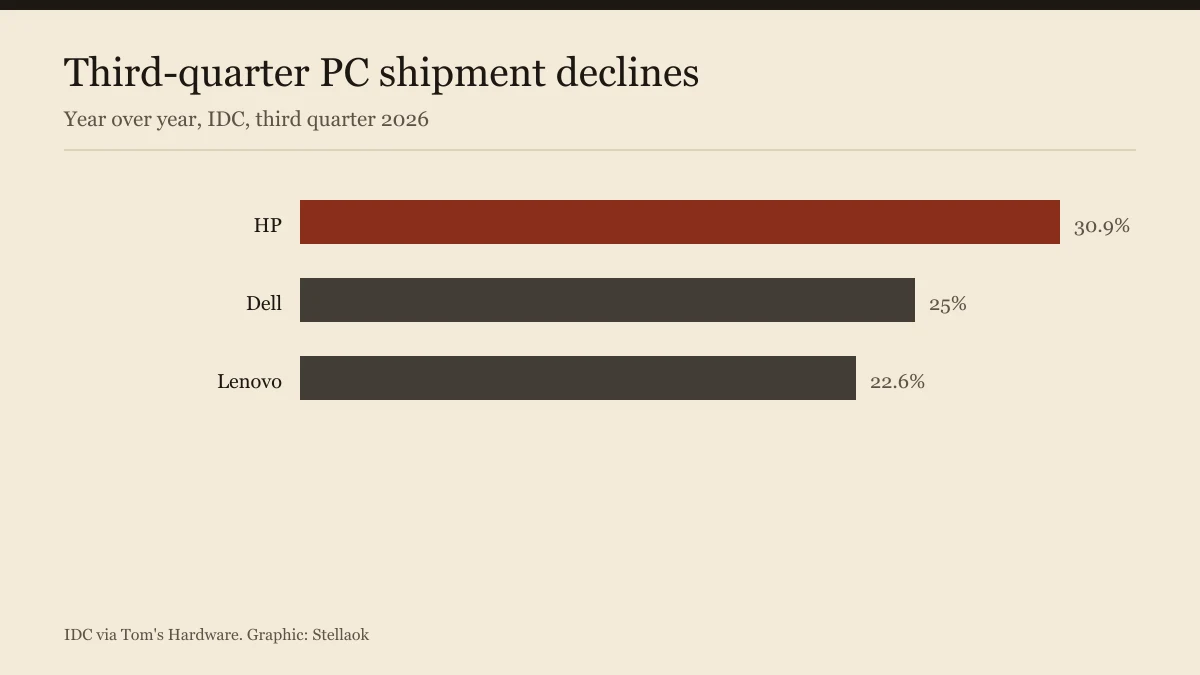
HP fell the most. Lenovo is still first.
Lenovo's shipments fell 22.6 percent. HP shipped 30.9 percent fewer units. Dell's fell 25 percent. The headline on Tom's Hardware says those three vendors together shipped 11.6 million fewer units. The 15.8 million is the whole market. Apple's shipments fell 11.3 percent. Asus fell 8.6 percent. Everyone else fell 14 percent. Lenovo, HP, and Dell still lead, at 23.8 percent, 16.5 percent, and 12.1 percent of the market. Micron's profit is what the memory shortage did to one supplier's quarter. The shipment drop is what it did to the companies that put that memory in a PC.
Chen's cheaper-PC date is late 2027
Acer chief executive Jason Chen said the fears are being talked up to protect memory makers' margins. He estimated PC prices will come down in the second half of 2027 as Chinese memory capacity comes online. He carved out high-end parts: LPDDR5X-9600 and niche processors such as Nvidia's N1 and N1X stay short, on his account. Micron and others have said the shortage does not ease for several years. Ubrani's line and Chen's line are both in the same story, and they do not pick the same year. Two-gigabyte Raspberry Pi boards already took the same twelve-dollar increase.
The 20.1 percent is IDC's year-over-year figure for the quarter. The 9.1 percent is the drop from the quarter before. The 11.6 million is the top three. Chen's date for cheaper PCs is the second half of 2027, and it does not cover the fast memory or the N1.