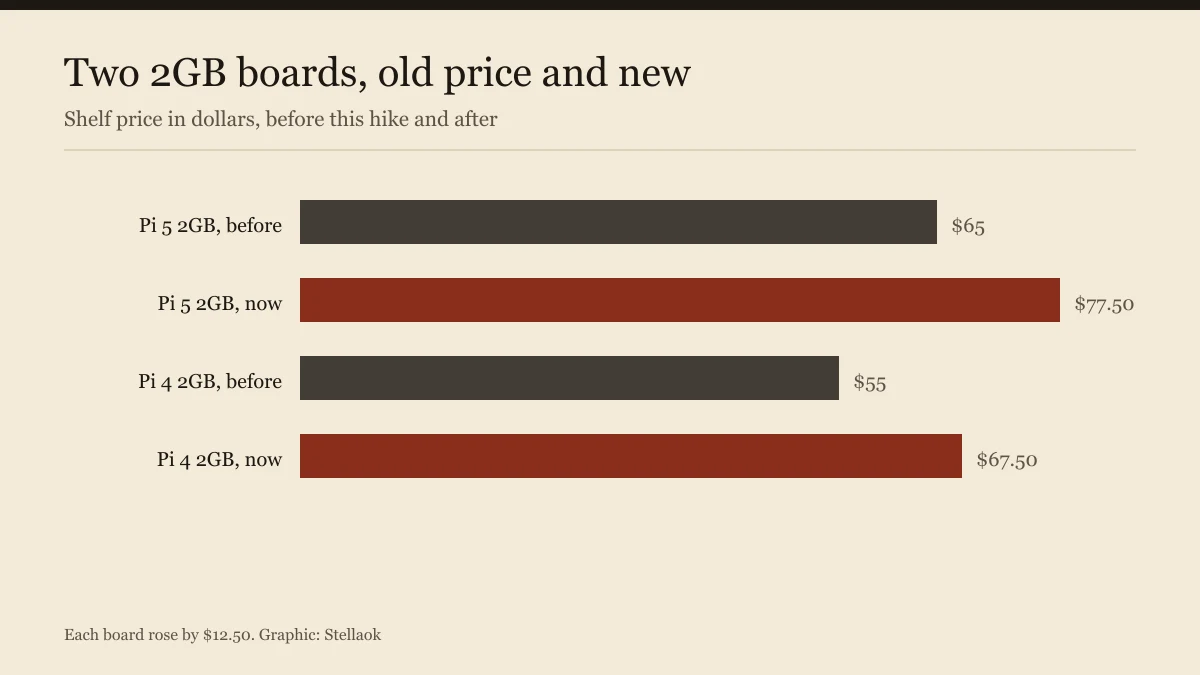
The Raspberry Pi 5 with 2GB of memory now costs $77.50. It had been $65. The Raspberry Pi 4 with 2GB now costs $67.50. It had been $55. Each board went up by $12.50.
Tom's Hardware, citing chief executive Eben Upton, says the 2GB models had escaped an April increase that hit other boards. Upton's line is that keeping the previous price on the lower-capacity models is no longer feasible. LPDDR4 and LPDDR5 are the parts that moved. Global demand for them has stayed high, supply has stayed short, and the cost of building a Pi has kept climbing. The headline on the piece calls this the third increase of the year. The body describes the April round and this one. The two $12.50 steps are the change both descriptions share.
The same $12.50 landed on two different boards
A $12.50 increase is 19% on the Pi 5's previous $65 shelf price, which matches the 19% Tom's Hardware states. On the Pi 4, $12.50 is the 23% the piece states against the previous $55. The percentages differ because the bases differ. The cash step is identical, and it is the number a buyer actually pays.
The Pi 5 2GB launched two years ago at $50 and later settled at $65 for a long stretch. From that $50 launch to $77.50 is $27.50, the 55% lifetime increase the article reports. The Pi 4 2GB launched at $45, fell to $35 when memory was cheap, and had reached $55 before this week. From $45 to $67.50 is $22.50, the 50% reported against the launch price. From the $35 low to $67.50 is $32.50, the 93% reported against the cheapest official price. A buyer who remembers the discount and a buyer who remembers the launch are describing the same new shelf price. The two new tickets sit $10 apart, $77.50 against $67.50. The increase that produced them was the same $12.50 on each board.
Launch prices and the $35 low tell different histories
Memory is the expensive part on these boards, and the higher capacities have moved further from their original prices across 2026. Tom's Hardware puts the Raspberry Pi 5 16GB at an 83% increase versus its original price, the Pi 5 8GB at 63%, and the Pi 4 8GB at 53%. Those three percentages are lifetime comparisons with the first shelf price.
The 1GB boards are the line still priced at launch
The 1GB models are the company's remaining hold, still at the original manufacturer's suggested price. How long that line stays there is the open item. Everything above them has been marked up at least once this year, and the 2GB pair was the holdout from the April round until this notice. In April the higher-memory boards took the increase and these two did not. Upton's new confirmation is that the exception is over, because the memory on even a 2GB board now dominates the cost of building it. Fairphone has said memory is now 60% of its materials bill. Micron's 512GB DDR5 module, drawing 16 watts, is the server end of the same shortage. A gaming PC can look reasonably priced only because the memory inside it has swallowed the quote. A Pi is the small version of that bid: two gigabytes, a public price, and a chief executive saying the old ticket no longer covers the part.
Tom's Hardware floats one product response. If the memory is the expensive component, sell a board without it and let a buyer solder their own. That would take the LPDDR invoice off Raspberry Pi's bill and put it on the hobbyist. The company has not shipped that SKU.
Recent firmware updates lock each board to the capacity it left the factory with. A later chip swap is what that software refuses: the board will recognize the memory size Raspberry Pi fitted, and no other. The hike and the lock landed together. Paying the new shelf price is how a buyer gets a 2GB Pi 4 or a 2GB Pi 5. Adding memory to a board they already own is the path the firmware closed.