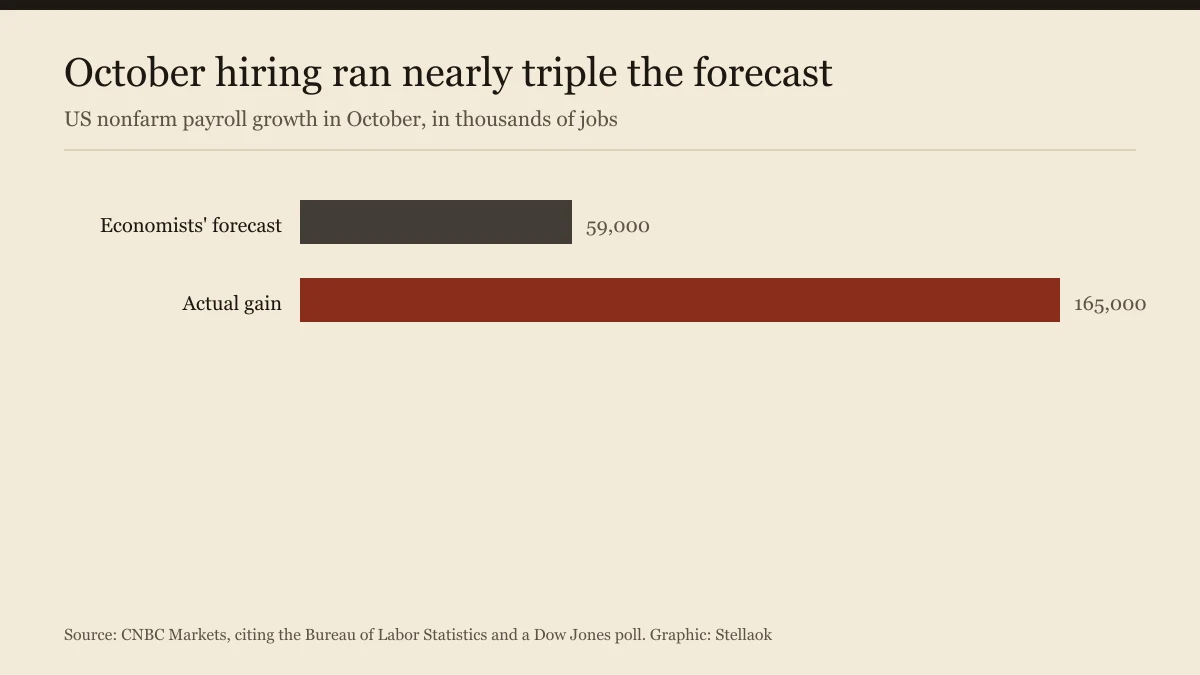
The October jobs report surprised nearly everyone. Nonfarm payrolls grew by 165,000, according to the Bureau of Labor Statistics, against the 59,000 economists polled by Dow Jones had forecast. Beneath the headline sit three categories that are reshaping the debate over whether artificial intelligence destroys or creates work.
Consultants hit a record headcount
The labor force for management, scientific and technical consulting expanded by 17,300 jobs between September and October, its largest monthly increase in nearly two years, and accounted for a quarter of the professional and business services sector's gains. Over the past year the category has added more than 45,000 jobs, pushing total employment past 1.9 million for the first time on record. Hiring in the field had largely stalled since 2023, and Wall Street has spent that stretch asking whether AI would gut demand; shares of Gartner have lost more than half their value over three years, with Accenture down about 18% and FTI Consulting down about 9% while the S&P 500 climbed roughly 74%.
The October surge suggests the opposite force at work: businesses hiring consultants to help them adopt AI. Gartner forecast in September that worldwide AI spending would total $2.7 trillion in 2026, up nearly 50% year over year, and LPL Financial chief economist Jeffrey Roach said "the AI buildout and corporate interests to increase utilization will keep the technical consultants employed." Moody's Analytics counts a net 786,000 jobs created by AI since ChatGPT launched in November 2022, driven partly by data center construction, and its chief economist Mark Zandi wrote on Monday that "for now, AI is adding to job growth, not subtracting from it." Public opinion has not caught up; in a 34-country poll, most people still expect AI to cut jobs, even as recruitment firms report AI compressing the fees they charge for placements.
Temp hiring as a leading indicator
Temporary help services added 18,600 jobs in October, one of the largest monthly gains since 2022 and 27% of the sector's increase. The workforce remains below its 2022 record, but headcount has grown roughly 3% since December, reaching levels last seen in April 2025. Economists read temp hiring as a leading indicator, since short-term workers often convert to permanent roles. The catch is the calendar: year-end holiday staffing could be inflating the number, employers rarely staff up this early, and the Bureau of Labor Statistics adjusts for seasonal trends only slowly when the pattern itself is shifting. One corroborating signal sits in couriers and messengers, another holiday barometer, which supplied just over one in ten of the month's new jobs.
Campaign money was hiring too
Political organizations employment historically peaks in October of midterm and presidential years, and this cycle's record spending may have amplified it. The 2026 congressional elections are on track to be the most expensive midterm on record according to OpenSecrets, and billions of dollars of campaign coffers translate into paid door-knocking, phone banking and field work. Whether those jobs survive past Election Day is not in doubt; whether the consultant and temp gains do is the question the next two reports will answer.
Source: CNBC Markets