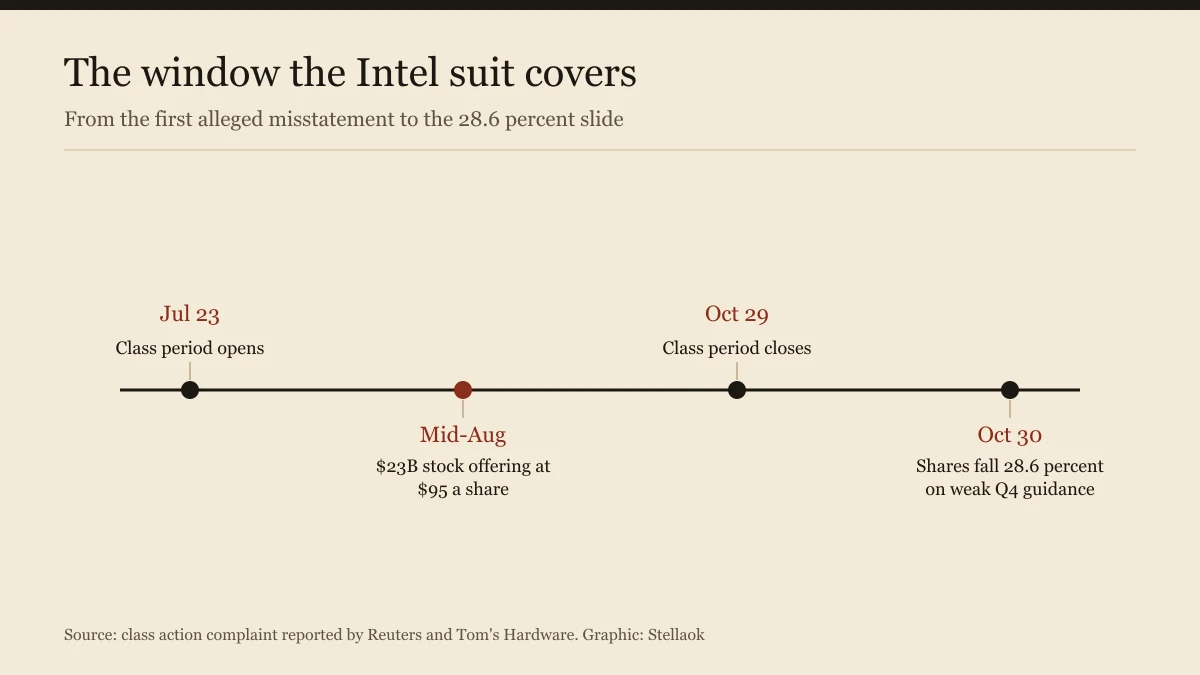
Intel was sued on Friday by shareholders who say the company downplayed how badly the PC downturn would hit its quarter, and that it did so while selling $23 billion of stock at $95 a share. The proposed class action, led by the Southfield Fire and Police Retirement System pension fund, was filed in federal court in San Jose, California, and reported by Tom's Hardware from the Reuters account of the filing.
The claim covers anyone who bought Intel shares between July 23 and October 29. On October 30, after the company guided fourth quarter revenue and earnings below expectations and warned the PC slump would continue, the stock fell 28.6 percent in a session and about $140 billion of market value disappeared. Chief executive Lip-Bu Tan and chief financial officer David Zinsner are named as defendants.
The case is about timing, not the numbers
Nobody disputes that demand fell. The allegation is that Intel knew by mid-quarter and did not say so. Memory prices have climbed through the DRAM shortage, which pushed up the cost of complete PCs and pulled consumer demand down with it, and Intel's own earnings call featured Tan expressing disappointment about supply constraints and the state of the memory market. Shareholders argue that the effect on client CPU sales was visible well before the guidance cut, and that positive AI data center demand did not offset it.
PC Gamer puts the October drop in worldwide PC sales at an estimated 20 percent, driven by the same memory costs, and notes the suit also claims Intel's distributors were left holding hardware they could not move at the new prices. The same shortage that produced the weak quarter is now the subject of a separate price-fixing complaint against the memory makers, which means the cost input at the centre of this case is itself under investigation.
Why the stock sale is in the complaint
The $23 billion raise in mid-August, at $95 a share, came roughly halfway through the third quarter. Intel has said the capital was for expanding manufacturing capacity. Shareholders argue the company had a financial incentive to keep the demand picture quiet until that raise closed, and they point out the shares now trade far below the offering price, around $59.66 in PC Gamer's account this week, which is 37 percent under what the August buyers paid.
That does not prove intent, and securities cases rarely turn on a single inference. What it does is give the plaintiffs a motive narrative to place next to the disclosure record, which is the part of the case Intel will have to answer with documents.
The habit Intel gave up
The complaint's sharpest institutional point is that Intel used to publish mid-quarter updates. Under Craig Barrett in the early 2000s the company regularly told investors when its outlook changed, and in September 2004 it used exactly that channel to cut third quarter revenue and margin guidance because of weaker processor demand and customer inventory adjustments, which is close to the situation in the third quarter of 2026.
Intel abandoned the practice in January 2006 under Paul Otellini, keeping it only for exceptional periods such as the financial crisis. The plaintiffs are not asking the court to reinstate a disclosure policy, but the contrast does the argumentative work: a warning in September would have been normal by the company's own former standard.
What Intel has going the other way
The company is not in free fall. It took overall CPU market share back from AMD last week after five consecutive quarters of losses, a result that complicates the claim that its client business was visibly collapsing, and its shares are still up 62 percent since January even after the October session. AMD's own valuation has moved in the opposite direction, which is the comparison investors will make when they decide whether Intel's problem was disclosure or execution.
The class period gives the case its shape: July 23 is when the allegedly misleading statements began, October 29 is the day before the guidance cut. Investors who bought in that window have until January 12, 2027 to join, according to the notice from law firm Robbins LLP, and the first real test will be whether Intel can show it was still reading the memory market correctly in September rather than sitting on a warning it owed investors.