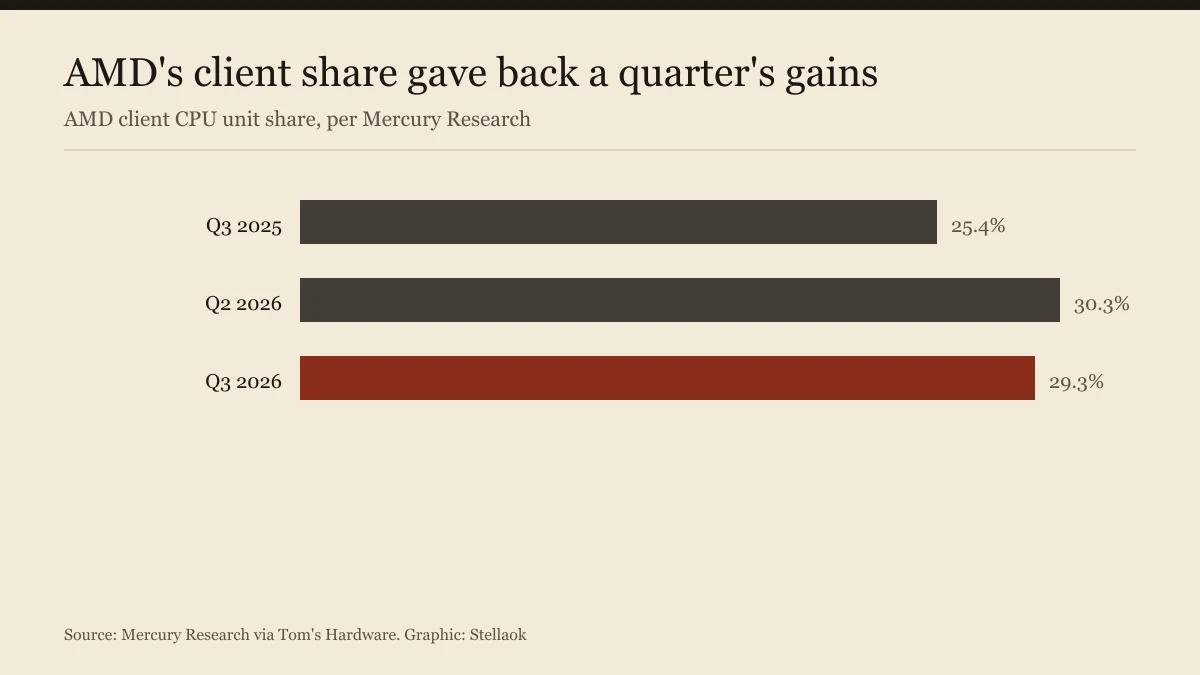
Intel gained overall CPU market share from AMD in the third quarter for the first time since 2025, according to the latest Mercury Research numbers, and the reason is not a boom but a bust. Client CPU shipments fell far more than expected as PC demand softened late in the quarter, notebook processors dropped by more than ten percent, and Intel's desktop line, which had been undersupplied for a while, recovered hard enough to swing the balance. The overall x86 market counted 68.93 million processors shipped in the quarter, split into 60.8 million client chips and 8.13 million data center units, per Jon Peddie Research's tally of the same period, a market whose valuations have swung dramatically over the past year.
The numbers behind the swing
AMD's client unit share fell to 29.3 percent, down from a record 30.3 percent in Q2 but still well above the 25.4 percent of a year earlier. Intel moved to 70.7 percent, an improvement that still leaves it far below the 74.6 percent it held in Q3 2025. The desktop segment carried all of the change: Intel's desktop unit share climbed five points sequentially to 70.1 percent, also up 3.7 points year over year, while AMD slid to 29.9 percent from 34.9 percent, giving back roughly a year of gains in a single quarter.
Mercury's principal analyst Dean McCarron attributed the client downturn partly to Q2's unexpected strength, which appears to have pulled demand forward. Both companies told investors about rapid softening late in the quarter, and both guided to a client decline exceeding twenty percent for Q4. Intel's sequential gains came entirely from desktop shipments, while AMD kept gaining ground in notebooks, only at a much slower pace than in previous quarters. Analyst Jon Peddie of JPR added that OEMs kept inventories lean and the DIY channel stayed weak, with PC conditions expected to remain difficult into the first half of 2027.
Server tells the opposite story
While notebooks dragged the market down, server processors kept growing at more than twenty percent year over year, their fastest annual rate in nearly five years, driven by AI infrastructure buildout. AMD's overall x86 share excluding embedded and semi-custom chips still grew 4.5 percent annually despite the sequential dip, and the company set new records in mobile and server segments even as its console-related shipments shrank.
The awkward footnote is what is making PCs expensive in the first place: rising component costs, with memory prices the sharpest edge, are suppressing the very demand these shipments serve, a squeeze suppliers have been feeling across their bills of materials all year. Mercury also cautions that shipment counts land months before the chips reach store shelves, so Q4's decline is partly seasonal arithmetic rather than pure collapse, and the Q3 figure itself was measured at the factory gate, not the checkout. Intel's quarter is real, but it was won in a shrinking market, by filling a desktop channel it had starved, against a rival whose losses came mostly from a segment neither company can currently sell into at the pace they planned.