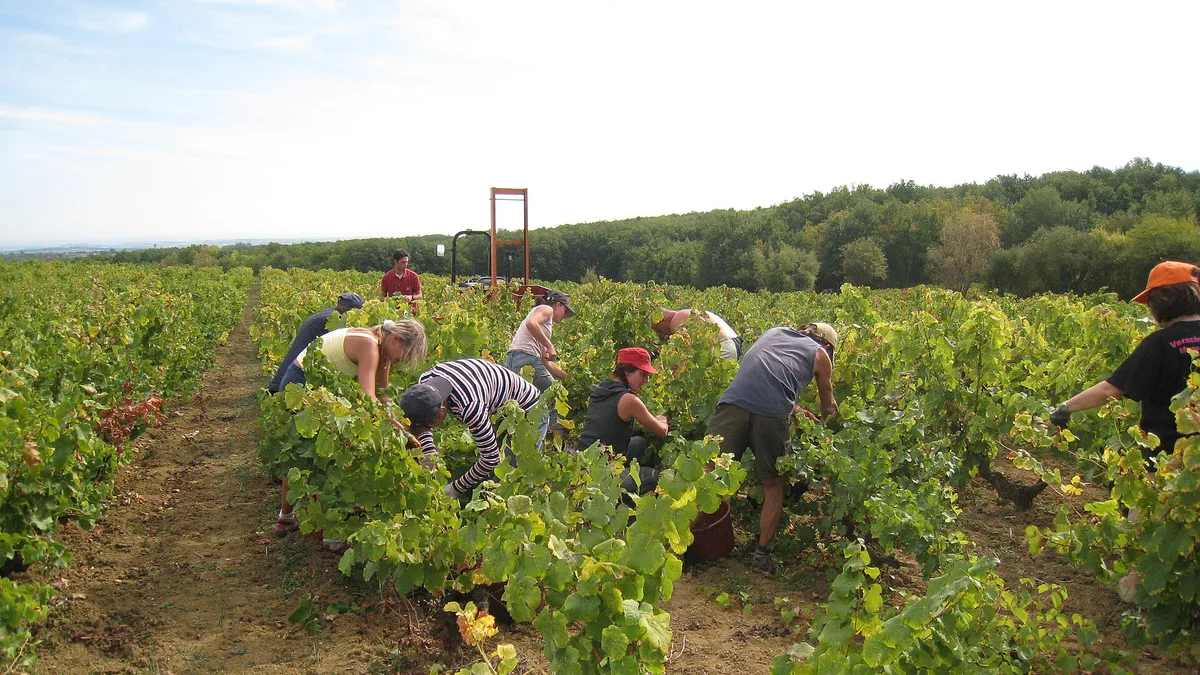
France's agriculture ministry has warned that wine production could fall to a 70-year low in 2026, the third consecutive year of reduced output after a record-hot summer and severe drought.
"We felt we were so close," Louis-Fabrice Latour, head of Maison Louis Latour, told CNBC. "Just a bit more rain would have produced a fantastic harvest on both counts, but we had to settle for quality, and about half of a harvest." Choosing quality over volume is the decision available to an estate with a name. It is not available to most of the sector.
The temperate regions are taking the damage
The geography of this is not what most people would guess. The worst-hit areas are the cooler ones, the Loire Valley and Champagne, while Bordeaux and Languedoc-Roussillon in the south reported better harvests than last year.
That inversion makes sense once you stop thinking about average temperature and start thinking about adaptation. Southern growers have spent generations building practices around heat. Northern regions built theirs around marginal ripening, and a run of hot years pushes them past the conditions their grape varieties, canopy management and harvest calendars were designed for. "We are realizing that no region in France is safe from heatwaves today," said Jean-Marie Cardebat, chair of wines and spirits at the INSEEC Grande École and an economics professor at the University of Bordeaux. "The 2023 vintage was decent, but yields have been pretty disastrous since the start of the decade."
Timing is shifting with it. Latour's domaine started picking on August 14 this year, the earliest in its history, which compresses every logistical decision that follows: labour, press capacity, tank space, transport.
Spain has irrigation. France has paperwork
Cardebat's sharpest point is comparative. "Spain is more often affected by heatwaves and global warming; however, it is better prepared," he said, largely because an irrigation network already exists there. In France irrigation is rare and permitted only in exceptional cases, and building the permission takes as long as building the infrastructure.
This is where a climate story becomes a regulatory one. The appellation system, the AOC framework that underwrites the value of the words Champagne and Pomerol, also fixes irrigation restrictions, planting densities and permitted grape varieties. Those constraints are the product. They are also a set of assumptions about weather that no longer hold.
Last year Chateau Lafleur withdrew all six of its wines from the Pomerol and broader Bordeaux designations. The Guinaudeau family, which owns the estate, said the rules stopped it adapting quickly enough and that leaving would let it handle "the reality of climate change with precision and effectiveness." An estate of that standing walking away from Pomerol is a pricing signal as much as an agronomic one: it is a bet that the brand on the bottle is now worth more than the appellation on the label.
What this looks like from outside the vineyard
For anyone watching this as a market rather than a harvest, three things follow.
Supply is tightening at the premium end while the mass market keeps shrinking on its own, which pushes the whole category further toward scarcity pricing and away from volume. The AOC system faces a slow legitimacy problem, because every estate that leaves makes leaving easier for the next one. And the capital requirement is rising, since irrigation, replanting to heat-tolerant varieties and cooling capacity all cost money that a grower cannot recover from half a harvest.
Consumers will feel the last one before they see it on a label. Input costs that rise faster than a producer can pass them on end up in the freight and retail layers first, which is the mechanism that pushed diesel prices through trucking and into the wider economy earlier this year. Wine is slower than fuel, because a vintage takes years to reach a shelf. The direction is the same.
That last pressure is the familiar one. It is the same squeeze visible whenever a physical input reprices faster than the business around it can adjust, the way memory costs came to dominate Fairphone's bill of materials. Producers absorb it until they cannot, then the structure changes. French wine has reached the part where the structure changes, and the rulebook is the thing standing in the road.