Etched is looking at investment offers that would value the AI-chip startup at $40 billion or more, about two months after it raised $700 million at a $21 billion valuation. One person familiar with the offers told TechCrunch the bids run from $40 billion, from well-known investors, to $50 billion from lesser-known ones. The talks are early. Etched declined to comment.
Jane Street already took delivery
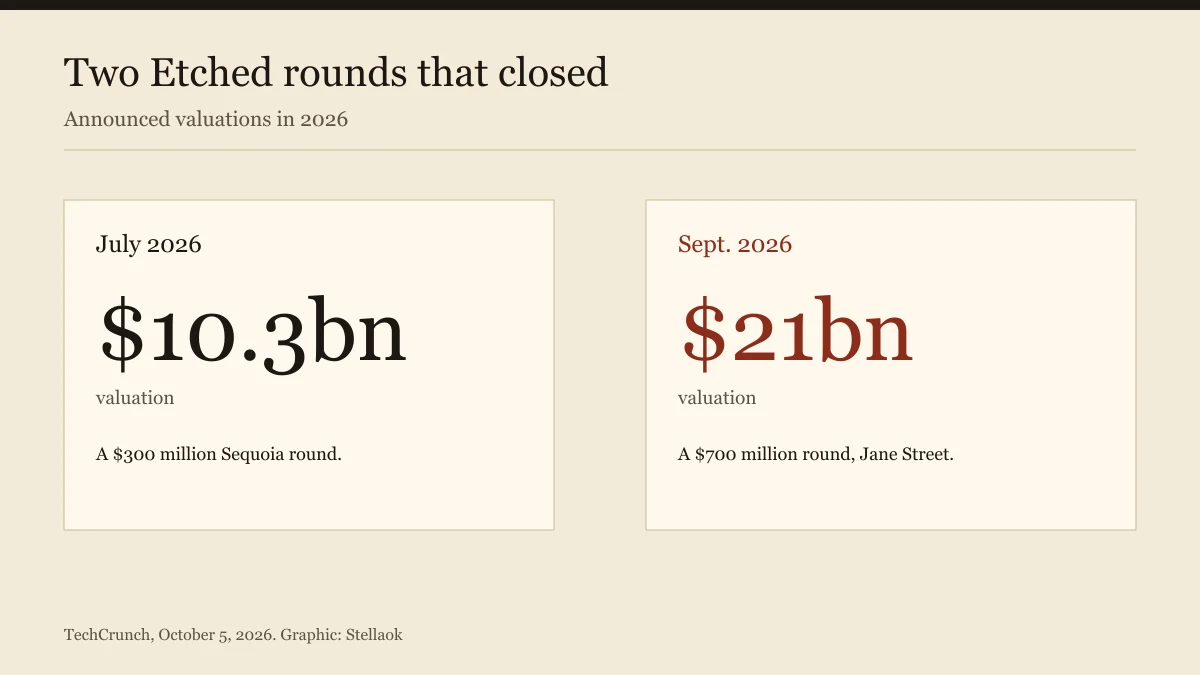
TechCrunch's account puts two closed rounds underneath those bids. In July 2026 Etched announced a $300 million round at a $10.3 billion valuation, led by Sequoia. In September it announced the $700 million round at $21 billion. Jane Street led that one and is also a customer. It has taken delivery of an early system. Etched said in July that it had $1 billion of customer orders, including Jane Street's, after a test chip was made at TSMC over the summer. AMD just cleared $1 trillion, and Nvidia is at $5.4 trillion. Etched's pitch is that a four-year-old company can sell inference speed to a trading firm that prices a microsecond.
The closed prices doubled, and the new bids are not closed
The $40 billion and $50 billion numbers are offers, and TechCrunch says the terms can still move. Etched would not comment. The person describing the bids also described a cushion: a raise the size of the last one, $700 million, could mean as much as 3.5 years of cash. That arithmetic is the source's, and it only applies if a round of that size actually closes. The two components Wachen has talked about are inference parts designed from scratch. The claim attached to them is more tokens, faster, at a lower cost than Nvidia's chips. Jane Street is both the lead investor and a customer that already has hardware.
Wachen's point, as TechCrunch reports it, is speed after the prompt. A trading firm can turn a small latency edge into money, which is why Jane Street both led the September round and took a machine. The July order book of $1 billion includes that delivery. The test chip was made at TSMC. The 10-megawatt Silicon Valley site and the Taiwan office are the physical plant around that chip. The Wall Street Journal figure, roughly 15 percent of about 400 people, is the share of the staff that previously worked at Nvidia. Uberti, Zhu, and Wachen left Harvard to build it. The July Sequoia round and the September Jane Street round are what TechCrunch treats as two tranches of one financing, with the valuation marked up in between.
The same person said that if Etched raises as much as it did last round, the cash could cover as much as 3.5 years. That is a conditional, tied to a raise that has not been signed. Co-founder and chief operating officer Robert Wachen has said investors like the company because it designed two new components from scratch to speed inference, the work that happens after a prompt. The company claims its chips move more tokens, faster and cheaper, than Nvidia's. About 15 percent of a 400-person staff used to work at Nvidia, according to the Wall Street Journal. Etched runs a 10-megawatt data center in Silicon Valley and a site in Taiwan next to TSMC's production. Huang has said chip sales will double next year. The offers on the table are for the company that wants a piece of that inference bill.
The founders left Harvard to build the chips
Co-founders Gavin Uberti and Chris Zhu met in an advanced math class at Harvard. Wachen was Uberti's roommate. They left school to start the company. TechCrunch treats the July and September announcements as a single financing cut into two tranches with two valuations, a pattern it says is now common among the most chased startups. Micron's quarterly profit is the memory side of the same shortage Etched is designing around.
The $10.3 billion and $21 billion figures are rounds the company announced. The $40 billion and $50 billion figures are bids a source says are being reviewed. No new round has closed at either of those marks.