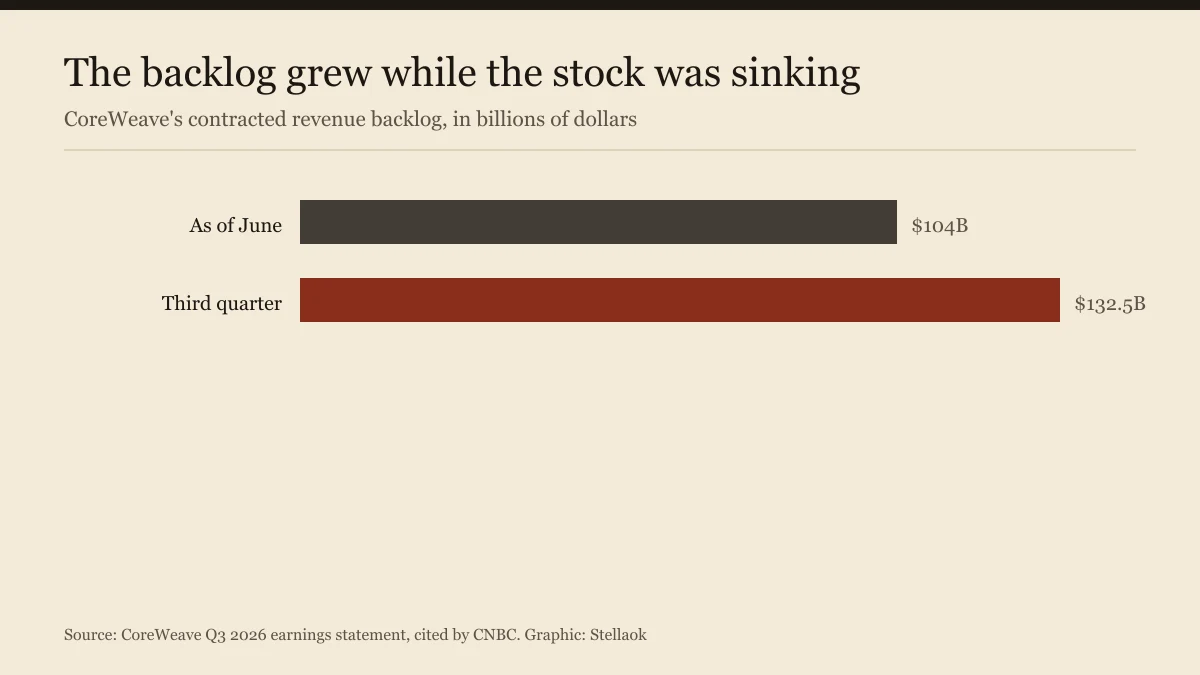
CoreWeave's stock jumped 24.7% on Wednesday, its best single day since April 2025, after the AI cloud provider beat estimates and raised guidance. Revenue for the third quarter hit $3.7 billion, up 168% from about $1.36 billion a year earlier, and the company now expects $13 billion to $13.3 billion in 2026 revenue with $1.275 billion to $1.375 billion in adjusted operating income, well above both its August forecast and analyst expectations. Its $132.5 billion revenue backlog, up from $104 billion in June, is the number that makes the rest of the quarter worth reading.
The rally needed all the help it could get. Shares are still down 18% in 2026, and the month before earnings had taken more than 40% off the stock as investors questioned how a company carrying almost $47 billion in debt would keep financing its buildout. Yields on some CoreWeave bonds topped 15%, part of a repricing across bond markets that strategists read as fiscal risk rather than pure AI-debt panic, and its credit default swap spreads widened past 11%, a level generally read as distress. The company entered this quarter with $35 billion of debt on its books and lenders asking hard questions; Wednesday's numbers bought it time, not absolution.
The financing pivot is the actual story
The most concrete news in the quarter is what CoreWeave stopped doing. "We will not use the unsecured debt market to fund our business at current yields, nor do we need to," chief executive Michael Intrator said on the earnings call. Finance chief Nitin Agrawal put a ceiling on the alternative: under $5 billion in parent-level debt financing through 2027, with asset-level secured loans, which the company says trade around par, doing the heavy lifting. A new asset-level deal, already rated high investment grade, is expected to price at 7% to 7.5% interest within weeks, a figure that quietly makes the point about unsecured yields better than any argument could.
Customers are funding the rest. CoreWeave expects about $9 billion in customer prepayments and deposits over the next three months, including more than $3 billion tied to new contracts for capacity it has already built, which requires no new hardware spending. In August it closed a $2.6 billion loan structured specifically to borrow against short-term customer contracts in installments. Rivals Nebius and IREN have made similar arrangements with Microsoft prepayments, so CoreWeave is pioneering a model the whole neocloud sector is adopting at once.
Shorter contracts, higher prices, renewals as risk
The demand side has a price attached. CoreWeave raised prices roughly 25% in July and another 10% later in the quarter, and Intrator told CNBC that "demand for the infrastructure is and remains overwhelming," with 2027 capacity 10x oversubscribed. The company is steering capacity toward short-term deals priced above $40 million per megawatt annually, while four- and five-year contracts move toward $20 million to $25 million per megawatt. TechCrunch's analysis of the shift flagged the trade-off directly: prepayments ease borrowing needs today but lock in today's prices, and lenders weight long-term contracts more heavily even when they pay less, because predictable cash flow is what repays loans.
Intrator also canceled his own 10b5-1 share sale plan, after selling 8.26 million shares at an average of $96.14 for $794.2 million under a plan announced last November. That is a governance gesture aimed at exactly the investors who spent the past month fleeing the stock.
The election happened, and management shrugged
Last week's midterms handed data center skeptics an unusually clean sweep: voters backed restrictions in 40 of 41 ballot measures across 10 states, Democrats took both houses of Congress, and in Texas, Gina Hinojosa unseated Governor Greg Abbott after campaigning against 20-year tax breaks for large data centers. J.P. Morgan Asset Management judged projects from 2028 onward "most exposed." Intrator's answer was flat: "We do not anticipate any impact from the seismic regulatory shift that's occurred," noting that permitted and under-construction facilities in Texas will continue, and that 1.85 gigawatts of active power remains on track for year end alongside $37 billion to $39 billion of capex.
The quarterly interest expense, $846 million, is the quiet denominator underneath everything. Nebius reports Thursday with the same investor question hanging over it, and Anthropic, a marquee CoreWeave customer, debuts on the Nasdaq next week at a valuation around $1.4 trillion. Wednesday's 24.7% pop shows the market will reward demand proof. What it has not yet been shown is a full cycle of renewals at the new, higher prices.
Source: CNBC