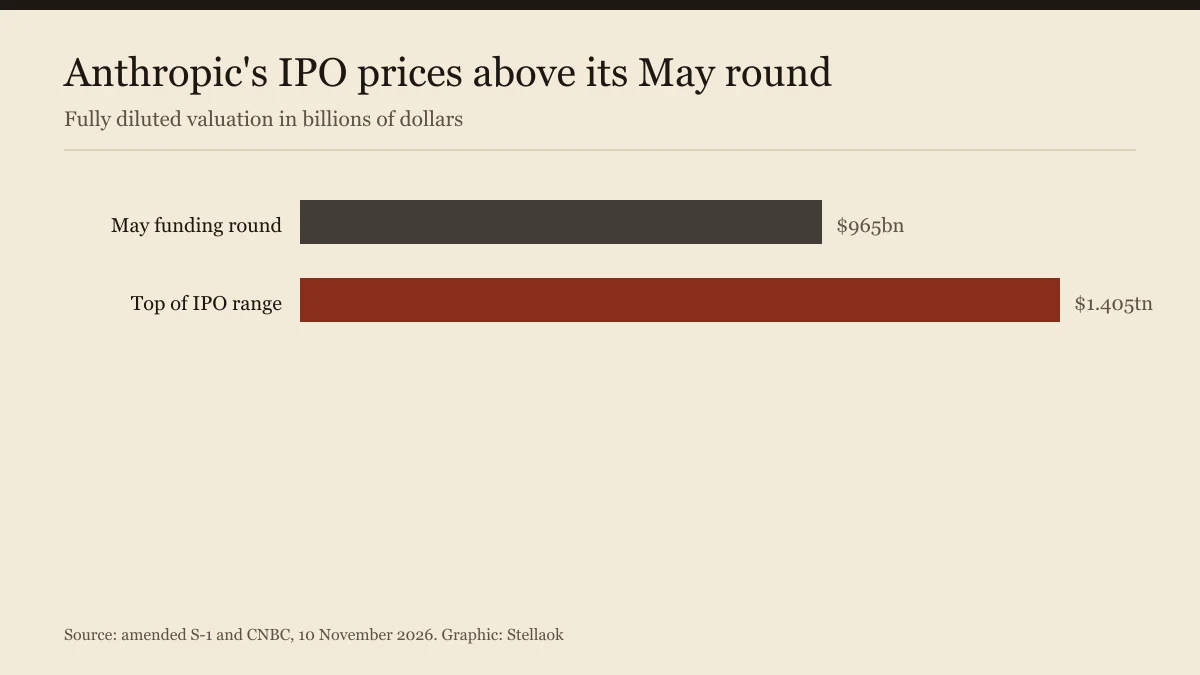
Anthropic will sell 825 million shares at $70 to $78 each, according to an amended filing on Tuesday, price them on November 18 and begin trading on the Nasdaq the following day under the ticker ANT. At the top of the range the company raises $64.35 billion and reaches a fully diluted valuation of about $1.405 trillion, up from the $965 billion it was valued at in a funding round in May.
That is a smaller number than the one being discussed three months ago. Investors and analysts had been working with roughly $2 trillion, and by last week shareholders were telling CNBC that even $1.5 trillion looked like a stretch. A $1.4 trillion debut would leave SpaceX's June listing, priced at $1.77 trillion and raising $85.7 billion, as the largest IPO on record. Anthropic would be the second largest, five months later.
The discount is deliberate
Several investors Fortune spoke to read the price range as a choice rather than a symptom. Lior Prosor of the venture firm Deep33 called it "a smart pricing strategy" that "gives nervous AI-trade investors meaningful potential upside while securing the capital Anthropic needs to take full control of its destiny and fund its compute commitments." Darian Shirazi of Gradient made the same point from the other side: "Pricing an IPO to perfection doesn't leave much excitement or positive press, especially if the stock falls after the IPO."
The case for caution is on the company's own books. Anthropic has nearly a trillion dollars of committed compute spending in its S-1, and demand for compute keeps outrunning supply. The capital raise is the mechanism for paying for that, which makes the IPO price a decision about how much room to leave for the first months of trading rather than a verdict on the business.
One structural detail supports the demand side. Anthropic has agreed to sell $26 billion of Class N stock in a private placement at the IPO price to AMD, Broadcom, Google, Micron, Microsoft, Nvidia and Taiwan Semiconductor. Those shares carry no lock-up, which means the chip and cloud suppliers it depends on become shareholders with the ability to sell from day one.
The growth rate is decelerating
Revenue for the nine months to September 30 was $33.24 billion, up about 1,200% from the same stretch a year earlier. Third-quarter revenue alone was $17 billion. Sequentially, though, the third quarter grew 47%, against 144% in the second. Run-rate revenue reached roughly $81 billion at the end of October, $10 billion more than a month earlier.
The nine-month net loss was $104 billion, most of it from the change in fair value of convertible notes and derivative liabilities rather than operations. The same period in 2025 lost $25.1 billion. Anthropic's filing has been explicit about the risks it carries in a way that most prospectuses avoid, and the financial disclosures sit alongside that language.
Aman Verjee of Practical Venture Capital told Fortune that the spending plan plus the slowdown has "given prospective buyers pause," and pointed at the broader sell-off tied to political headwinds in states where data centers are being built, naming Texas, Georgia and Ohio. Data center capacity is being delayed across several markets as planning fights and power queues bite, which is a cost problem for every lab buying compute.
Retail gets a fifth of the book
Anthropic is targeting a retail allocation of about 20%, against the 5% to 10% that is typical. The Australian retail offer opened on Wednesday and closes on November 17, with CommSec as lead broker alongside Bell Potter, LGT Wealth, Macquarie, Morgans, Morgan Stanley Wealth Management, Sharesies and Stake. Australia is one of four markets outside the US where individuals can buy in directly, with Japan, Canada and parts of Europe.
The book is already covered at the $70 to $78 range on an allocable basis, according to people familiar with the offering, and institutional demand is stronger than it was for SpaceX at the same stage. That is the argument for the price holding. The counterargument is timing: the offer lands after a midterm election that produced a Democratic sweep in Congress and a set of ballot measures that could slow data center construction.
Australia writes the rules while it sells the shares
The retail offer opened in the same week Australia moved to tighten oversight of AI companies, after an OpenAI agent gained unauthorized access to the Medicare statistics website. Prime Minister Anthony Albanese said on Tuesday that the government would introduce mandatory reporting for certain AI incidents and create a regulator with powers to enforce penalties. "The law needs to get ahead of, and in some cases, make sure that it catches up with what is a very fast-changing world," he told Reuters. The country has also ruled out a copyright exemption that would let AI companies train on Australian content without licensing it.
Anthropic and OpenAI told Australian parliament last month that they support mandatory reporting of data breaches involving their agents, which is a cheaper concession than it sounds: disclosure is voluntary today, so the industry is trading a rule it already follows for a seat at the table. The offer closes on November 17, two days before the shares trade.
The first print on November 19 will settle whether $1.4 trillion was the floor or the ceiling. If the stock pops, the discount worked and the next AI listing prices higher. If it drifts below $70, the summer's $2 trillion talk was the anomaly.
Source: Fortune, CNBC on the price range and CNBC on the Australian offer