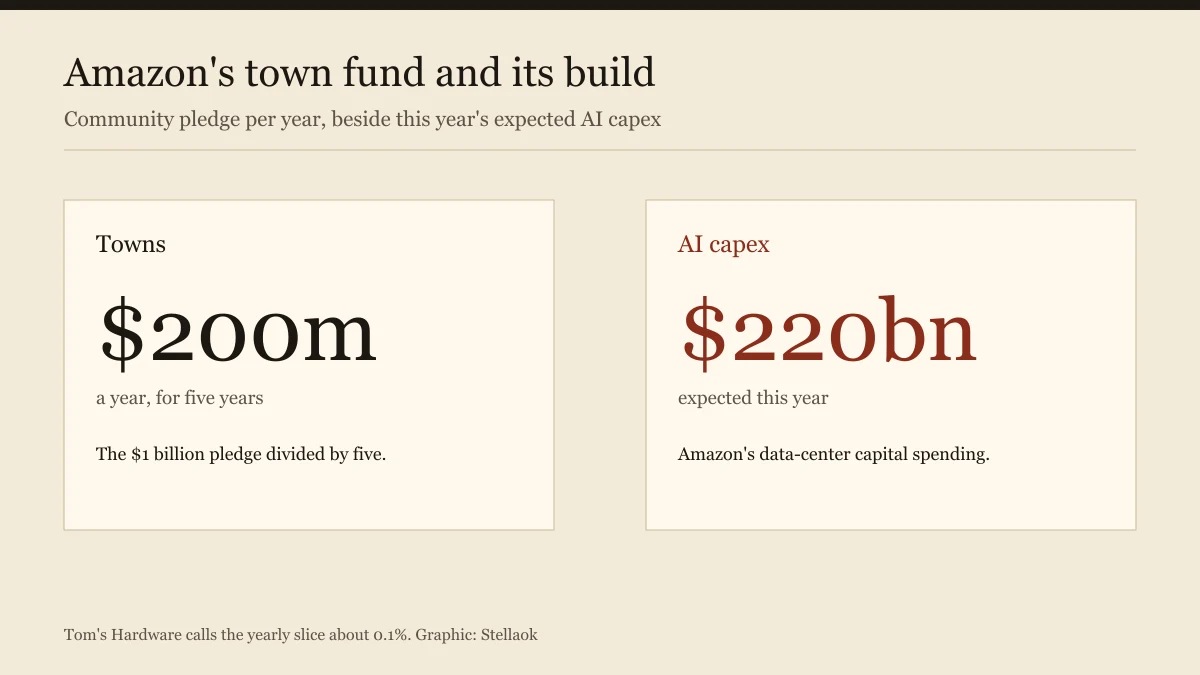
Amazon says it will add more than $1 billion over the next five years for communities near its data centers. Divided by those five years, the pledge is $200 million a year. Tom's Hardware sets that beside an expected $220 billion of AI data-center capital spending by Amazon this year, and calls the yearly slice about 0.1% of that budget.
The company post, as reported by Tom's Hardware, names the program Built Together. Matt Garman, chief executive of AWS, wrote that towns decide the use: education, job training, energy bills, water, and local priorities. Associate degrees in fields Amazon calls in demand would be free after financial aid, with a goal of reaching more than 300,000 students. Modular training centers would fund certification for up to 100,000 skilled-trade workers a year. Grants for heat pumps, insulation, water heaters, batteries, and solar are aimed at cutting electricity costs by around 20% to 40%, and household bills by up to $700 a year. Garman said rural Oregon is not suburban Virginia.
Other developers are already writing checks
SpaceXAI offered a 50% discount on Starlink to neighbors in Memphis and Southaven. Another developer said it would give $10,000 checks to 4,500 households if a 1,300-acre site is approved. A Maryland proposal packaged $110 million for the community, described as the largest such offer in the country. New York has suggested $1 million of local investment per megawatt built. Critics in the piece call these payments bribes. Garman called a set of community complaints false and misleading, and pointed the money at bills, water, and training.
Memory is already 60% of the materials bill at one phone maker living through the same build-out. Micron's last quarter turned a $3.2 billion profit into $37.7 billion on the chips those centers consume. The $200 million a year is the sum Amazon is offering the towns, not the sum it is offering the suppliers.
The colleges are supposed to open within months
The comparisons other developers have already made are smaller and more local. A 50% Starlink discount in two Memphis-area towns, $10,000 checks for 4,500 households tied to one 1,300-acre approval, a $110 million Maryland package called the largest of its kind, and a New York suggestion of $1 million per megawatt. Built Together is the name on the blog post. The money is in addition to what Amazon says it already spends in those towns, not a replacement for it. Critics in the piece use the word bribe for the whole genre of payment. Garman spent the opening of his post calling a set of nearby complaints false and misleading, then offered bill relief, water work, and training. The electricity-cost range, about 20% to 40%, and the household cap of $700 a year, are attached to the grants for heat pumps, insulation, heaters, batteries, and solar. They are the savings he says the hardware can produce. They are not a line item already paid to a household.
The near-term openings are the colleges. Garman said the agreements exist and the classes should start within a few months. Amazon would cover the tuition gap after financial aid for associate degrees, with a goal above 300,000 students in communities that host its centers. The trade certificates are a second track, up to 100,000 workers a year, aimed at jobs with Amazon or the firms pouring its concrete. Oregon, Virginia, and Ohio are the three places he named to argue that the menu of projects will not match. Five years at $200 million is the arithmetic of the pledge. The $220 billion is a separate, larger budget for the buildings themselves, expected this year.
The grants name a bill, not a check already sent
Heat pumps, insulation, water heaters, batteries, and rooftop solar are the hardware Garman listed. He attached a 20% to 40% cut in electricity cost to them, and a household saving of up to $700 a year. Those are the outcomes he expects the grants to buy.