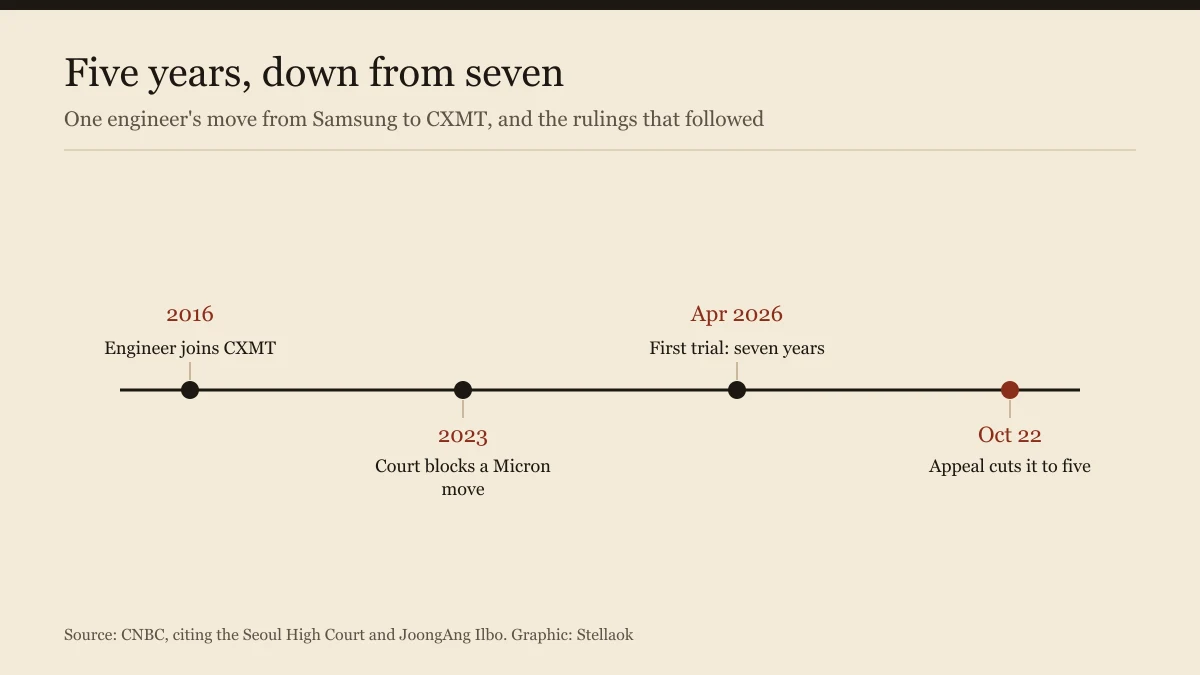
A former Samsung Electronics engineer who moved to Chinese memory maker ChangXin Memory Technologies was sentenced to five years in prison by the Seoul High Court on October 22 for leaking Samsung technology. The sentence was cut from seven years at his first trial in April. He had joined CXMT in 2016, CNBC reported, and the case has become the reference point for how Korea now treats the movement of chip engineers.
The two-year reduction is the part lawyers will read closely. An appeals court that accepts the conviction and still removes almost a third of the sentence is signalling that the harm was real but the culpability was not what the first court found. For engineers weighing an offer from a Chinese fab, that is a message with two halves: the risk is prison, and the risk is negotiable.
Five years, down from seven
Korean courts have treated semiconductor know-how as a protected asset for years, but the penalties have been climbing. In 2023 a Seoul court granted Samsung's request to stop a former DRAM researcher from joining Micron, ruling that a two-year non-compete was not excessive because the technology and business information at stake justified it, according to JoongAng Ilbo. That was a civil remedy. The CXMT case is criminal, and the sentence is measured in years rather than in an injunction.
South Korea has also designated certain semiconductor manufacturing technologies as National Core Technologies, which raises the penalty for leaking them. The label does the work that a general trade-secrets statute cannot: it tells a court in advance that the information mattered, without requiring the company to prove in open court what it lost.
The non-compete is the tool that actually gets used
Samsung's everyday defence is contractual. Senior employees sign two-year restrictions on joining rivals, and the company tracks where departing engineers go, according to a former employee who spoke on condition of anonymity. The point of the tracking, that person said, was as much about the people who stayed as the ones who left: a visible case tells the rest of the team that moving is difficult.
That logic only works while the alternative employer is a known quantity. A decade ago Samsung's concern was SK Hynix and Micron, both of which compete on the same products in the same markets and can be deterred by the threat of litigation. Chinese memory makers were not on that list. They are now, and they are hiring with packages that include salary, stock, housing and family support, according to Counterpoint Research analyst Jeongku Choi.
Choi says that recruitment has helped Chinese firms clear technical bottlenecks precisely because US export controls limit access to advanced equipment. People are the input that sanctions do not cover. Counterpoint's memory tracker for the second quarter of 2026 projected CXMT would reach 10 percent of global DRAM revenue, which is a share that used to belong to the three companies now suing over it.
Taiwan pays for the restraint
The comparison that makes Korea's position look severe is Taiwan's. Jamie Yang, a partner at Innovatus Law, told CNBC that Taiwanese law caps post-employment non-competes at two years and requires the employer to pay at least half the former employee's average monthly salary during the restriction. A company that wants a year of protection buys it.
Yang also makes an argument that cuts against the whole premise of the cases: semiconductor manufacturing is so complex that no single engineer knows enough to replicate a production line somewhere else. If that is right, the value of an individual hire is in solving a specific problem rather than transferring a process, and the criminal law is aimed at the wrong target.
Singapore and Hong Kong take a narrower view again. Zechariah Chan of Lee & Lee says proving that a rival used proprietary manufacturing methods is hard because outsiders only see the finished product, and that there is no bright line between an engineer's general expertise and a company's secrets. Hong Kong courts enforce non-competes only where they protect a legitimate interest and go no further than necessary, according to Jezamine Fewins of Lewis Silkin.
Where the next cases come from
The pattern of enforcement will follow the pattern of exports. Choi expects trade-secret management to extend into intellectual property and litigation once Chinese memory companies move beyond their home market and start exporting, because that is when their products become visible to the companies that hold the patents.
Market share is already moving. CXMT's new memory design pulled Micron, Samsung and Hynix down when it was announced, which is the reaction of companies that expect price pressure rather than a lab experiment. SK Hynix is asking for China tool licences while planning a US fab, hedging across both sides of the restriction, and Qualcomm is paying Huawei for patents in the same market where licensing used to flow the other way.
The next criminal case will probably involve a company that exports rather than one that only sells at home, and the sentence will be argued on how much of the process a single engineer could carry. That is a question the industry has not answered, and the Seoul High Court has now put a number on the answer: five years, with two of them taken off on appeal.