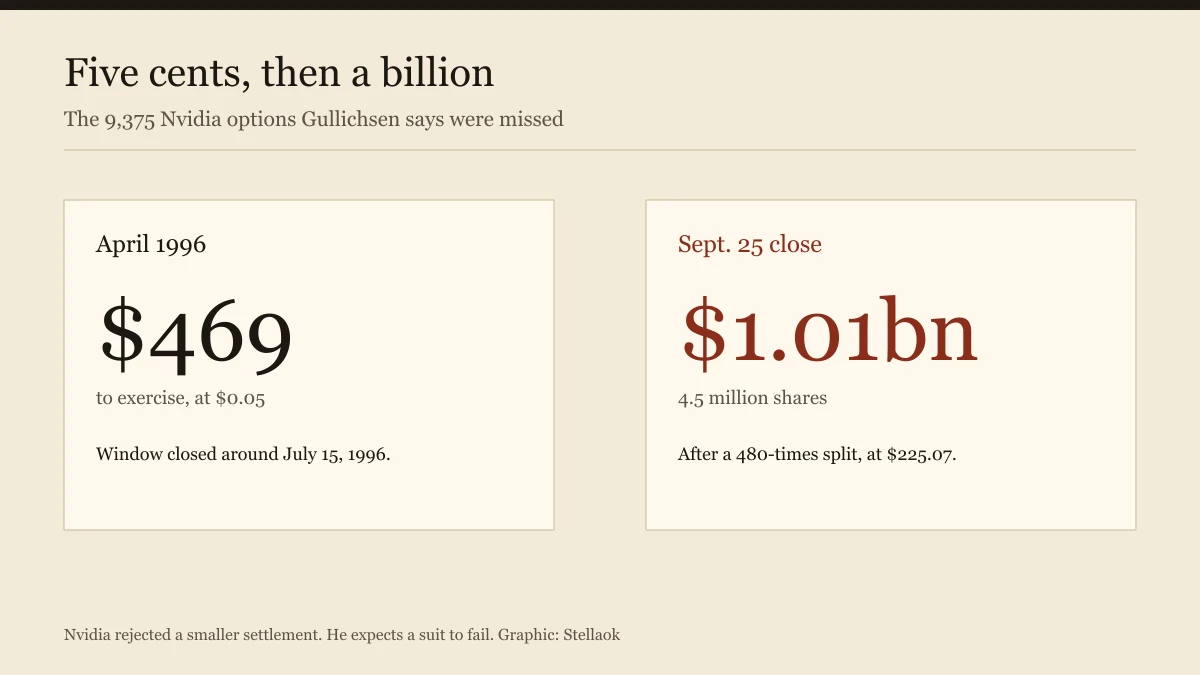
Nine thousand three hundred and seventy-five Nvidia options from 1993, run through a 480-fold split, are 4.5 million shares. At the Sept. 25 close of $225.07, that is about $1.01 billion.
Eric Gullichsen says those shares should have vested and did not. Tom's Hardware is reporting his blog, the grant he posted, and a CFO letter. Nvidia has not answered in public. He and his lawyers already decided a lawsuit probably dies on the statute of limitations.
The cover sheet says one year. The invitation says four.
The grant he posted is No. 7, dated Sept. 9, 1993, for 25,000 shares, signed for Nvidia by Jensen Huang. It says all shares vest one year from the grant date, fully vested by Sept. 9, 1994, with 25% at three months and then quarterly. An undated invitation, also signed by Huang, says the option "vests over 4 years."
CFO Marcel Gani's letter of April 16, 1996 ends Gullichsen's contract with the Technical Advisory Board and counts 15,625 options vested, at $0.05, with 90 days to exercise. Fifteen thousand six hundred and twenty-five times five cents is $781.25. The 9,375 he says were left off would have cost $468.75 to exercise the same way.
Fifteen thousand six hundred and twenty-five is 62.5% of 25,000, which is 10 of 16 quarters. That matches a four-year schedule running from Sept. 9, 1993 to April 16, 1996. The CFO's arithmetic fits the invitation. The signed cover sheet fits a one-year vest. The cover sheet also says a conflict with the attached legal provisions is governed by those attachments, and the attachments are not in the post. It says it supersedes earlier written agreements, which would put the invitation underneath it.
$468.75 against $1.01 billion is the whole argument
Four and a half million times $225.07 is $1,012,815,000, the "about $1.01 billion" in his post. Divide that by the $468.75 exercise cost and the claim is about 2.16 million times what it would have cost to buy the disputed slice in 1996.
He found the mismatch re-reading the grant in 2024. Lawyers worked on contingency. After about a year of letters, the two sides met. He says they offered to settle "for a far smaller number." Nvidia "still made the call to say nope." After "thirty-odd years," he and counsel thought they would not get past a motion to dismiss. The 1996 exercise window, 90 days from April 16, closed around July 15, 1996. His own settlement note includes "the likelihood I would have sold." The disputed slice is 9,375 of the original 25,000, which is 37.5 percent of the grant.
The work history is not in dispute in the post. He co-founded Sense8 around 1990. He says a fast texture-mapping trick brought Curtis Priem to a houseboat in Sausalito in 1993, with Huang and Chris Malachowsky. A 1994 patent, US5796426A, names "the NV-1 chip sold by N-Vidia Corporation." The NV1 did not sell. He had not, as of Monday morning, answered questions about shares he did receive.
A rejected settlement is not a balance-sheet item
This is a claim Nvidia has already waved off, from a person who agrees the clock ran out. It does not belong in a model of what the company owes. It does show how a five-cent option from the advisory board becomes a billion-dollar sentence once the split ratio is 480.
The $150 billion buyback authorisation is a current-capital decision. This dispute is a 1993 form. AMD clearing $1 trillion while Nvidia sat at $5.4 trillion is the scale that makes 4.5 million shares loud. Huang's line that chip sales will double next year is the operating story. Gullichsen's is a document story.
What would change it is the missing attachment. If those legal provisions say four years, the cover sheet points at them and the claim shrinks to a blog post. If they say one year, Nvidia has still bet that thirty years is enough. The company has not said which bet it is making.