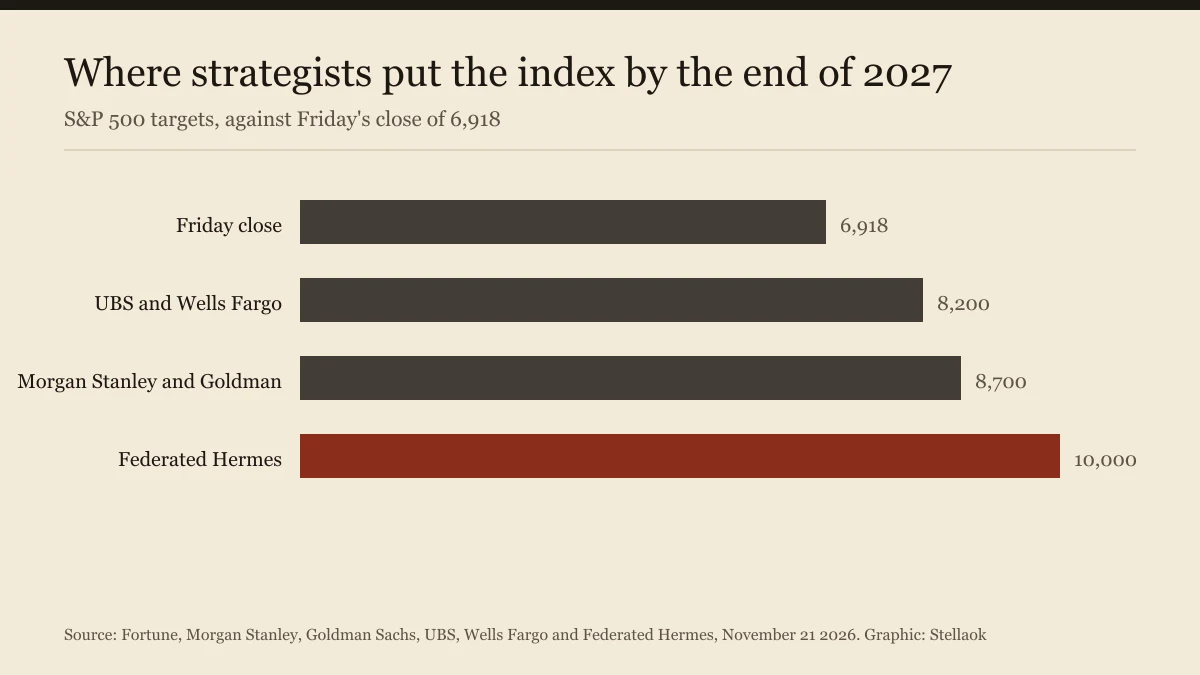
The S&P 500 closed Friday in a correction, its worst week since the early days of the pandemic, and the largest banks spent the same week publishing targets for the end of 2027 that imply a strong recovery. Morgan Stanley and Goldman Sachs both see the index at 8,700 in a year's time. UBS and Wells Fargo have 8,200. Federated Hermes has 10,000.
Those numbers cover a wide range: about 19% upside from Friday's close at the low end and 45% at the top. What they share is a view that this month's selling is a valuation reset rather than the start of a recession.
"This does not mean stampedes are uninformative or palpitations never presage heart attacks, but today's panic does not feel like an AI bust," Viktor Shvets, head of global desk strategy at Macquarie Capital, wrote in a note on Friday.
The case for 8,700
Morgan Stanley's chief US equity strategist, Michael Wilson, published 8,700 earlier this week, a 15% gain from where the index stood when he made the call. "We see the mid-cycle transition now ending with a more stable mid-cycle backdrop evolving in 2027," he wrote.
Goldman Sachs has the same number with a caveat, expecting "higher volatility than in recent years." Peter Oppenheimer, the bank's chief global equity strategist, argued that earnings growth will slow but that inflation, bond yields and oil prices will also come down. "We expect the equity bull market to continue," he said.
Both forecasts rest on profits holding up. Goldman's own note on the selloff said AI capital spending produced about half of this year's earnings growth, which makes the 2027 estimate a bet on that spending continuing.
The more cautious end
UBS Global Wealth Management put the index at 8,200, about 19% above Friday's close. It expects more earnings gains next year but is watching whether the investment cycle can support profits into 2028. "Cannibalization, financing, and execution risks around AI have increased while expectations and index concentration remain high," the bank wrote, adding that the market is "more sensitive to earnings disappointment or a further rise in discount rates."
Wells Fargo also has 8,200, and also assumes slower profit growth. That is not a bearish call so much as a hedge: both banks are saying the direction is up and the slope is uncertain.
The same reasoning shows up in how strategists talk about timing. Wall Street expects more tightening in the coming months, and some analysts see rate cuts later in 2027 as inflation cools, a sequence that would let valuations recover in the second half rather than the first. Michael Monaghan of Founder ETFs described the current mood as a market that is "selling first and asking questions later," while Jamie Cox of Harris Financial Group predicted investors would "return to rationality" and focus on consumption and GDP.
The outlier
Steve Chiavarone, chief investment officer for equities at Federated Hermes, has a year-end target of 10,000. He argued that fears about the data centre buildout slowing are overblown, and that even a modest pullback would help rather than hurt.
"A modest pullback in the data center buildout could give cash flows time to catch up, easing inflation pressures and making the investment boom more sustainable," he wrote.
That argument ties the market's recovery to the same spending that has been driving it. Slower construction would ease the pressure on prices and rates, which would let the Fed stop raising, which would let valuations expand again. It is coherent, and it depends on a chain of ifs.
What the market is actually pricing
Gaurav Mallik, chief investment officer at Modera Wealth Management, called the slide a "garden variety correction" and pointed to leadership rotating from technology into industrials and financials. "The pullback in stocks sets the market up nicely for 2027, which we believe will be a high-single-digit year," he said. "Multiples are shrinking, and total returns are a function of earnings growth, which he said looks solid for 2027."
The disagreement is not about whether the economy grows next year. It is about what investors will pay for a dollar of those earnings, and whether the AI spending that has supported the index can keep doing so once the companies funding it have to show a return. The IMF made a similar point about the world economy leaning on one industry earlier this month.
The Federal Reserve meets on December 9, and futures put the odds of another rate increase at about 95%. Whatever the strategists publish between now and then will be tested by that meeting first.