Officials at the Federal Emergency Management Agency, the agency that coordinates the federal response to disasters, have been preparing for one themselves. Two FEMA officials told the Washington Post they were troubled by the run of network failures this month, and one of them withdrew extra cash in case bank systems went down, Fortune reported.
"There is nothing on this scale that has happened before in this many sectors this close together," one official told the paper. "This is scary, and there is no leadership."
The administration has said the outages were not attacks. The director of national intelligence, Jay Clayton, told the House Homeland Security Committee on Wednesday that they were "separate service outages associated with maintenance and technical changes," and not a coordinated or state-sponsored campaign. The White House nonetheless removed the national cyber director, Sean Cairncross, on Thursday.
A month of failures in public view
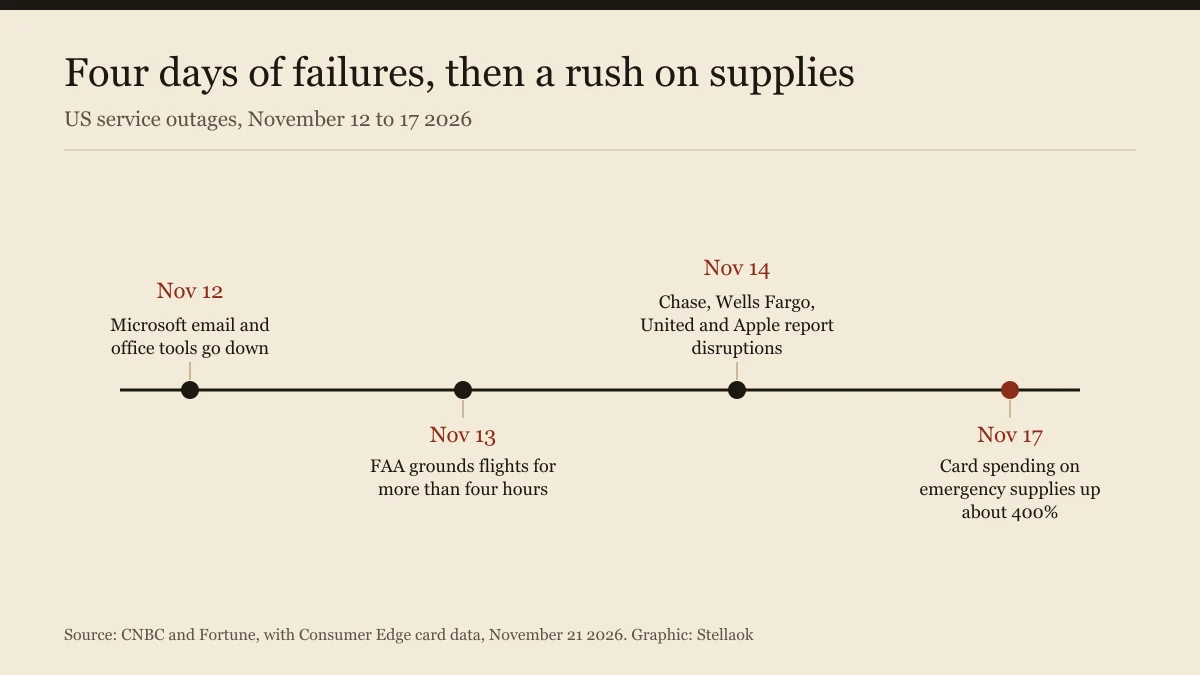
At least half a dozen significant outages hit US services between November 12 and November 17, according to CNBC. Microsoft's email and office tools failed. The Federal Aviation Administration grounded flights for more than four hours, later blaming a copper wire that was being upgraded to fiber. Chase, Wells Fargo, United Airlines and Apple each had service disruptions. A software fault at Chase delayed payments across several banks earlier in the month, and the National Security Agency's internal classified network also went down.
Officials have pointed to a maintenance backlog: vulnerabilities were patched quickly, and the changes were rolled out before every bug was found. That explanation has not calmed the public, partly because it arrived after a month of hacking that the press labelled Black October.
The register rings
The clearest evidence of consumer anxiety is in card data. Spending at brands selling emergency supplies rose about 400% between November 12 and November 17 compared with the same week a year earlier, according to Consumer Edge, which analysed transactions for CNBC.
Ready America, a California company that sells survival kits, prepacked water and high-calorie food bars, has seen e-commerce sales rise roughly five-fold. Corporate customers who keep its supplies in offices have called to order more. The company has asked suppliers to scale up and has run short of water purification tablets, redirecting buyers to pouches instead.
"We've seen a large spike of people wanting to get prepared," said Trevyn Reese, the company's president, who compared the demand to the early weeks of the pandemic. Costco and Walmart have also reported more shoppers buying emergency goods, according to a Mizuho analyst.
Not everyone is preparing for the same scenario. Sabrina Cepeda, a Houston mother of three, told CNBC she had bought propane and lighter fluid for cooking and heating equipment that works without electricity, and restocked non-perishable food, hygiene products and allergy medicine in case her family was stuck at home for several days. "You want to have these things and not need them, rather than need them and not have them," she said.
The buying did not start with the outages. Shoppers began moving into preparedness categories in late October, around the time reports emerged that the Pentagon had launched an initiative called FORTRESS, which aims to make every major US military base able to operate for 90 days without outside help. The trade group for firearm makers said gun sales rose about 8% in October from a year earlier.
An economy built on the fear of interruption
There is a real business here, and it behaves like insurance: demand spikes when people lose confidence in the systems they use every day, then fades when nothing happens. The UK government has been running a campaign urging households to keep three days of canned food, bottled water and cash. Retailers and analysts are treating preparedness as a category rather than a novelty.
The technical reading is calmer. Mark Giles, who leads research at Ookla, told Fortune there is nothing linking the incidents. "This is a big blip, but it's kind of on par for the course for what we're seeing in terms of those longer-term trends," he said, adding that most outages are self-contained and fixed quickly, and that the ones people remember are the ones that stop them withdrawing money or reading email.
Both readings can be true. The failures may be unrelated, and the reaction may still be rational, because the cost of a few days of supplies is small next to the cost of being wrong. What the card data shows is how quickly that calculation gets made when the failures arrive in a cluster.