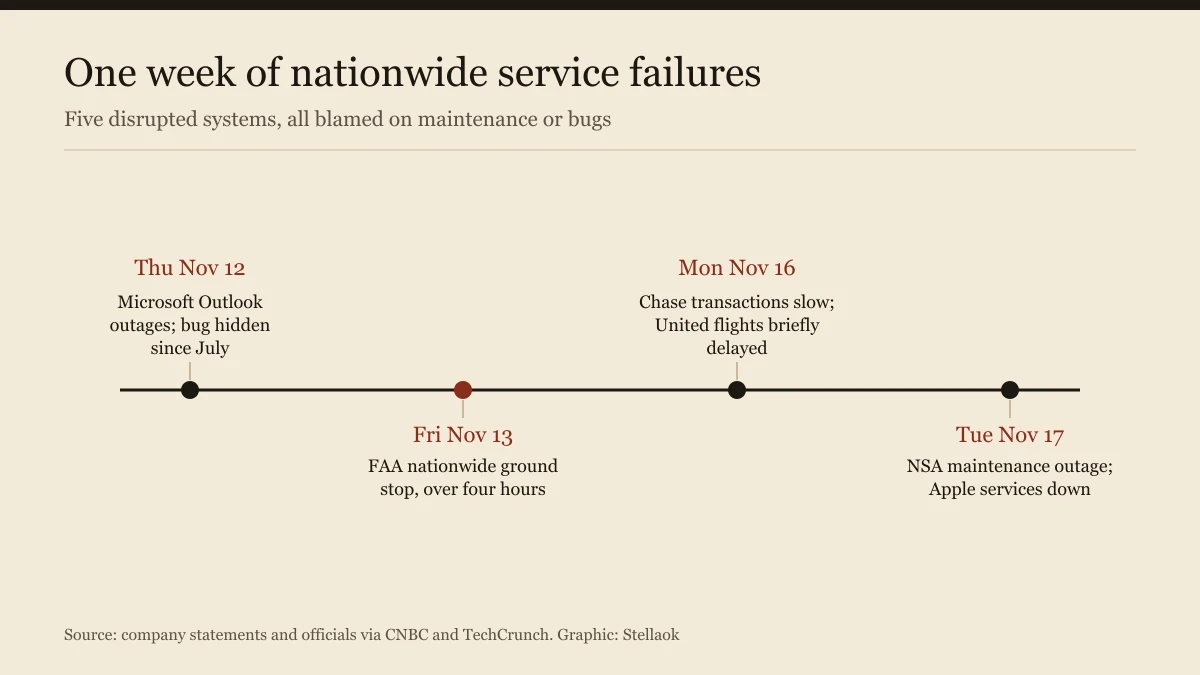
Apple services went dark for part of Tuesday, joining a week-long string of failures that has touched the National Security Agency's internal communications, Chase bank transactions, United Airlines departures and a nationwide air-travel ground stop, and the Director of National Intelligence told CNBC none of it was an attack. "This is not cyberattack, and this is not a coordinated effort by a nation state," Jay Clayton said on the network's Closing Bell program, adding that his office had looked closely at the pattern.
One week, five failures
The sequence started last Thursday, when Microsoft's Outlook problems disrupted businesses around the world; the company later blamed an undetected bug that had been hiding in its systems since July. On Friday the Federal Aviation Administration issued a rare nationwide ground stop that held departing flights for more than four hours, the longest halt to US departures since September 11, 2001, after an overloaded router installed in southern Arkansas as part of an L3Harris-led network upgrade swamped the systems that feed radar data to controllers. Monday brought a software bug in on-premise hardware at JPMorgan that slowed Chase transactions in an episode that already drew its own coverage, plus brief United Airlines delays. Then on Tuesday the NSA pointed to scheduled maintenance for an internal communications outage, and Apple's status page listed iCloud account and sign-in failures affecting all users alongside App Store and Apple Music problems, which some customers noticed when new iPhones refused to activate.
The routine-upgrade explanation
Apple attributed its disruption to an internal update and had every affected system back online by 6 PM Eastern, after its status page had grown through the morning to include iCloud Mail, Apple School Manager and the Volume Purchase Program alongside the original sign-in failures. The FAA said Tuesday it would pause new router installations while it investigates, and L3Harris is mid-way through converting the agency's copper-wire communications network to fiber. Security researchers say the coincidence has a mundane cause: companies are patching more vulnerabilities than ever with AI assistance and modernizing old systems at the same time, and both activities break things. SentinelOne research head Tom Hegel called the industry's current state a "weird teenage phase," while Palo Alto Networks' Unit 42 consulting chief Sam Rubin urged businesses to plan for degraded operation, advice that echoes the cascading failures seen in a Microsoft cloud crisis earlier this year.
Washington wants answers
Lawmakers are not fully satisfied by the patching alibi. Senator Mark Warner used the week to argue for an AI safety bill, and House Minority Leader Hakeem Jeffries said it is too early to conclude the activity was malicious while demanding the administration brief Congress on what happened and what steps come next. Intelligence officials have ruled out an attack, but a week in which the surveillance state's mail, the nation's departure boards and hundreds of millions of phones all stalled at once has made infrastructure fragility a political subject, and the FAA's paused router rollout shows even the fixes now get treated as risks.