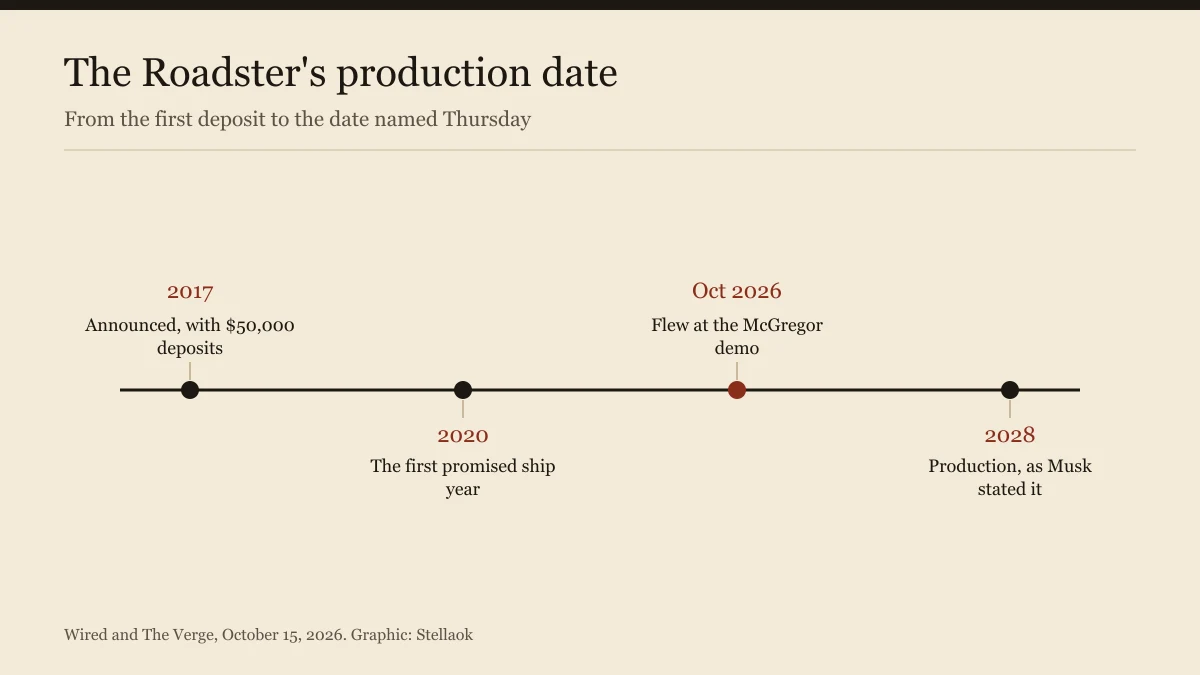
Tesla demonstrated a next-generation Roadster on Thursday night at a SpaceX facility in McGregor, near Waco, Texas. The car drove up an inverted ramp, flew over the rest of the lineup, and the event timer showed 0.81 seconds from zero to 60 mph. Chief executive Elon Musk said production starts in 2028.
The Verge's account of the demonstration and TechCrunch's writeup both have vehicle engineering vice president Lars Moravy walking through the hardware. Wired's report from McGregor has the older promise this demo was supposed to close. Musk told the crowd the collaboration was between what he called the best car company and, in TechCrunch's telling of a separate remark, a car he is not sure moves revenue much.
The demo was a ramp, a flip, and a pass over the lineup
The Roadster drove up a tall ramp and hung upside down, using downforce to stay on the surface, then used cold-gas thrusters to turn and come back down. Moravy called one of the aerial moves a kick flip. The car then flew over a Model 3, a Model Y, a Cybertruck, a Semi, and a Cybercab. Musk said attitude-control thrusters plus main thrusters at the rear let it fly like a rocket and do rolls. He also said this is not a safety-optimized car.
A fan system under the car, which The Verge attributed to SpaceX, can generate up to two Gs of suction. Seats are molded into the chassis. Steering, brakes, and throttle are steer-by-wire, including a yoke. Moravy said the shape took cues from aerospace work such as the SR-71. Musk's line for the car was "the last best driver's car." He also said the version shown will be the car that goes on the road, and that it will be able to puff itself up for these maneuvers when the owner wants.
Tesla delivered 486,532 cars last quarter, 6,406 more than the quarter before. That is the volume business. Musk has said he is not sure the Roadster moves the needle on revenue, which leaves the delivery print as the part of the company this demo was not trying to change.
Ten nozzles, 600 liters of air, no chemical propellant
Moravy said the car uses 10 thrusters fed by 600 liters of compressed air, and that the tank can be recharged. The Verge put the stored air at about 250 kilograms, in two ultra-high-pressure tanks, pushed through 10 nozzles. Tesla, in a post TechCrunch quoted, said every usable void is packed with carbon-fiber overwrapped pressure vessels, the same class of tank that has failed on spacecraft. The air is the propellant. There is no separate chemical fuel to load.
TechCrunch said every trim is rated for 300 miles of range and for speeds over 230 mph. Musk, on the stage, talked about cracking halfway to the speed of sound. That line is a tease, not the figure Tesla put on the trims. He also floated a jump of the Snake River Canyon, the gorge Evel Knievel tried in a steam rocket.
On a podcast earlier this year, Musk said safety is not the main goal, compared the car to a Ferrari, and said Tesla would aspire not to kill anyone in it. The Verge noted that a car that flies would still have to satisfy the Federal Aviation Administration and the National Highway Traffic Safety Administration before a customer could do the demo's stunts on a public road.
The site is taking reservations. The event did not name a sticker
The demonstration did not walk through price or a delivery month. Tesla's site, TechCrunch reported Thursday, is taking reservations in three trims. Performance is described as road-ready, seats two, has active aerodynamics, and uses the suction system on a track and off it. Reserving that trim costs $50,000. Thrust costs $250,000 to reserve. Rocket is invite-only.
Wired recorded the 2017 version of this ask: enthusiasts put down $50,000 on a car advertised at $200,000, a deposit worth more than $68,000 in 2026 dollars. Some buyers tried to cancel. OpenAI chief executive Sam Altman complained on X last year that he had trouble getting his reservation refunded. Musk posted that Altman had the money back in 24 hours. Tesla is also still opening markets where someone else already leads, which is a different problem from a halo car that has not shipped.
The first ship year on the calendar was 2020
Wired's history of the car starts at the 2017 announcement, when Tesla called it the fastest production vehicle in the world and pointed at 2020. The company missed that year and every delivery target after it. Thursday's event mentioned the new production timing and did not mention a sticker. Design lead Franz von Holzhausen was at McGregor with Moravy and Musk. The show ran under half an hour, which The Verge described as closer to a stunt than a spec briefing.