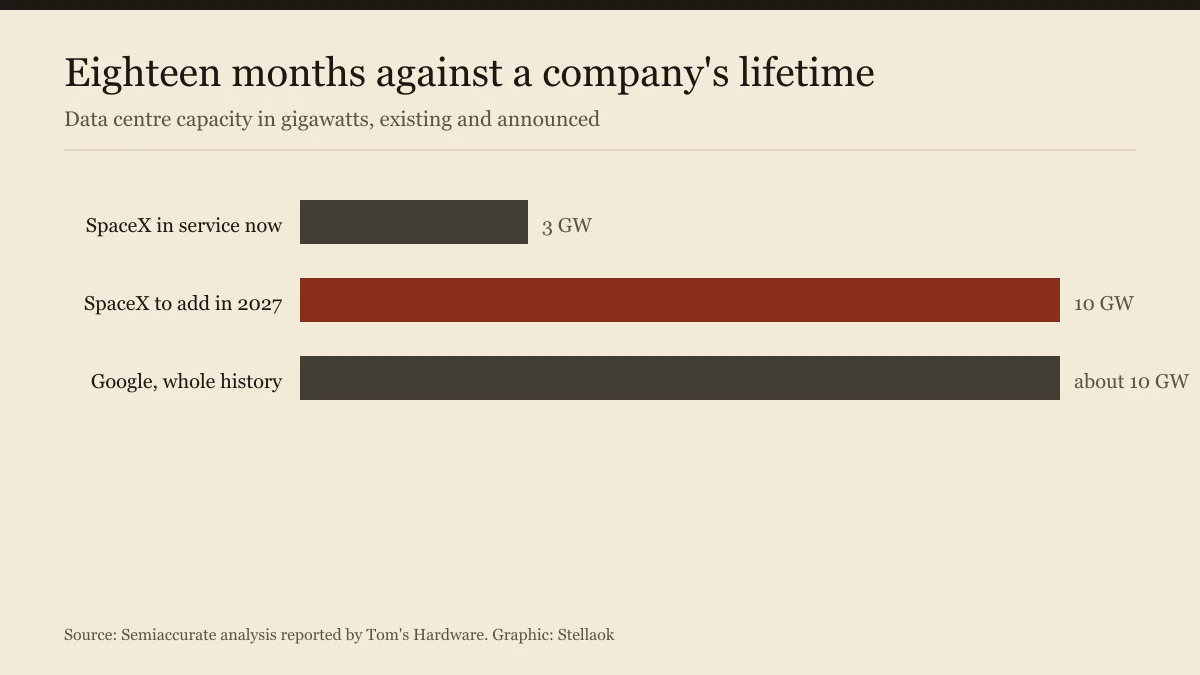
Elon Musk said two weeks ago that he was "highly confident" SpaceX could build 10 gigawatts of data centre capacity during 2027. On Wednesday, the analysts at Semiaccurate published a walk through the numbers and concluded the target is realistic, provided a long list of things keep going right.
The comparison that makes the claim worth reading comes from the same post. Ten gigawatts on top of the roughly 3 GW SpaceX already operates would mean the company adds, in eighteen months, as much capacity as Google has built over its entire existence. In other words, SpaceX would match a two-decade buildout in a year and a half, and end 2027 with 13 GW running.
Tom's Hardware reported the analysis, which leans on aerial photography rather than press releases. That is the only way to see this buildout: nobody publishes a schedule.
Ten gigawatts in eighteen months is a category change
The evidence the analysts put forward is the pace of the two Colossus sites. Colossus 2 had 0.4 GW of generation capacity in January and is projected to reach 2.4 GW by the end of the year. Across the sites they track, including Colossus and the Starbase facilities, Semiaccurate counts 9 GW of potential capacity.
The second number is the interesting one. A single campus carrying 89 turbines works out to roughly 28 MW per turbine, and the same site holds 1,377 Tesla Megapacks. Tesla builds both. That is the mechanism behind the speed: the two hardest pieces of a data centre, generation and storage, come from a sister company that can ship them as modules.
Whether the racks inside those buildings are full is a separate question, and the company has given one data point. As of September 25, Musk said Colossus 2 had 550,000 GPUs working.
The turbines run before the permits arrive
Regulation is where the arithmetic gets awkward. Emissions rules will eventually allow the campus to run only about 1.24 GW of its own turbines, and 1.2 GW is due to arrive from the grid, leaving a 300 MW gap that the batteries are meant to cover. Mississippi has agreed to let SpaceX run the extra turbines temporarily, with a phase-out promised by July 2027.
Semiaccurate's observation is that SpaceX starts construction before it has decided how a site will be powered, then solves the power problem afterwards. Some of those temporary turbines sit on truck flatbeds. That is a company treating a regulatory limit as a queue to be managed rather than a wall.
The gap between 2.5 GW of installed turbine capacity and 1.24 GW of permitted running time is the whole story in one number. Hardware is not the bottleneck for SpaceX. Permission is, and permission is the part that does not scale with manufacturing.
What it means if your chips are waiting for a rack
Satya Nadella has described the industry's actual condition more plainly: "You may actually have a bunch of chips sitting in inventory that I can't plug in. In fact, that is my problem today." Power, zoning, water and public opposition decide when a building becomes compute, and none of those are things a supplier can compress.
For the rest of the market, the uncomfortable implication is that speed is being priced in. Capacity that exists on paper still commands a premium, because demand outruns supply by enough that buyers cannot wait for the tidy version. The same squeeze is visible in the memory chain, where Macronix has walked away from game cartridges to make flash for data centres.
Public patience is the variable nobody has modelled. Local bans already hold up 2.3 of the 38 gigawatts due in 2027, and those numbers were counted before this month's ballot results.
The date to watch is July 2027. That is when the Mississippi arrangement expires, and it sits inside the same year SpaceX has promised to deliver the ten gigawatts.