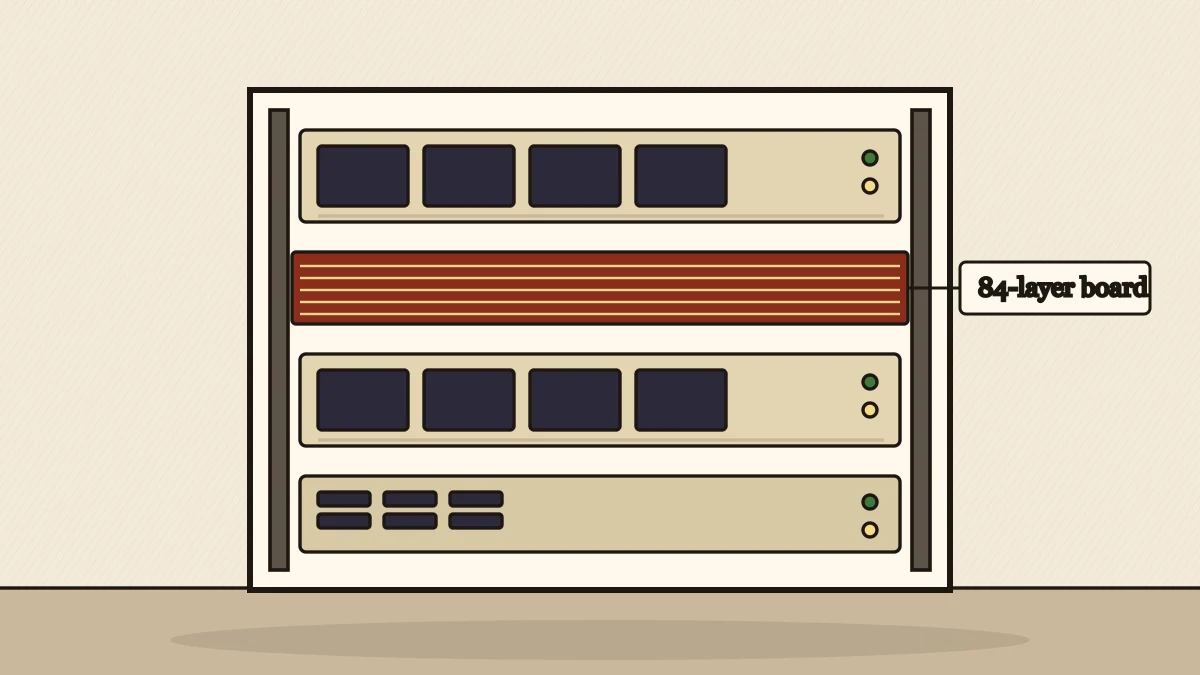
SpaceX has developed its own rack-scale AI system built on Nvidia's next-generation chips, according to a SemiAnalysis report covered by Tom's Hardware. The machine is codenamed Kessel, and it keeps the guts of Nvidia's Vera Rubin NVL72 platform (36 Vera CPUs, 72 Rubin GPU packages, and nine NVLink switch trays) while throwing away the part that normally connects them. Instead of Nvidia's NVLink cable cartridges, Kessel places its compute and switch trays back-to-back around a passive printed circuit board midplane, an 84-layer slab of copper and laminate that replaces dozens of high-speed cables.
The design choice has a precedent inside Nvidia itself. The company's upcoming Kyber architecture, which scales to 576 GPUs across 144 packages, also relies on a board-based interconnect rather than cable assemblies, and its backplane is a 156-layer PCB built on M9 copper-clad laminates. Kessel's board uses a layer count nearly half that of Kyber's, but pairs it with the more advanced M10 laminate class. For context, a high-end server motherboard runs 15 to 20 layers. An 84-layer board is hard to manufacture, and a defect buried in an internal layer can scrap the whole thing.
Fewer cables, but not necessarily less money
Eliminating cable assemblies simplifies assembly and removes a class of connection that can work loose or fail. It does not obviously save money. Ultra-low-loss M10 laminate is expensive, the manufacturing process demands precise quality control, and yield on an 84-layer board could become the project's defining obstacle. SemiAnalysis framed the economics the same way: Kessel only wins if the savings from ditching cables and buying components independently outweigh the cost of that monstrous midplane.
The procurement model is the more interesting change. Rather than buying Nvidia's assembled compute boards or trays as planned for the Vera Rubin generation, SpaceX intends to acquire the accelerators, CPUs, switches, and networking gear directly from Nvidia and source everything else from its own suppliers. That gives the company control over PCB fabrication, component vendors, and manufacturing partners, and it matters most for the deployment target that gives Kessel its reason to exist: orbital data centers, where hardware has to be optimized for an environment no terrestrial vendor designs for. The company already laid out the scale of that ambition, planning ten gigawatts of compute capacity in 2027.
What this means for Nvidia's grip on its best customers
For Nvidia, the arrangement cuts both ways. Selling chips and switches instead of finished boards trims revenue per unit, but a customer successfully building its own Nvidia-based racks is the strongest possible rebuttal to custom silicon, which hyperscalers keep rolling out. If Kessel works, other large buyers may copy the playbook and end up deploying more Nvidia hardware, not less. If it fails on yield, the traditional procurement model looks vindicated.
The memory question hangs over the whole plan. GPU and HBM supply is tight across the industry right now, tight enough that European buyers are already chasing Blackwell allocations they cannot get, and a company assembling racks from raw components competes for that memory directly against Nvidia's finished-board customers. The first Kessel racks will answer the yield question before the orbital ones answer the vacuum question, and the terrestrial deployments are how the orbital ones get paid for.
Source: Tom's Hardware