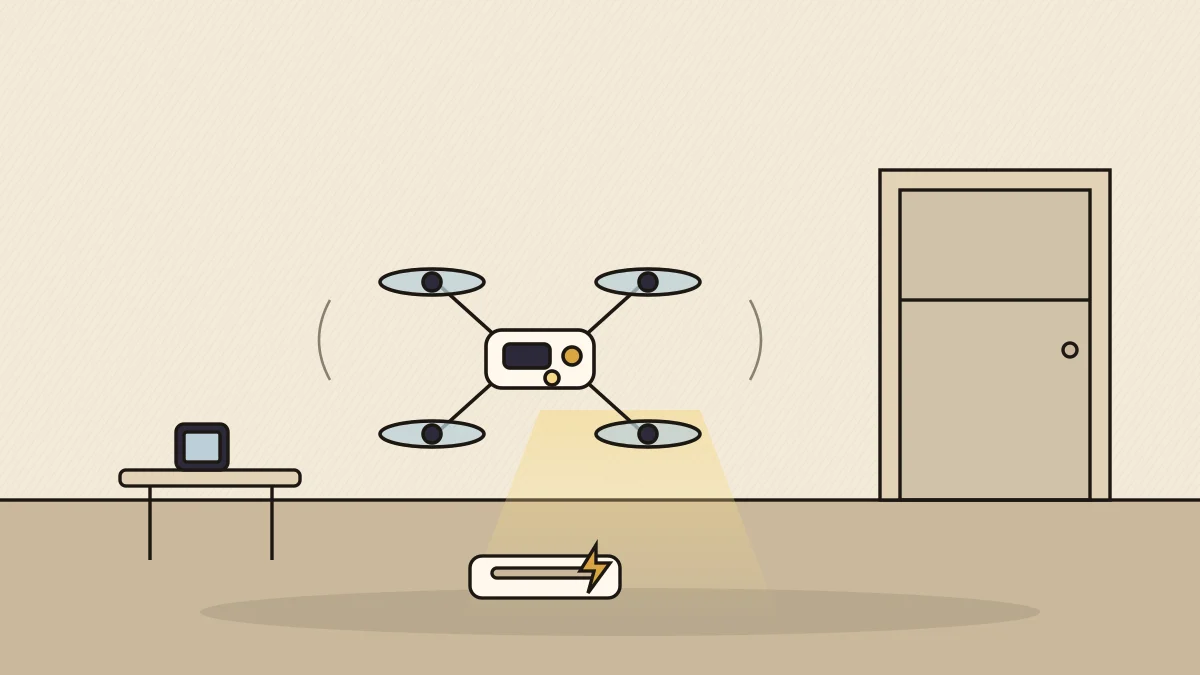
Ring announced two robots on Tuesday under a new sub-brand called Ring Robotics, and the cheaper one flies. The Ring Drone Cam costs $250, weighs 165 grams, carries a 2K camera and lifts out of a charging dock to fly a preset route through a house, including up the stairs. It ships on January 27, 2027. The second product, the Ring Rover Cam, is a wheeled security robot for warehouses and offices at $1,000, shipping December 16.
Both run on software Ring calls AI Pilot, which builds a map of the interior from the device's cameras and sensors and then moves between patrol points a user sets in the app, such as a side door or a window. Nobody steers the drone by hand. That is the design, not a limitation of the demo.
The cloud does the thinking
Ring first showed a flying camera in 2020 as the Always Home Cam and nearly launched it last year. Founder Jamie Siminoff says the team kept hitting edge cases that demanded more sensors, and every added sensor pulled more power, which made the aircraft harder to keep in the air. The fix was to strip the intelligence out of the drone. Video goes straight to Ring's servers, where an AI agent decides where it goes next. The drone keeps only enough onboard logic to land if the Wi-Fi drops.
That trade has a cost. Because the video is processed server-side, Ring holds the encryption key briefly before deleting its copy, which is weaker than end-to-end encryption. Every Ring account requires two-factor authentication, and the company says privacy is the default mode, with an LED that lights while recording. The drone is also loud. ZDNET's reviewer heard a constant high-pitched whirring from four propellers, loud enough to announce itself to anyone in the house. Siminoff frames that as a deterrent. It also means the thing cannot be used to spy quietly on the people who live there.
Flight time is five to eight minutes per charge, which is why the dock is both the start and the end of every route. The drone stays below the 250-gram threshold that triggers Federal Aviation Administration registration, and Ring has built in a block that stops it flying outdoors. Siminoff says it complies with US rules and is assembled in Texas.
What the robot on wheels borrows
The Rover Cam shares hardware with Astro, the Amazon home robot that the company repositioned as a $2,350 business security device and then bricked ten months after launch. Ring says it took "the best of Astro" and dropped the face. The result has a 4K camera on a telescoping mast, covers up to 5,000 square feet, runs about 30 minutes per charge, carries a siren and two-way audio, and projects a ring of light onto the ceiling so staff can find it on a factory floor. Buyers of either device take on the same risk Astro's customers did: Amazon has shut down a hardware line before.
Ring's own history is part of the pitch problem. The company has been criticized for normalizing suburban surveillance, partly through its police partnerships, and it has handed footage to police without a warrant. Amazon keeps pushing hardware deeper into the home at prices meant to move volume, most recently with tablets that start at $230, and a flying camera is the same play with a louder motor.
The privacy math you do at home
Thorin Klosowski, a senior security and privacy activist at the Electronic Frontier Foundation, told Wired that a device like this is a personal choice and that buyers should think through how it will feel to everyone else in the house, guests included. He went further about the companies: "I think the companies who make these sorts of surveillance products are invested in us feeling less safe at home." His argument is that the fear is partly manufactured, and the product is sold as the answer to it.
The consumer case is narrower than the marketing. A fixed camera covers one room. A drone covers a route, for eight minutes at a time, while making enough noise that anyone home knows it is flying. Pet owners should expect a fight. Amazon acquired Ring in 2018, and the smart-home hardware market it sells into is estimated by Grand View Research to pass $200 billion in sales this year, which is the real reason a $250 aircraft with a five-minute mission exists.
The useful question for a buyer is what happens when the software stops. Amazon's own budget hardware shows how fast a cheap device becomes a subscription, and the Drone Cam depends on a cloud agent, an app, and a server farm to do anything at all. Ring has not said what the drone does if that service ends.
Source: Wired