Amazon will keep supporting Fire tablets for four years after the last unit ships, and people can keep using the ones they own. It is not making new Fires. The leftover lineup is a 10-inch, an 8-inch, and two models aimed at children. The new line's aluminum back, higher-resolution screen, and faster chips are on every size. The glare layer Corning helped build is only on the 12 Pro. Alexa itself dates to the Echo in 2014. Putting that name on the tablet, instead of Fire, is the brand change. The dynamic tab and the on-screen look at a TikTok are the features Amazon is using to argue the higher price.
In a demo, Panay played a TikTok of someone cooking and asked Alexa to shop for the burger press in the clip. Amazon says a user can also open a game schedule and drop every date on a calendar. Panay's line was that Alexa does the homework and, if it works, brings up a list where he can hit buy. The Fire tablets already sold will be supported for four years after the last shipment. Amazon is not building new ones. The old line is a 10-inch, an 8-inch, and two kids' models.
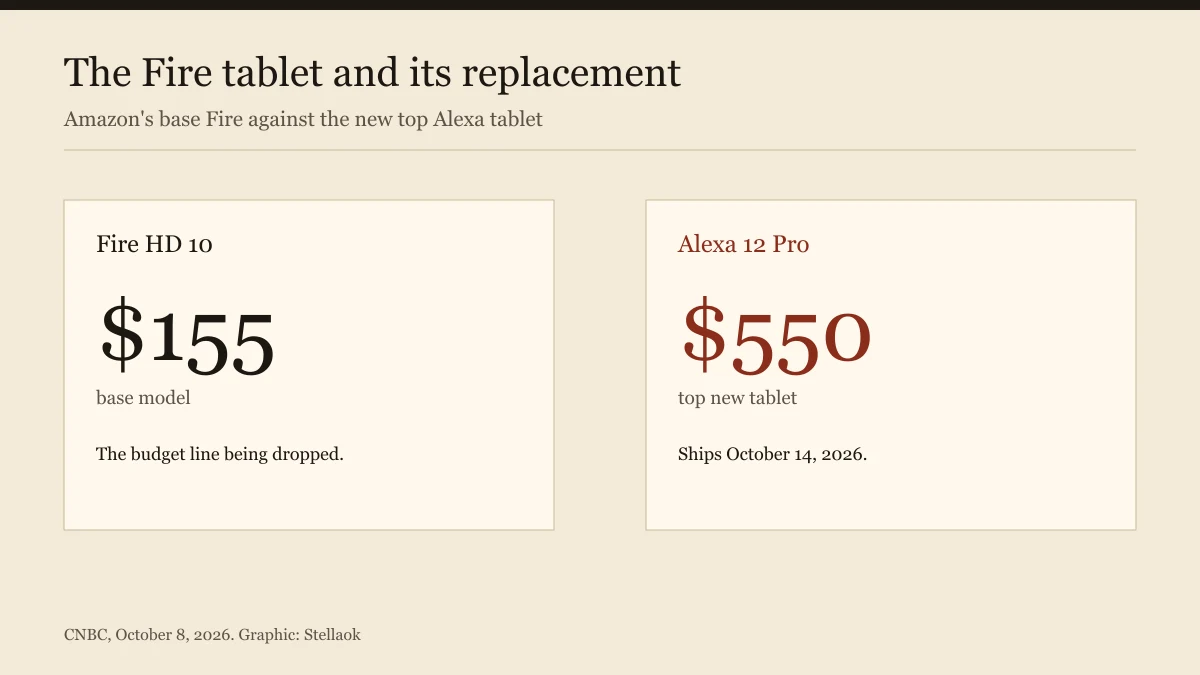
Amazon is ending the budget Fire tablet and replacing it with a pricier Alexa line. On Thursday, October 8, 2026, it showed 8-inch, 11-inch, and 12-inch models that start at $230 and run to $550. Preorders opened the same day. Shipping starts October 14, 2026. The $550 Alexa Tablet 12 Pro costs more than double the $155 Fire HD 10, which CNBC calls Amazon's base model. An iPad, for comparison in the same piece, runs from $449 to $1,199.
Jassy has been raising device prices since the Echo
Amazon used to sell devices at or near what they cost to build, both to undercut rivals and to pull people into movies, audiobooks, and the store, where the margin is better. An $80 Echo was the example CNBC uses. Andy Jassy, who took over from Jeff Bezos in 2021, has been pushing the devices unit to make more money. Last year Amazon raised Echo prices and began charging non-Prime members for Alexa+, the upgraded assistant. In August it raised prices on Echos, Kindles, Fire TVs, and other hardware and blamed memory costs. Apple raised MacBook and iPad prices earlier this year. Nintendo raised the Switch 2.
Panay says memory did not set the price
CNBC's interview with devices chief Panos Panay records a denial: memory prices did not drive the decision to charge more for the Alexa tablet. Panay still called the shortage "quite tricky" for a premium tablet at a reasonable price without trade-offs. He said the team kept the craftsmanship and the price. The company says speed, AI features, and the design justify the tag and put the tablets with "the best tablets on the market." The Surface Laptop Ultra that went on sale this week starts at $2,599. Amazon's ceiling is $550. The change is which cheap tablet disappears.
The new tablets run Android, not Fire OS
Every model in the new line uses Google's Android. Older Fires used Fire OS, a custom Android, and Amazon's own app store, which limited what you could install. This is also the first time Amazon has put the Alexa name on a set of devices. Alexa launched in 2014 on the Echo. On these tablets it sits in a "dynamic tab" on the home screen that recommends things and resumes a book or a show. You can say "Alexa" or tap "Ask Alexa." A feature called On-Screen Intelligence lets Alexa look at what is on the screen and suggest or act. The 12 Pro adds a "Nanomatte" layer developed with Corning to cut glare, plus an aluminum back, a higher-resolution display, and faster processors. Micron's last quarter is what the memory in these boards has been earning.
The $155 Fire HD 10 is the number Amazon is walking away from. The $230 floor and the $550 ceiling are the new range. October 14 is when the first ones ship. Panay's denial is on the record next to his admission that memory made the build tricky.