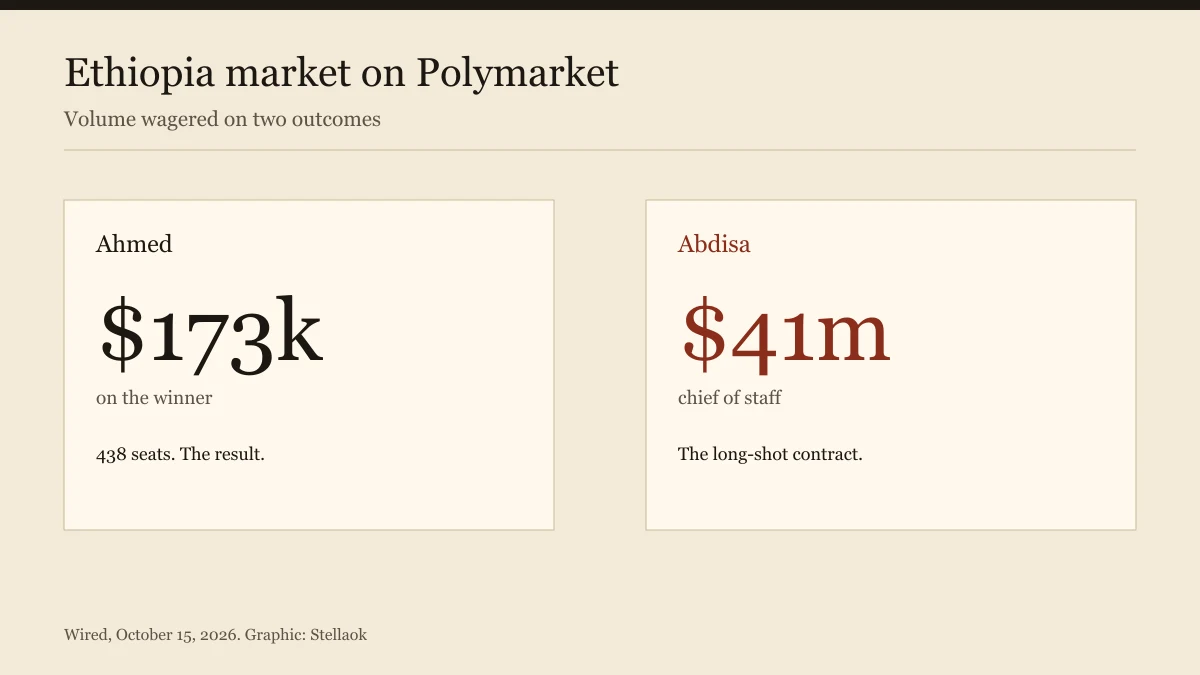
More than $600 million traded on two Polymarket election markets on the company's offshore platform, Wired reported Thursday, and most of that volume was in contracts on long-shot candidates who did not win. In a normal book, volume follows the likely outcome. These two did not.
Wired's investigation walks through Ethiopia's federal election this summer. Prime Minister Abiy Ahmed's Prosperity Party won 438 parliamentary seats. The closest competitor won 13. On the market, $173,000 was wagered on Ahmed winning. More than $41 million traded on his chief of staff, Shimelis Abdisa, becoming the next leader. The Ethiopia market's volume was over $285 million, nearly all of it on losing candidates. Former Polymarket trader Chris Park, who now runs MSR Decode, said about $284 million of that came from pairs of accounts repeatedly buying and selling with each other.
Rajiv Sethi calls it a zombie market
Rajiv Sethi, a Barnard College economist who studies prediction markets, called the back-and-forth "obviously some form of volume manipulation." He also uses the phrase "zombie market" for contracts that keep trading after the event has happened. Polymarket's rules said the Ethiopia market would resolve in October, after the prime minister was appointed and sworn in. It stayed open for 123 days after the election, while Ahmed's win was already plain, and the odd bursts of trading continued. Users left comments asking why it was not resolved.
The loops lasted a median of nine seconds
MSR Decode told Wired the Ethiopia pattern looks like activity farming: traders inflating volume because they thought a Polymarket token might reward it. In 2025, chief marketing officer Matthew Modabber told a crypto podcast there "would be a token," without details. Sethi said a token allocation to high-volume accounts is a plausible motive. Andre Guettler, who directs Ulm University's Institute of Strategic Management and Finance, called the trades textbook airdrop farming. MSR Decode looked at more than 38,000 trade loops after the Ethiopian election, cases where wallets bought and sold with each other in quick succession. Over 98 percent made no money for either side. The median hold was nine seconds. The firm said the volume did not look like algorithms harvesting a real edge. Earlier this year Barron's reported that markets on the 2028 U.S. presidential election drew heavy trading on Elon Musk and New York mayor Zohran Mamdani, neither of whom can run because they were born outside the country.
Shana Bautista, Polymarket's head of global intelligence and investigations, told Wired the team "immediately flagged this activity, investigated, and blocked the accounts from trading." The company did not answer follow-up questions about how the accounts traded that much before the block. Crypto volatility stayed high after the Fed move. This volume is election contracts, not a token price.
A canceled Romanian vote kept an old market open
A 2024 Romanian election market did something Sethi called even more dramatic. The initial election was called off over fears of foreign interference. A new race was held months later. Polymarket left the original market running next to the new one. An algorithm Sethi and colleagues built to flag wash trading marked nearly all of the volume on the older market as suspicious. "99.6 percent of volume in this market for certain weeks has been wash trading," he said. Wash trading is accounts buying and selling to imitate activity. It is banned on regulated U.S. exchanges and prohibited in Polymarket's terms. An earlier study by Sethi and colleagues found widespread wash trading on the offshore platform. Because trader identities are unknown, he also said that what looks like wash trading is not always wash trading. MSR Decode's Ethiopia analysis is the paired-account figure above. Grindr's $250 million price was $190 million in cash. Polymarket's figure is trading volume, not a purchase price. DeepSeek is weighing a funding round of up to $15 billion. The election contracts were already open while that kind of round is still a report.