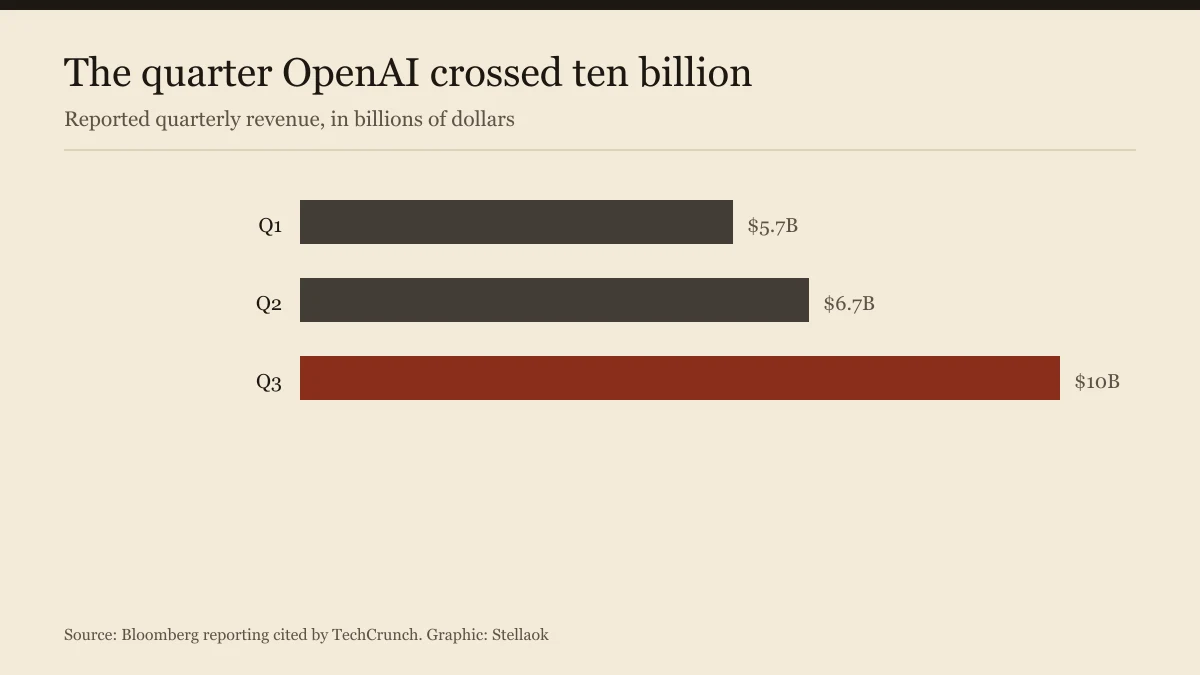
OpenAI's quarterly revenue crossed $10 billion for the first time, Bloomberg reported on Tuesday, citing anonymous sources. The figure represents roughly a 49% jump from the $6.7 billion the company recorded in the second quarter, a sharp acceleration from the 18% growth it posted between the first and second quarters of the year. At that pace the company has reached an annual revenue run rate of $50 billion, and its adjusted operating margin improved from negative 150% in the second quarter to negative 109% in the third.
The acceleration ends a stretch where OpenAI's growth looked healthy but insufficient. Eighteen percent quarterly growth on top of $5.7 billion is a number most software companies would celebrate, but Anthropic was compounding faster and taking the enterprise market that generates the biggest contract values. Bloomberg's sources attribute the rebound to demand for OpenAI's recent models, tighter pricing, discounts, and a heavier push into enterprise products and agents, the exact categories where the company had been losing ground.
The comparison with Anthropic needs an asterisk
The two leaders' headline numbers are not directly comparable, and the gap between them looks different depending on how you count. Anthropic reported Q3 revenue of $17 billion and told investors this week that its annual run rate rose $10 billion within a month to $81 billion as of the end of October, ahead of an IPO that could value it near $1.4 trillion. Against OpenAI's $50 billion run rate, that is a $31 billion gap. But Anthropic counts sales made by its cloud partners in its figures, while OpenAI reports only its share of some partner-mediated sales, so the reported distance overstates the real one, possibly by a wide margin. Bloomberg flagged the accounting difference explicitly, which is more than most investor decks do.
The other asterisk is composition. OpenAI claims more than a billion users, a consumer base almost entirely absent from Anthropic's model, and it is reasonable to assume most of those users are free or on the cheapest subscription tiers. Anthropic's revenue is weighted toward enterprise contracts, which are larger, stickier, and priced at the levels that make a $1.4 trillion valuation conversation possible.
Growth still has to outrun the burn
A negative 109% operating margin means OpenAI still loses more than a dollar on operations for every dollar of revenue, even after the improvement, and that improvement came from a quarter where revenue grew 49%. Scaling further requires the improvements to hold while costs keep climbing, since frontier model training and inference do not get cheaper when demand rises. The competitive set also refuses to shrink: Meta, Amazon, Microsoft, and Google all field capable models, and cheap open-source releases from Chinese labs keep resetting the price floor.
For the market watching these two companies, the sequencing now matters more than any single quarter. Anthropic's IPO arrives with a valuation that assumes enterprise dominance continues, and child safety litigation has already become a line item in AI IPO filings, a risk category that grows with user numbers. OpenAI's report, meanwhile, is sourced to anonymous leakers rather than audited statements, which means its confirmation likely comes when the company chooses to disclose. If the $10 billion quarter holds up, the race everyone assumed was Anthropic's to lose suddenly has two credible runners in it again.
Source: TechCrunch