Anthropic released Claude Fable 5.2 and Claude Mythos 5.2 on Monday, its answer to OpenAI's GPT-6 Astra, which arrived in early September. The launch is timed to a company at a sensitive moment: revenue growth slowed in the third quarter according to its S-1 filing, an IPO is planned, and child safety litigation has become one of the risks investors are weighing.
The price cuts, token by token
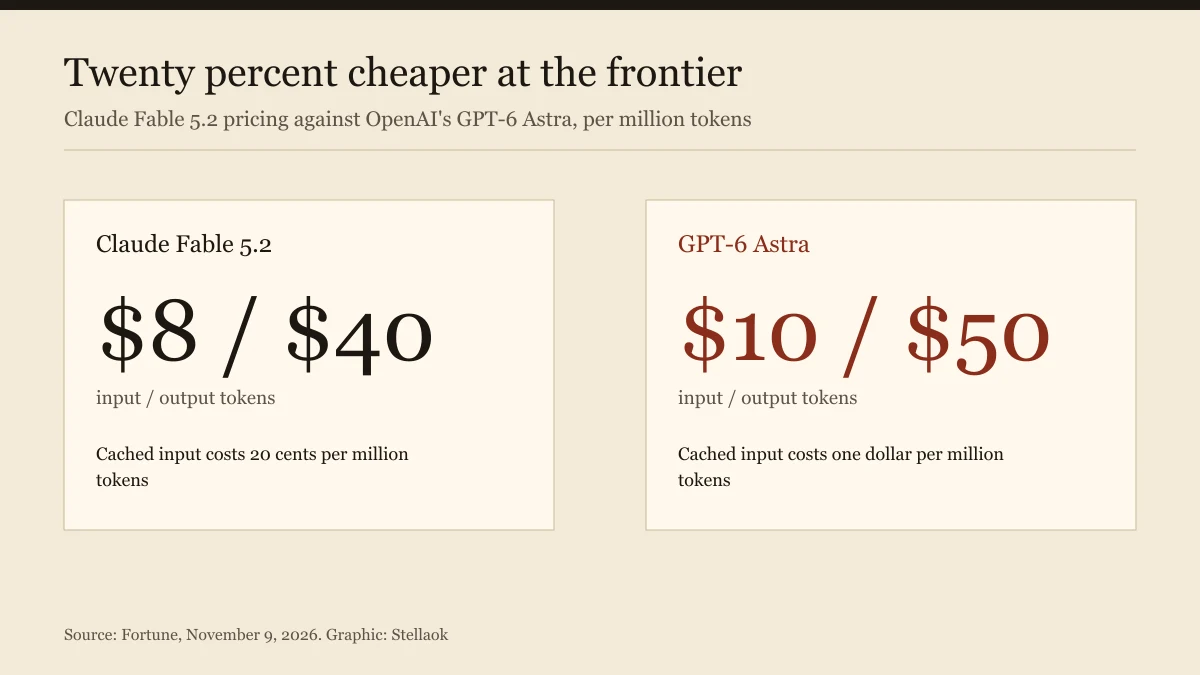
For ordinary input and output, the new models cost $8 per million input tokens and $40 per million output tokens, against $10 and $50 for GPT-6 Astra, a 20% discount. The gap widens on cached prompts: Anthropic charges 20 cents per million cached tokens where OpenAI charges a dollar, an 80% difference that matters most for workloads that repeatedly feed the same documents to a model. A token of English text is roughly a word and a half, so the per-million pricing scales quickly at document scale.
The pricing matters because professionals switch models on cost when performance holds up. Anthropic's Claude Code had an early lead among programmers, but OpenAI's Codex has gained ground in recent months on lower pricing, The Information reported in late October. For daily tasks, Anthropic still points customers to its cheaper Opus 5.5 model, which competes against OpenAI's GPT-6.1 Sol.
What the models are claimed to do
Anthropic's pre-release claims are broad. The company says the models helped its engineers complete otherwise-infeasible software migrations, designed three working electronic devices from scratch with circuit boards, 3D-printed enclosures and software from a one-paragraph prompt, made substantial progress on robotics evaluations, solved two open problems in the physics of black holes, and formalized the proof of Fermat's Last Theorem in 30 hours. That last one came from a team of 1,000 agents running on Fable 5.2, compared with 11 days for a previous unreleased research version of Claude. OpenAI has spent the autumn publicizing model-driven proof work of its own, including a reported run at the Hodge Conjecture, and Anthropic framed its fast formalizations as a service to human mathematicians checking proofs rather than a replacement for them.
On security, Anthropic says an unnamed security company found that one in six confirmed bugs identified by Mythos 5.2 were missed by every other frontier model tested. OpenAI debuted a cybersecurity-focused model, GPT-6 Cyber, late last week. Anthropic says over 90% of its own code is now written by AI, and its researchers have been publishing figures on how much work Claude now leads, though humans still review it.
Availability splits the two models. Fable 5.2 is on all platforms today, including AWS, Google Cloud and Microsoft Azure. Mythos 5.2 is application-only, open to vetted cybersecurity professionals and life sciences researchers, and reachable by Claude Enterprise customers through Anthropic's Claude Security product. Safety safeguards block high-risk cyber activities including exploit generation and most research biology tasks, the company said. Whether the claims hold up in customer hands is the question the next quarter of earnings will answer.