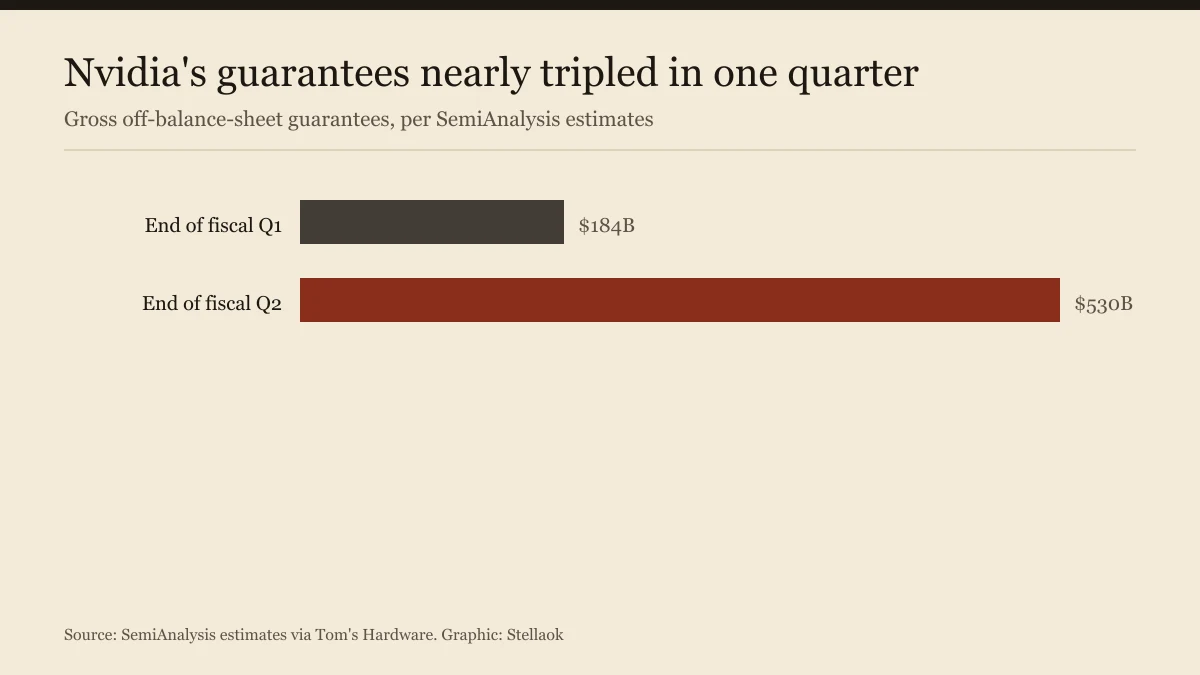
Nvidia ended its fiscal second quarter with $530 billion in gross off-balance-sheet guarantees, up from $184 billion three months earlier, according to SemiAnalysis estimates reported by Tom's Hardware. The same analysis puts equity investments at $99 billion, and supply and capacity commitments up by almost a quarter of a trillion dollars inside one quarter, most of it memory.
The guarantees exist because the customers Nvidia wants cannot always pay for the hardware at scale. Backing their financing lets Nvidia book orders from neoclouds and data center developers that would otherwise fail a credit check, which converts a demand problem into a balance-sheet one. A figure that nearly tripled in 90 days is the clearest available measure of how much of the AI buildout is now running on Nvidia's own credit rather than on its customers'.
The discount that comes with volume
The purchasing side explains why the commitments keep growing. By contracting for memory and wafers years ahead, Nvidia gets better prices than rivals can negotiate. SemiAnalysis estimates SK hynix will charge Nvidia between $3.00 and $3.30 per gigabit of HBM4 in 2027, while first-tier buyers such as AMD, Amazon, Broadcom and Google pay $3.70 to $4.10. At the midpoint, that is roughly a fifth off the memory bill, on a component that makes up a large share of an accelerator's cost.
Jensen Huang negotiated those agreements personally with suppliers in Taiwan and South Korea, which is the part of the strategy that does not transfer to a successor. The analysts also describe an informal arrangement in which Nvidia gives SK Group preferential access to its GPUs, which is the kind of reciprocal deal that works because one person on each side can commit.
The internal objections
Objections were raised inside the company. Then-chief financial officer Colette Kress questioned the criteria used to pick recipients of financial support and the returns those arrangements could produce, and she reportedly halved Nvidia's initial commitment to OpenAI's Ohio data centre project before the two companies signed an agreement on August 17. That facility is expected to house about $300 billion of Nvidia processors, so halving the initial commitment is a decision measured in tens of billions.
Huang, in an August meeting with senior executives, raised his own concern about the volume of wafers and memory Nvidia had committed to buy while major cloud providers were working to reduce their dependence on the company's hardware. He also described Kress, who is now interim chief executive, as a reporting CFO rather than an executive who makes strategic calls, which is a remark that reads differently now that she is the one answering for the strategy. Her interim appointment came out of a search the board ran at speed, and the questions she faces at this week's earnings are the ones the guarantees created.
What unwinds first
The risk in $530 billion of guarantees is not that all of it goes bad. It is that the commitments are long, the customers are concentrated, and the collateral is the same hardware that everyone else is also buying. If a handful of neoclouds miss projections, Nvidia is left holding contracts for memory it must take delivery of and equipment it has already been paid to finance.
The supply side has its own clock. SemiAnalysis expects customers other than Nvidia to account for more than 70 percent of TSMC's production capacity in 2028, which would loosen the allocation advantage Nvidia bought with these deals. Suppliers in Taiwan and South Korea invested on the strength of Huang's assurances, and a company without him may find that the same commitments are read as a forecast rather than a promise, which is why the $26 billion Nvidia is putting into Anthropic's IPO at the offer price looks less like an investment thesis and more like a way of keeping demand inside the tent.