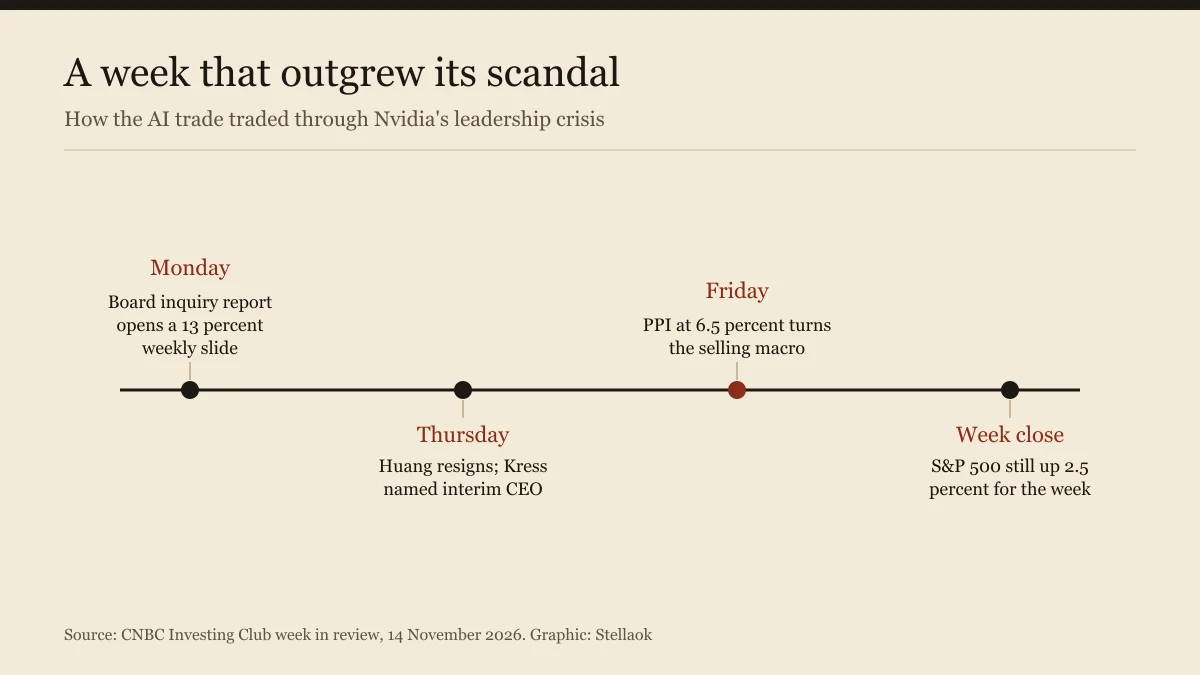
Wall Street closed a strange week on Friday: the S&P 500 gained 2.5 percent and the Nasdaq 2.3 percent, even as Nvidia, the market's most valuable company, fell for a fifth straight session. The divergence tells the story of the past five days, in which a leadership crisis at the AI trade's center was absorbed by the broader market, and then replaced by a macro threat nobody can fire.
Nvidia's shares dropped 2 percent on Friday, bringing the week's loss to nearly 13 percent, a slide that bucked a rebound across semiconductor stocks. The selling began Monday after reports that the board was investigating CEO Jensen Huang's relationship with a woman suspected of spying for China, escalated through allegations of affairs with employees, and culminated in his resignation Thursday. CFO Colette Kress was named interim CEO, a move that reassured some traders; the permanent search was already underway before the exit, and the stock's fall extended a losing streak that had already erased $1.7 trillion of value.
The indexes shrugged it off
The remarkable part is how little damage the scandal did to the wider tape. Both the S&P 500 and the Nasdaq rose enough on Monday and Wednesday that the declines on Tuesday, Thursday and Friday could not erase the week. Both indexes have also made sizeable dents in the losses from the postelection rout on November 5, when Democrats took Congress and investors repriced regulation risk.
Part of that resilience is arithmetic. Nvidia's crisis was seen as company-specific: its chips remain sold out through next year, its customers' buildout plans did not change, and interim leadership is a 13-year veteran of the finance desk. Analysts' notes through the week treated the CEO question as a governance issue rather than a demand issue, which is why chip stocks broadly rallied while the leader fell.
Then Friday changed the subject
The pressure that ended the week had nothing to do with Nvidia. Before Friday's open, the October producer price index posted its highest annual reading in nearly four years. The month-over-month print was cooler than expected, but the 6.5 percent year-over-year increase dominated, coming a day after Tuesday's hot consumer inflation report. Traders rotated from worrying about Nvidia's org chart to worrying about the Federal Reserve raising rates at multiple upcoming meetings, and the market's biggest names sold on that fear instead.
The pivot matters for positioning. A scandal can be resolved by a board, a resignation, or a testimony calendar. Inflation is the Fed's problem, and October's wholesale prices had already set a four-year high before the week began. If the central bank turns restrictive into year-end, the multiple that the entire AI trade trades on compresses, and no interim CEO can stop that.
The week's lesson is that the market can quarantine a governance shock at a single company, however large. What it cannot quarantine is the discount rate. Nvidia's next earnings report, its first without Huang, will answer the company question; the next few Fed meetings will answer the one that now matters more to the tape.