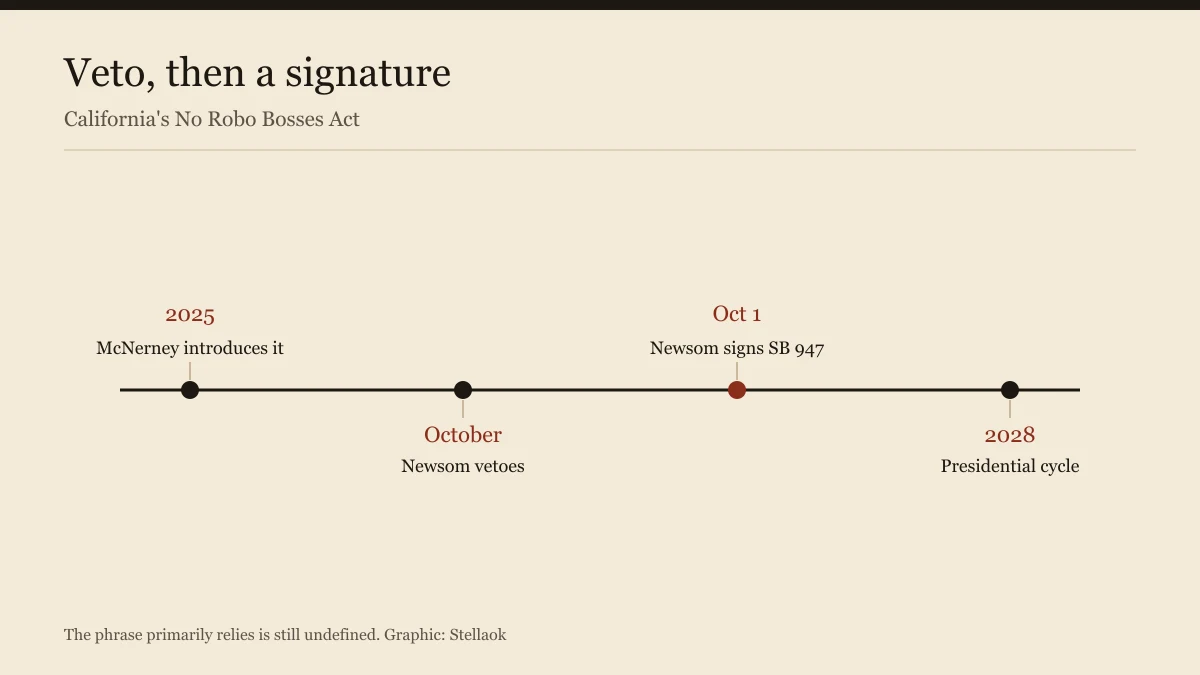
California employers may not discipline or fire a worker on the say-so of software alone. Governor Gavin Newsom signed SB 947, the No Robo Bosses Act, after vetoing an earlier version in October.
CNBC reports the core of the statute. Businesses in the state may not exclusively use "automated decision-making systems" for employee discipline and termination. State Senator Jerry McNerney, a Democrat and the bill's author, told CNBC the systems can raise productivity and have also "made errors and misjudgments and exhibited bias." His principle is one sentence. "AI must remain a tool controlled by humans, not the other way around."
The October veto did not reject the worry
McNerney first introduced the act in 2025, after organized labor pressed the legislature to limit AI when management takes action against workers. The bill cleared both chambers with what CNBC calls overwhelming majority support. Momentum then "hit a wall in October" when Newsom vetoed it.
The veto message kept the concern and refused the text. "I share the author's concern that in certain cases unregulated use of ADS by employers can be harmful to workers," he wrote, and he signaled he could accept a later bill. The version he signed was changed to get that signature. Tech and commerce groups still lobbied against it in the weeks before enactment.
Robert Singleton, senior director at the Chamber of Progress for California and the US West, wrote Newsom earlier this month urging another veto. The duties, he said, generally apply when an employer "primarily relies" on an automated system, "but that critical term is never defined." There is "no objective standard" for when a tool has moved from informing a decision to being the primary basis for it.
Eight points is one poll, asked twice
A July Gallup poll found 39 percent of Americans believe AI does more harm than good. In 2025 the same question drew 31 percent. Those are two readings of one series, a year apart, so the eight-point gap is a change in that poll. It is not a blend of different surveys.
Pew Research, in a study out this past August, found 71 percent think AI will "take people's jobs," an increase of around 7 percent from around two years ago. The word "around" is in CNBC's account of Pew, twice. That move is not an eight-point fact, and it is not Gallup's question. An earlier Pew reading on this site asked people in many countries what they expect, which is a third cut of the same anxiety.
The hiring end of the pipe is already clogged. UK graduate employers received 140 applications per vacancy in 2025. SB 947 does not say who may write those applications. It says who may end the job.
A notice rule in Illinois, and a federal bill that died
Over the past five years some local laws have limited AI in employment decisions. Illinois Public Act 103-0804 requires employers to notify workers when they use AI for a specified set of employment purposes. Senators Ed Markey of Massachusetts and Brian Schatz of Hawaii introduced a federal bill under the same "No Robo Bosses" name. It would bar employers from "relying on automated decision systems to make work-related decisions." CNBC says it landed in a Congress slow to regulate AI and was effectively dead on arrival.
Steve Hilton, the Republican nominee for governor of California, backed SB 947 earlier this month. "In some ways, I don't think SB 947 goes far enough," he wrote. Newsom is weighing a run for president in 2028. CNBC expects AI policy to be a live argument in that Democratic primary.
What a court will have to decide is the phrase Singleton underlined. If "primarily relies" means any score a manager could have ignored, the Chamber's letter was a prediction. If it means a recorded recommendation the manager did not override, the statute is narrower than "robo bosses." California has not issued a rule that chooses. Hilton's support does not define it either. A Republican nominee and a Democratic governor signed onto the same limit, and neither published the missing definition. 2028 is the election Newsom is weighing, not the date the phrase gets a gloss.