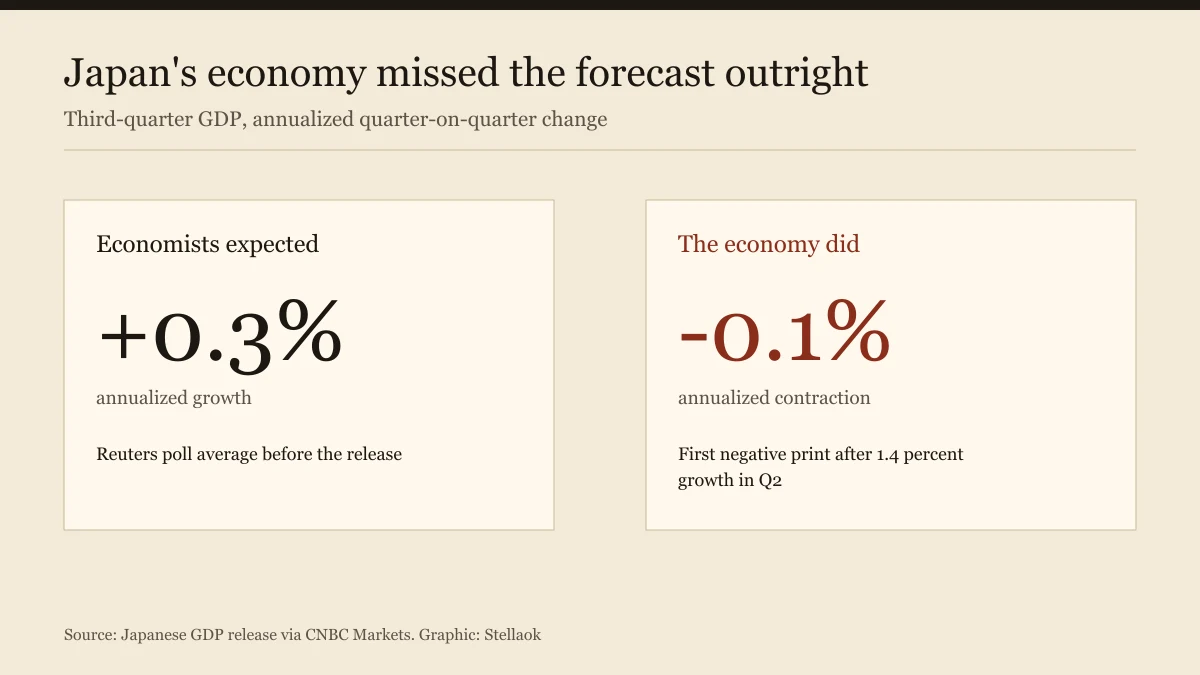
Japan's economy unexpectedly contracted in the third quarter, shrinking at an annualized 0.1 percent compared with the previous quarter, against a Reuters poll of economists that had expected 0.3 percent growth. The reading marks a sharp reversal from the 1.4 percent expansion of the second quarter and lands as a direct consequence of the energy economics of the Iran war: higher import costs cut into both consumption and net exports, subtracting 0.6 percentage points from growth in the quarter, extending the pressure that has shadowed Japan's rate normalization all year.
Where the weakness came from
The composition matters as much as the headline. Japanese exports beat expectations in two of the quarter's three months, yet net exports still dragged on growth because the cost of energy imports rose faster than the value of what the country shipped out. On the domestic side, energy subsidies for households expired in September, exposing consumers directly to elevated prices just as the quarter closed. The result showed up in demand: real final sales of domestic product fell 2.1 percent annualized, which economist Krishna Bhimavarapu of State Street Investment Management called the largest decline outside the pandemic and the first quarter of 2022.
Bhimavarapu's verdict on the policy implication was blunt: "Today's GDP data is hardly a green light for the BOJ to hike in December." That is the complication the print creates. Markets still assign a 75.6 percent chance to a 25-basis-point increase at the Bank of Japan's December meeting, according to LSEG, a probability built on the wage and price momentum the central bank has been chasing since it lifted rates to a three-decade high earlier in its normalization cycle.
The dilemma for the Bank of Japan
The central bank's position is now awkward in both directions. Hiking into a contracting economy risks confirming that the consumption side cannot carry the burden that import inflation has placed on it, and the third quarter is direct evidence of exactly that fragility. Waiting, meanwhile, leaves the yen exposed and lets imported energy costs keep feeding the domestic price level, the very dynamic a hike is meant to contain. The GDP data do not settle the argument; they sharpen it.
What the quarter establishes is that Japan's inflation problem is substantially imported, which means the standard domestic remedy, stronger consumption, is being eroded by the same force that argues for tightening. The December meeting will have to reconcile a 75.6 percent market expectation with a quarter in which final domestic demand shrank at the worst rate in years, in an economy that has already tested how far rates can rise without breaking growth. Economists will get a cleaner read on consumption when October household data arrive, but for now the growth engine the Bank of Japan assumed is running has stalled at the worst possible moment, with the subfields of the print pointing the same direction: weaker spending at home, costlier fuel coming in, and an export machine whose gains the import bill has swallowed whole.