For years, grid managers in Europe, Australia, the United States and Malaysia logged the same odd signal: once every 60 seconds, system frequency dropped slightly, and the dips lined up across countries and continents to the second. Dirk Witthaut, a researcher at Forschungszentrum Jülich in Germany, traced the cause to the batteries that back up data centres and buildings, which check their state of charge on the minute and share near-identical clocks because they are internet-connected.
Tennet Germany, the country's largest transmission system operator, brought the puzzle to Witthaut. His team's conclusion was published after several years of measurement and modelling, TechCrunch reported, and the fix it recommends is a software change: randomise the schedule instead of checking charge on a round minute.
The signal matters because frequency is the grid's shared clock. Operators hold it inside a narrow band, and oscillations that grow too large, or that arrive without a known cause, can push a system toward a blackout. Even when nothing trips, unchecked swings wear on plant equipment, particularly hydropower turbines.
The obvious suspect did not fit
Hydropower has historically driven ultra-low frequency oscillations. Every turbine vibrates, and when those vibrations land on a resonant frequency they can amplify, the way a note shatters a glass. Witthaut's group built a computer model of a hydropower plant control system on the Scandinavian grid and did find conditions that produced a resonance peaking once a minute.
What the model could not explain was persistence. Resonances in mechanical systems come and go, and the grid signal should fade with them. This dip arrived every minute without fail, for years. A pattern that regular needs a clock, the team reasoned.
So they looked for one close to home. The researchers installed more than 80 power quality meters around the Jülich campus, which runs medium and low voltage distribution lines, transformers, solar panels, battery storage acting as uninterruptible power supplies, and a high performance computer alongside ordinary office machines on much smaller UPS units. The meters sampled frequency, voltage, current and power every three seconds. The transformer attached to the battery storage peaked once a minute, matching the big grids.
Ireland supplied the proof
The mechanism is mundane once you see it. Stationary batteries, from data centre UPS racks to grid-scale storage, poll their state of charge every minute, and because the devices are online their clocks drift into near perfect agreement. One battery checking its charge is invisible on a national grid. Millions of them doing it on the same second is not.
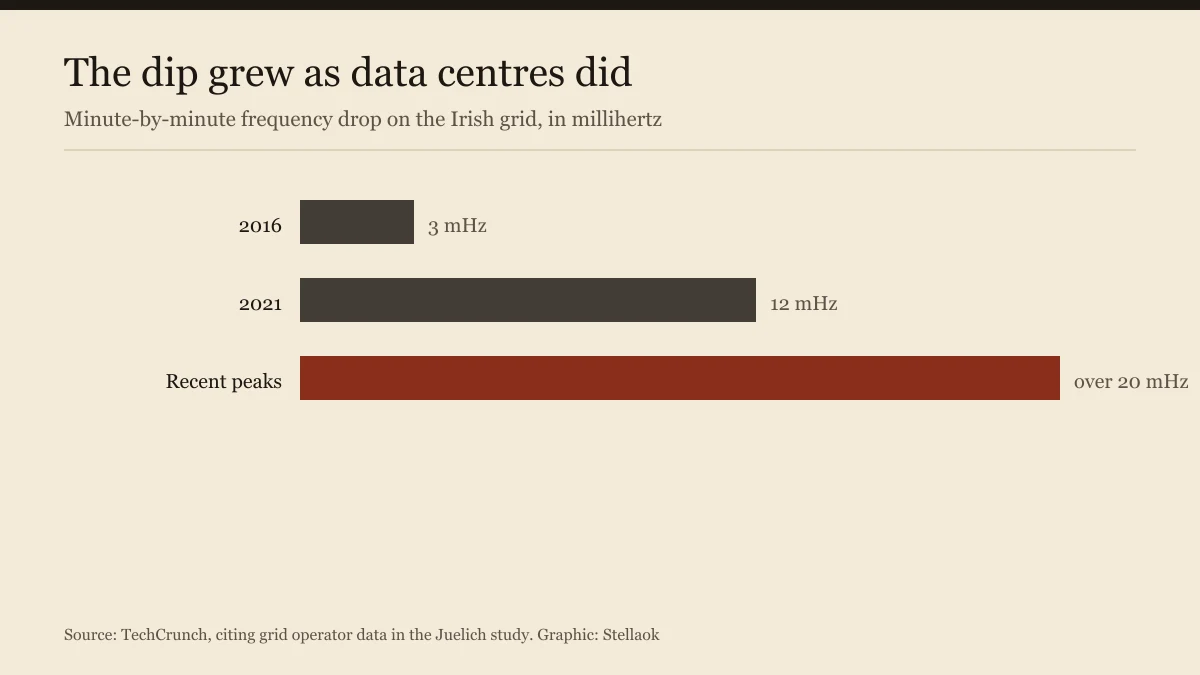
Ireland made the case. Data centres had grown to 18 percent of the country's electricity load by 2022, each served by a fleet of UPS units. Between 2016 and 2021 the minute-by-minute frequency drop on the Irish grid quadrupled, from 3 millihertz to 12 millihertz, and some recent dips have passed 20 millihertz. The 50-hertz system is built for swings of plus or minus 200 millihertz, and the operator would prefer to keep them inside 100. Twenty is small on its own, but data centres are not the only load pulling on the same grid.
That is the part that ties the story to the buildout. Data centre demand has been colliding with local resistance and with connection queues, which have pushed gigawatts of capacity back by years, and every new facility adds another fleet of batteries on the same minute. The researchers also tested ordinary connected devices, including a smart oven and Raspberry Pi clusters, and found periodic fluctuations there too. The same patch would fix them, but many devices never receive updates: one recent study found fewer than 3 percent of IoT devices run the latest firmware.
A patch that needs a global agreement
Witthaut's recommendation is that UPS and battery manufacturers add randomness to the charge check, which removes the synchronisation without changing how the hardware works. Regulators can require that inside their own markets, but a grid operator can only control what connects to its network. Because the pattern crosses borders, the fix ultimately depends on coordination between manufacturers and regulators in many countries at once.
There is a second lesson in the finding, and it is about how little the industry knows about its own load. A grid is now partly a network of devices that were never designed to act in unison but do, because they share a time source. Researchers looking at where AI load actually stresses a grid have made a similar point from the other direction: the risk sits in control decisions as much as in raw megawatts. The signal was there for years in operator data. Nobody could name it until someone installed 80 meters and watched a transformer.