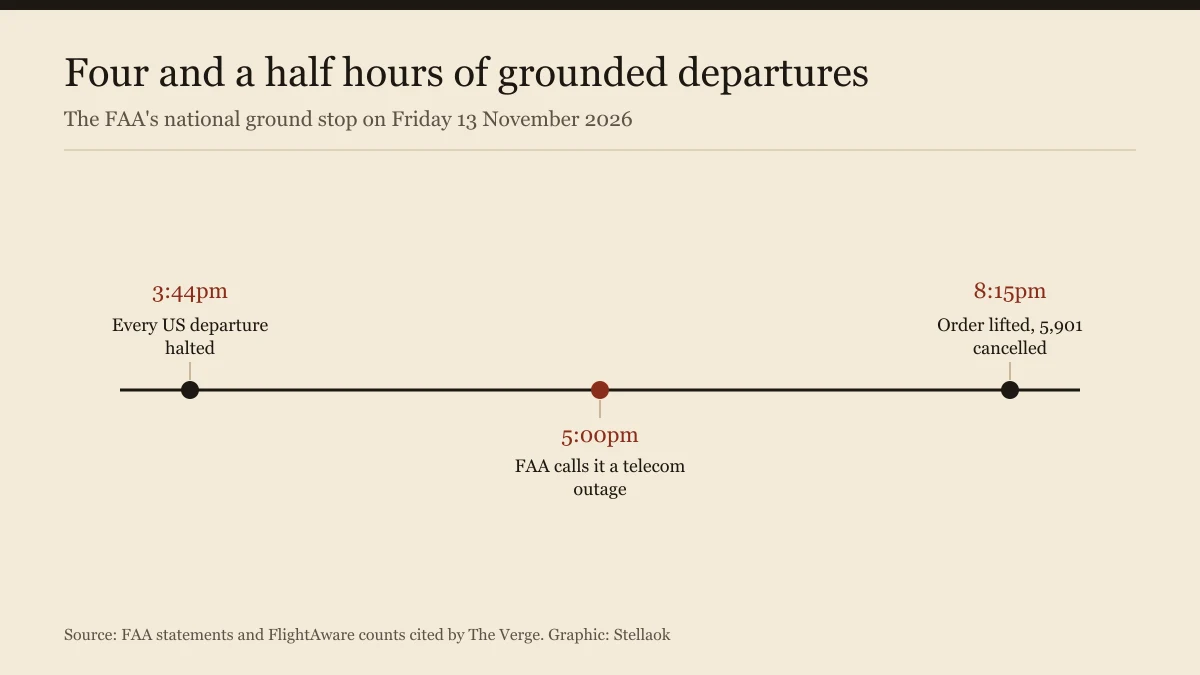
The Federal Aviation Administration stopped every departing flight in the United States at 3:44 pm ET on Friday and lifted the order at 8:15 pm, four and a half hours later. Planes already in the air were allowed to land. It was the third nationwide ground stop on record, after September 11, 2001 and a January 2023 halt that lasted about 90 minutes.
The cause, as described by Transportation Secretary Sean Duffy at a White House briefing that evening, was a communications failure across the air route traffic control centers that guide aircraft around the country. "We had inconsistency in the data from the radars and the communications from airplanes," he said. The devices involved were analog telecom switches and routers that "got overloaded with data."
The failure ran through a private phone network
The FAA's communications backbone is the FAA Telecommunications Infrastructure network, known as FTI, and L3Harris Technologies operates it. Wired reported that a failure in FTI was linked to the decision to declare the stop. CBS News, cited by The Verge, reported that an update to that private network triggered a system reboot. L3Harris did not respond to requests for comment from either outlet.
Jon Ostrower of The Air Current traced the sequence: the trouble started at the Chicago control center, then appeared in Boston, Washington, New York and Minneapolis, and as the FAA stopped eastbound departures more facilities reported problems. Radar and radio frequencies both degraded, which is why the response was national rather than regional.
Homeland Security Secretary Markwayne Mullin said the trigger was "putting patches into the system" while new equipment was being installed. "The new technology was overwhelming the older system." He said there was no indication of a cyberattack, then added that "there's not complete certainty right now."
FTI is midway through a multiyear rebuild that replaces copper with fiber. L3Harris said in May it had completed half the work, and this month that 70 percent of FAA sites were on fiber. In August the FAA chose AT&T for a replacement network under a $73 million contract expected to grow into the billions over its life; Verizon had held the earlier award.
Mullin was asked whether the outage related to SMART, a cloud-based system for managing airspace routes that went live nationwide on November 10. He said the agency was looking into it. Air Space Intelligence, which built SMART under a 12-year, $875 million contract awarded in June, denied any connection.
Nine thousand delays, and a duty-time problem
FlightAware listed 9,124 US flights delayed and 5,901 canceled as of 8:39 pm ET, after the order was lifted. Wired counted more than 6,300 cancellations and 9,500 delays at the moment of the lift, with freight and mail flights included. The tallies were taken at different times and neither is final.
Recovery is the harder half. Crews that sat for five hours ran into duty limits, and aircraft finished the day at airports they had not planned to reach. Airlines need days, possibly weeks, to reposition planes and staff before schedules settle. Duffy put it plainly: "It will take us some time to unwind what has happened."
Duffy asked for $50 billion the same evening
Hours before the stop, Duffy sent congressional leaders a letter requesting $30.1 billion to modernize air traffic control and airports. At the evening briefing he raised the number. "I want $50 billion," he said.
The case for money is easy to make. The case for the agency's ability to spend it well is not. A Government Accountability Office report in September warned that the accelerated program "could be prioritizing speed over costs and air traffic disruption," found no well-documented lifecycle cost estimate, and counted 11,389 separate schedules that are not integrated into a master plan.
Scale helps explain why a single network fault went national. The 2023 stop followed a failure of the system that delivers alerts to pilots and grounded traffic for roughly 90 minutes. Friday's ran past four hours, and unlike 2023 it arrived with no confirmed explanation.
The timing drew attention because it landed two days after Nvidia announced Jensen Huang's resignation, following a board inquiry into his link to a suspected foreign intelligence figure, and a day after Microsoft's mail and collaboration services went dark for hours. Mullin said there was no reason to connect the two outages.
The next data point is the modernization itself. The administration wants the work finished by the end of 2028, and the GAO's finding on 11,389 unintegrated schedules is the part worth tracking. If the FAA cannot say which upgrade lands in which quarter, the same old switches stay in the path of the next overload.
Source: The Verge, Wired, TechCrunch