ElevenLabs has an inbound sales development agent that handled more than 3,000 customer leads this year and qualified over 90 percent of them in 32 languages without a person on the call. Field chief technology officer Alex Holt described the deployment to Fortune along with the rest of the company's agent stack, which includes a role-play coach for new sales staff, a recruiter that runs first-round interviews, and agents inside Slack that answer questions about internal process.
Holt joined as an engineer in September 2023 after five years at Palantir and became field CTO in June 2026. Three months after that promotion, the company said its valuation had doubled to $22 billion. Chief executive Mati Staniszewski has said an initial public offering in 2028 is a possibility, which gives the agent programme a deadline: every internal efficiency claim eventually has to show up in a number investors can check.
Three thousand leads and no human on the first call
The sales agent is the clearest example because the output is countable. It uses voice to work out whether a prospective buyer is serious, then hands the qualified ones to a person. Almost all candidates who apply to work at the company are screened first by an AI recruiter, which Holt says returns about 30 minutes per hire to the human recruiter at the end of the process, when persuasion matters more than filtering.
One customer recently completed an entire purchase through two agents, with the inbound request handled by the SDR agent and the contracts and legal documents handled by an account executive agent. That is the case Holt finds most interesting, because the chain ran end to end without a handoff to a person.
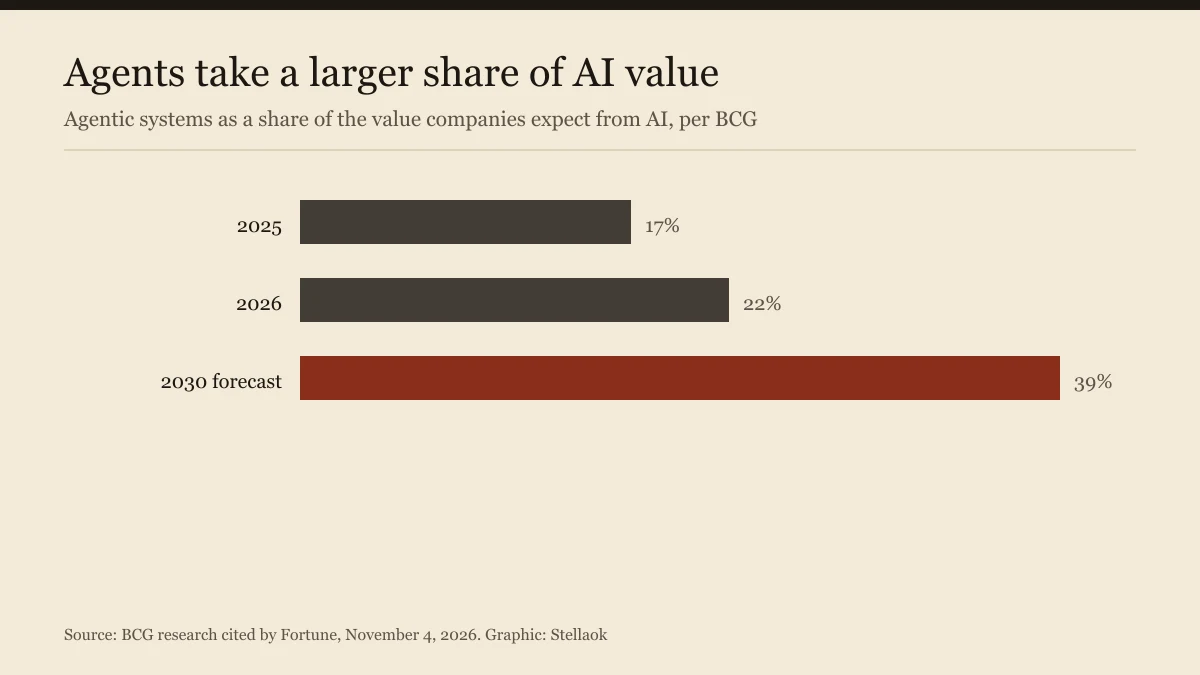
The economics of agentic AI are being repriced across the industry on exactly this basis. BCG puts agentic systems at 22 percent of AI value this year, up from 17 percent in 2025, and projects 39 percent by 2030. If that forecast holds, the share roughly doubles again in four years, and the companies already running production agents have a head start that is about process rather than models.
An engineer on every team of nine
The organisational choice matters more than the tools. ElevenLabs puts an engineer inside every team across the business, and keeps every group under ten people. In recruiting, two forward-deployed engineers sit in a pod with HR colleagues whose only objective is shortening the time from application to decision.
This is a structure that trades scale for speed. Small teams with an engineer embedded can rebuild a workflow in a week; large teams with a central platform group wait a quarter for a ticket. The cost is that engineering headcount is spread thin and the company has to hire people who can work on sales operations without losing interest.
Holt is careful to say the business metrics have not changed. Sales is still measured on revenue, support on satisfaction scores, and the agents are a tool the business units drive rather than a programme run out of IT. That discipline is the difference between an agent that removes work and an agent that generates a new reporting burden, and it is the part most enterprise deployments get wrong.
The labour market has already adjusted to this shape. Software job ads are up 15 percent since Claude Code shipped, which is what you would expect if agents substitute for routine work and increase demand for the people who wire them up. The same substitution shows in volume: agents used 7.3 trillion tokens against 1.4 trillion for humans in the period one measurement covered.
The refund that got through
The failures are more instructive than the successes. A customer service agent once issued a small refund under $30 and did not escalate the case to a person. ElevenLabs rebuilt the call as a test, traced the reasoning that led the agent astray, and changed the prompts and guardrails.
Holt's argument is that this is a gain rather than a loss, because a human who issued the same $30 refund without escalating would probably never have been noticed. Every agent decision is logged, which makes the error visible and repeatable as a test case. That is true, and it is also an argument for logging everything a person does too, which is a larger change to how companies supervise work.
The governance answer so far is a human-led monitoring layer over the agents. It is a reasonable description of where the industry is: agents do the work, people watch the queue, and the queue is only as good as the cases someone thought to write.
ElevenLabs is now pushing into multi-agent systems where one agent passes work to another with shared context, which is where the refund problem gets harder. A single agent that errs is a bug. Two agents that err in sequence produce a transaction nobody approved, and the audit trail has to be good enough to reconstruct which one decided what. That is the technical problem behind the 39 percent forecast, and it is the one that will decide whether the 2028 listing conversation is about growth or about risk.