U.S. software-development job postings have risen nearly 15 percent since February 2025, the month Anthropic launched Claude Code, even as postings across the whole labor market fell. Indeed Hiring Lab is the source of that count, in a CNBC story published October 11, 2026. The same series still sits about 27.5 percent under its pre-pandemic level. The rebound came after a steep drop from a 2022 hiring peak, when technology firms pulled back from a pandemic surge.
CNBC's account sets the ads next to what the code itself is doing.
One in three pull requests now includes an agent
As far back as 2023, GitHub said that on projects where its AI was available, the tool was close to writing half the code. Some outside experts now say AI-written code across all of GitHub has passed halfway. GitHub has not signed that claim. In October it did say that one in three pull requests involves an AI agent. A year earlier the share was fewer than one in ten. If that pace holds, GitHub wrote, within two years most code pushed to the site could be written by an agent, and much of it may never be fully read by a person. UK graduate employers got 140 applications per vacancy. The software ads are a count of openings, not of people chasing them.
Senior roles were 71 percent of the increase
Indeed found that senior roles accounted for 71 percent of the rise in software-development postings between May 2025 and May 2026. Job titles that mention AI accounted for 37 percent of that same increase. Sneha Puri, an economist at Indeed Hiring Lab, said firms still want people who can oversee generated code, refine a product, and connect a tool to the rest of a company's systems. Eric Kutcher, North America chair at McKinsey, told CNBC's Squawk on the Street that companies are producing more code than ever, and that developers who work with AI are in demand in the places where the biggest displacement had been expected. A McKinsey Global Institute note says the earlier drop in the field was also the comedown from that 2022 peak, not a pure AI story.
Ages 22 to 25 fell harder than the ads
Stanford's 2026 AI Index found that employment in AI-exposed fields for people aged 22 to 25 has fallen 16 percent since generative AI spread. Early-career software developers fell 20 percent, while older developer roles expanded. Puri said students should learn the tools and also keep communication, interpersonal skill, and leadership, because those still sit in the middle of the work. She also said today's entry-level hires are the senior experts of ten years from now, and that a firm which skips the pipeline will not have them. Claude already leads 26 percent of Anthropic's own research. The coding agent that marks the Indeed window is one of that lab's products.
The bureau still projects 10 percent growth
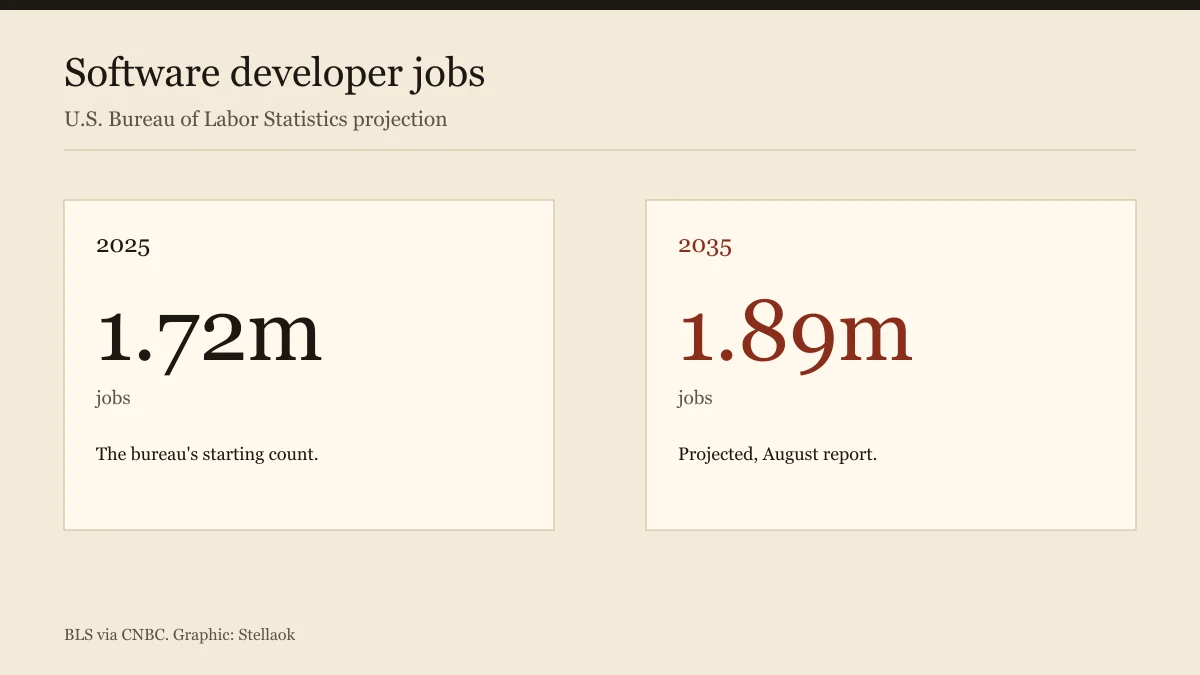
An August report from the U.S. Bureau of Labor Statistics projects software-developer employment will grow 10 percent from 2025 to 2035, from about 1.72 million jobs to 1.89 million, about 174,700 positions added. Economist Steve Rattner, looking at bureau data from May 2023 to May 2025, found software developer among the categories with positive growth, in line with all occupations and well below the pace of the blue-collar jobs tied to building data centers. Anthropic's own researchers said humans are still needed to watch the automation and to supply input, and they added that it is by no means certain the pattern lasts. GitHub's pull-request note says that as more code arrives, so do more risks, and that if the human effort on the remaining bugs does not fall, the volume of vulnerabilities becomes untenable. Microsoft's Copilot seats are 30 million against 450 million. The seat count and the job-ad count are two different shelves in the same company.