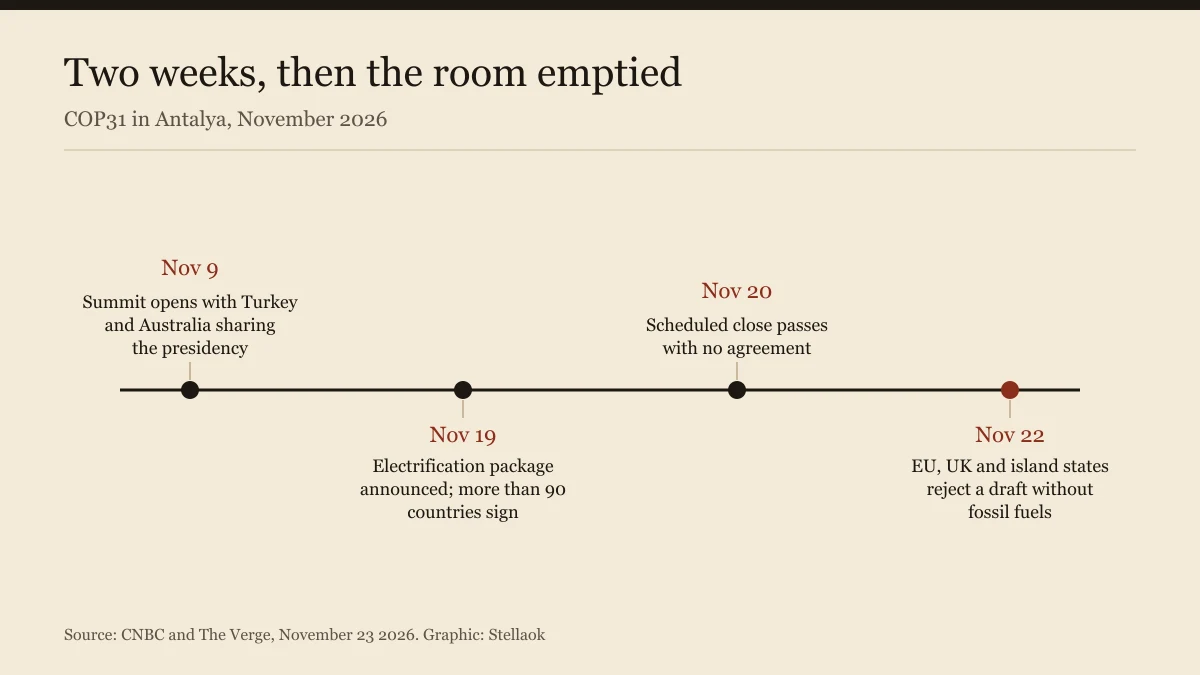
The United Nations climate summit in Antalya, Turkey ended on Sunday without a cover decision, after the European Union, Britain and a bloc of island states rejected a final draft that did not mention fossil fuels. The talks, held jointly by Turkey and Australia, ran two days past schedule and closed with the secretary-general, António Guterres, saying he was "deeply disappointed" that no consensus was reached.
The collapse is the second in three years for a process that works by consensus. Nearly 200 countries spent two weeks arguing over electrification, finance for developing nations and how to respond to warnings that the 1.5 degree target will be overshot. The draft that emerged on Sunday addressed none of the first and little of the second, and its silence on oil, gas and coal is what broke the room.
Who refused to sign
Ireland's climate minister, Darragh O'Brien, speaking for the EU, said the conference had been "hijacked by some oil states" when asked about Saudi Arabia's role. The EU said in a statement that the text "does not respond to the science" and that it would not accept a COP that "greenwashes fossil fuels." Britain said the proposal "moves us backwards on the science." Island nations, which produce less than 1 percent of global emissions, refused as well.
"Three years ago in Dubai, the nations of the world agreed by consensus to transition away from fossil fuels in their energy systems," Philip Davis, the prime minister of the Bahamas, said in a statement. "Antalya exhausted that patience." Mohamed Adow of the think tank Power Shift Africa called it "the worst COP ever," and said rich countries blocked a just transition mechanism. The Stockholm Environment Institute's Albert Salamanca described the outcome as "tantamount to a death sentence for vulnerable communities."
The one number that survived
The summit's central economic goal was to raise electricity's share of global final energy use from roughly 23 percent to 35 percent by 2035, the precondition for replacing petrol and gas with renewables. A package of voluntary commitments announced on Thursday was presented as a first milestone. Australia's climate minister, Chris Bowen, who presided over the negotiations, said more than 90 countries signed; COP31 president Murat Kurum put the figure at around 80, and the list has not been published.
The pledge says nothing about how the electricity gets generated, which is where the arithmetic becomes difficult. About 57 percent of the world's power came from fossil fuels in 2025, according to the think tank Ember. If demand rises and supply grows in the same proportion, electrification increases emissions rather than reducing them.
That tension has a new cause: data centers. The International Energy Agency expects their electricity consumption to double by 2030, and the buildout has become a climate question in its own right. A Sierra Club analysis cited by The Verge projects that power sector emissions in the United States could rise 42 percent by 2030 as utilities add fossil capacity to serve them, and Harvard researchers found that American hyperscale facilities already emit more than Denmark. The same pressure is visible in how a fuel shock moves household budgets and in data center assets changing hands before they are finished.
Delegates tried to address it with a separate pledge calling on data centers to run on less polluting energy. It drew little support, and its wording, "low-emission energy," leaves natural gas inside the definition. The Natural Resources Defense Council said the pledge was a step in the right direction that "needs teeth." Bruce Douglas of the Global Renewables Alliance put the problem in a sentence: rising power demand from data centers is not yet sustainable, and "an AI boom cannot be allowed to become a fossil fuel boom."
What comes next
The failure does not cancel the transition. Roughly half the global economy is accelerating electrification, according to the UN's climate chief, Simon Stiell, and the voluntary pledges made in Antalya will be reported through national plans. The question is whether voluntary is enough when the countries with the largest electricity demand are adding capacity faster than they are decarbonizing it.
The United States was absent from the negotiating rooms, having withdrawn from the Paris agreement under an administration that favors fossil fuels, which removes the largest historical emitter from any deal. Oil producers, meanwhile, have learned that a consensus rule lets a small group block language they dislike, and that a summit without a cover decision costs them nothing.
For investors, the signal is that climate policy is now priced country by country rather than through a global framework. The Antalya Pact contains language on food security that some supply chain groups welcomed, and ocean protection appears in the climate plans of more than 95 percent of island and coastal nations, about 60 percent of which rely on external funding. None of that substitutes for a decision on fossil fuels, which the next summit will have to attempt again.