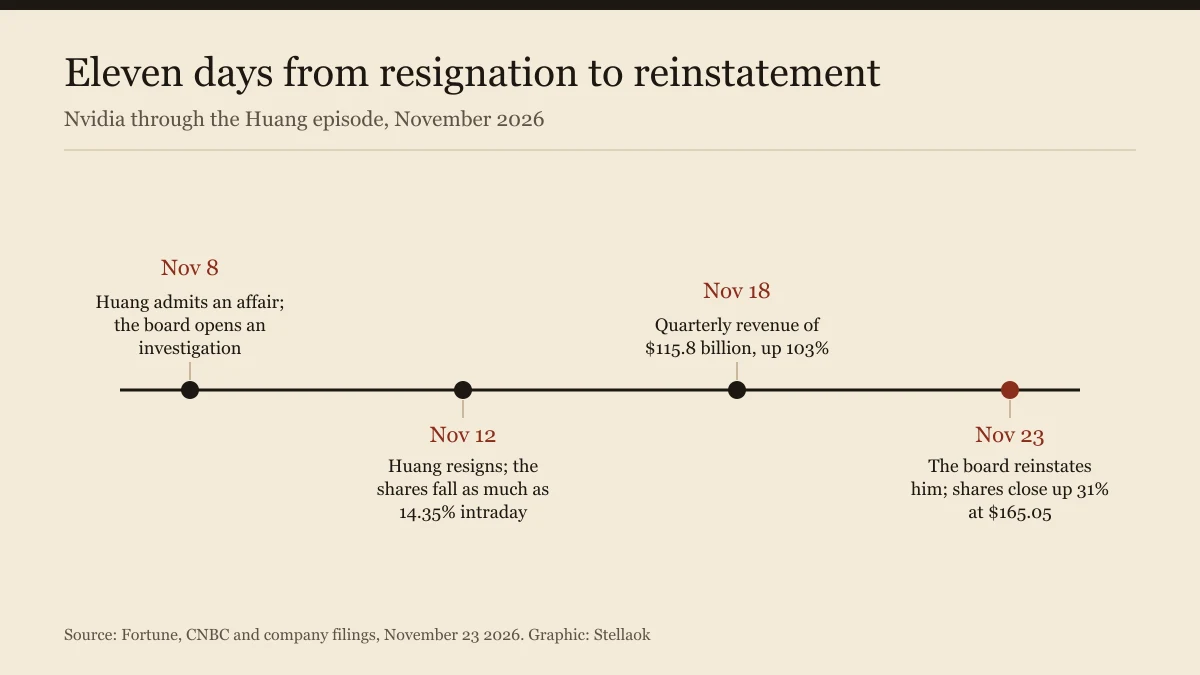
Nvidia's board reinstated Jensen Huang as chief executive on Monday, eleven days after he resigned, and the company's shares closed up 31 percent at $165.05. The unanimous vote came after the board said it had "received input from senior levels of the United States government" and concluded that his return "poses no national security risk." The independent investigation into Huang and the circumstances of his exit will continue, the board said, and Huang has committed to cooperating with it.
The reversal returned roughly half of the market losses from the previous week. The S&P 500 rose 4.7 percent and the Nasdaq 6.5 percent, the best session for both since April 2025, after a week in which the S&P fell 8.6 percent and the Nasdaq 10 percent. Nvidia had lost nearly a third of its value from its November 6 close of $186.64, and the stock's collapse was one of the forces that pushed the board back to the table.
How the eleven days ran
The sequence began on October 29, when the New York Times reported that United States intelligence officials had concluded Alice Huang, an executive at Singapore data center company Megaspeed, was passing information to the Chinese government and had a close relationship with Nvidia's chief executive. On November 8, Huang admitted to an affair and said there was "no excuse" for it; the board announced an investigation the same day and said it had no reason to believe company secrets had been compromised.
On November 10 the independent directors hired Wachtell, Lipton, Rosen & Katz. The next day the Times reported an affair with Kimberly Powell, a Nvidia vice president who reported to Huang, and the Wall Street Journal reported that the board was preparing to remove him. By the morning of November 12 he had resigned, with chief financial officer Colette Kress as interim chief executive and Harvey Jones named the company's first board chair. The shares fell as much as 14.35 percent intraday, erasing about $600 billion in value before closing down 4.34 percent. That exit, and the petition that followed it, ran through a board that had already been reported to be preparing his removal.
The campaign to reverse it started almost immediately. An Nvidia employee launched an open letter demanding reinstatement, which Fortune reported had gathered more than 206,000 names by Monday, including Elon Musk, Travis Kalanick, Tobias Lutke and Tim Sweeney. A separate petition site, Stand With Jensen, claimed more than 10,000 signatures from Nvidia employees; Wired reported that an internal review found dozens of suspicious names on it, out of a workforce of about 49,000 people plus 18,000 contractors.
The pressure from outside
Musk, speaking at the New York Times DealBook summit, compared the board's decision to the Chicago Bulls trading Michael Jordan. Palmer Luckey argued that removing Huang only helped China. Trump said publicly that he would support reinstatement, then told CNBC he had been speaking with the board "directly and indirectly" and had talked to Huang on Sunday, asking him to promise to "work hard." Semafor reported that Trump called into the Sunday board meeting where the decision was made; the White House communications director said the president was "totally involved."
The board had spent the week saying the opposite. After Nvidia reported quarterly revenue of $115.8 billion, up 103 percent, Jones said the board did "not intend to reinstate Jensen as CEO" and that Heidrick & Struggles was running a search. Senior government officials briefed the board late last week that no national security laws had been violated, according to CNBC's sources, which prompted the directors to reach out. Huang and the board held their first conversations on Saturday and settled the question on Sunday.
The legal exposure did not disappear with the vote. The SEC is investigating whether Nvidia's disclosures misled investors, California's attorney general subpoenaed the company, and the independent committee's inquiry continues. Huang is due for a closed-door transcribed interview with the House Foreign Affairs Committee and two others on December 1; Nvidia's general counsel, Tim Teter, appears before the same panels the next day. On December 3 he is the sole witness at a Senate Banking Committee hearing titled "Protecting America's AI Advantage: Oversight of U.S. Export Controls." Senator Elizabeth Warren called the reinstatement "reckless" and said Huang and the board still owe Congress answers about export control compliance.
What the board bought itself
Monday also produced the week's least discussed detail: the Commerce Department added Megaspeed to its blacklist, barring the company from receiving Nvidia chips without a government license. That is the entity at the center of the original report, penalized on the same day its former executive's associate returned to the top of the chip industry.
Employees at Nvidia's Santa Clara headquarters greeted Huang with applause. "Thank you all for a second chance," he told them. "I'm going to be a better CEO the second time around." Wired found a quieter reaction elsewhere in the company, where staff who had seen the resignation as a chance to change a culture of minimal bureaucracy and unquestioned leadership said they were reconsidering how much they were willing to forgive. One noted that Huang had not yet sent a companywide note, because he was still getting his laptop set up.
The governance question is what investors now have to price. A board that voted unanimously to remove a chief executive and then voted unanimously to restore him, citing government input and a share price, has told the market that its judgment follows external pressure. For a company whose valuation rests on the assumption of continuity, the more important number may be the one analysts attached to the episode: the directors demonstrated they will reverse themselves in eleven days, and everyone who trades the stock now knows it.