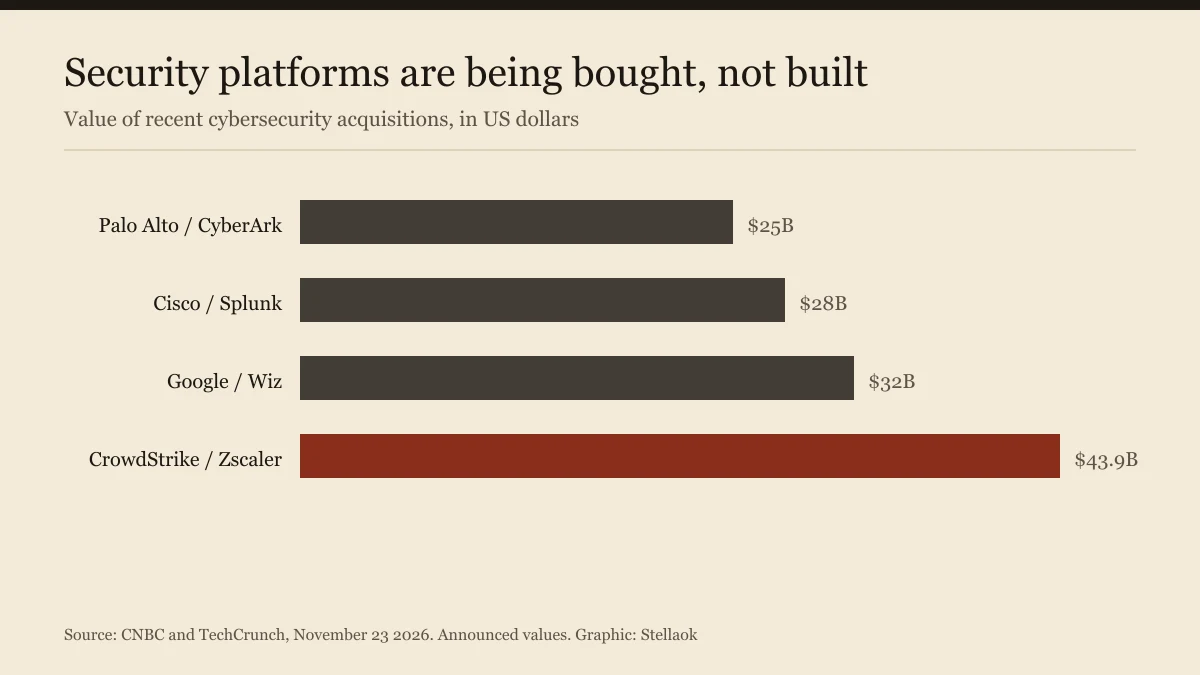
CrowdStrike agreed to buy Zscaler for $43.9 billion in stock, the company said on Monday, uniting an endpoint security vendor with a cloud network security vendor at a moment when investors are paying up for anything that promises to stop AI-assisted attacks. Zscaler shareholders will receive 1.135 CrowdStrike shares for each share they hold. The deal needs regulatory approval and is expected to close in the second half of CrowdStrike's fiscal 2028.
The market's verdict was split. CrowdStrike fell 9 percent and Zscaler rose nearly 18 percent, the usual pattern for an acquirer issuing paper. Together the companies were worth more than $265 billion as of Friday's close, behind Palo Alto Networks at $282 billion, a leader neither could approach alone.
What CrowdStrike is buying
CrowdStrike's Falcon platform protects laptops, phones, servers and cloud workloads. Zscaler protects the connections between them, using a zero-trust model that requires users to authenticate each time they reach an internal system. Buying it moves CrowdStrike into network security, a market it had approached through partnerships rather than products, and adds about 8,000 enterprise customers.
Chief executive George Kurtz told CNBC that only about 2,000 accounts overlap, leaving roughly 8,000 Zscaler customers who do not buy CrowdStrike today. He put the expansion of the addressable market at about $185 billion and described the combination as "cybersecurity's operating system: a single control plane to deploy AI, control AI, and enable any agentic application to run safely."
The two companies have been partners since at least 2019 and expanded that arrangement in August 2025. Kurtz called Zscaler "our No. 1 technology partner," an argument aimed at integration risk. Zscaler's founder and chief executive, Jay Chaudhry, framed the timing around AI attacks: bringing the platforms together, he said, creates the best protection against them, and both companies are "coming from strength."
The price and the quarter behind it
CrowdStrike also reported third-quarter results on Monday, a week earlier than scheduled, with earnings of 34 cents a share on $1.58 billion in revenue against forecasts of 31 cents on $1.53 billion, according to LSEG. Zscaler's fiscal first-quarter results beat estimates as well. The acquisition announcement overshadowed both.
Investors focused on dilution. Paying in stock issues new shares, and the 1.135 ratio transfers a meaningful slice of future CrowdStrike earnings to Zscaler holders. Kurtz argued the deal is accretive to free cash flow per share immediately after closing and grows more so with modest synergies. Analysts at JPMorgan wrote that Zscaler adds breadth in an era of vendor consolidation and, more importantly, network security that positions CrowdStrike for demand around AI sovereignty.
The comparison that matters is Palo Alto Networks, which has spent the past two years assembling a platform through acquisitions, including its $25 billion purchase of CyberArk and its deal for Applied Compute. Scale in security is now bought rather than built, because enterprise buyers have consolidated onto a handful of vendors. Google's $32 billion agreement for Wiz and Cisco's $28 billion purchase of Splunk set the benchmarks; CrowdStrike's offer is the largest of the group.
Why the timing is not accidental
Cybersecurity deal-making has accelerated after a year of high-profile breaches and outages, including incidents at Microsoft, the Federal Aviation Administration and JPMorgan Chase. Companies are patching aging systems faster, and vendors are arguing that only integrated platforms can keep up with attacks that automate reconnaissance and exploitation. The same pitch appears in the agents already running inside corporate networks. CrowdStrike's shares had risen about 96 percent this year entering Monday, while Zscaler was down 13 percent, a gap that made stock the cheapest currency available.
The risk sits in the integration. Both companies sell to the same security buyers with different procurement cycles, and the promised cross-sell assumes customers want one contract rather than best-of-breed tools. Regulators will also look at whether a market that already consolidated around three or four vendors can absorb another merger, particularly one that removes an independent network security supplier.
For CrowdStrike, the arithmetic is straightforward: it trades a ninth of its market value for the layer of the stack it did not own, and bets that AI-driven demand grows faster than the dilution costs. For Zscaler holders, the 18 percent gain is the premium on a business that had underperformed the sector all year. The question neither side answered on Monday is what happens to the 8,000 customers who picked Zscaler precisely because it was independent of their endpoint vendor.