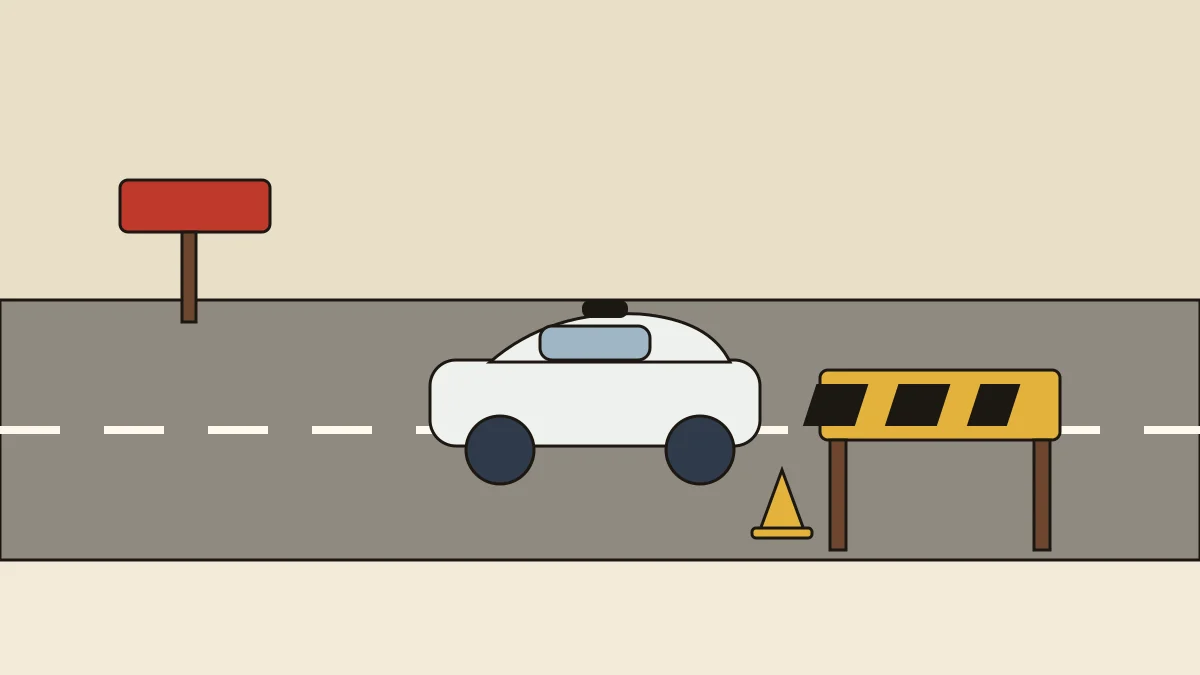
Waymo's robotaxis have stopped driving on California freeways after the state DMV restricted the company's driverless highway operations, and the Alphabet-owned company has gone further, pausing freeway rides in every one of its 15 US markets while it reviews its performance. The order, issued November 11 but made public only Tuesday, declares that Waymo's driverless freeway operations "pose an imminent hazard to public safety" because of recurring incursions into active construction zones despite a prior restriction and corrective actions.
What triggered the order
Two incidents are named in the DMV's account. In one, three Waymo vehicles drove into an active construction closure on US Route 101 near Burlingame on the San Francisco Peninsula. In the other, captured on a widely shared video, a Waymo car interfered with California Highway Patrol vehicles on Highway 280 in San Francisco as officers tried to enforce a traffic break while workers cleared crash debris. Nobody was hurt in either episode, but the department said the restrictions stay in place until Waymo demonstrates "effective corrective actions," with no timeline for the review. The episode lands as Tesla markets its own robotaxi ambitions to the public on steep contract terms.
A familiar problem resurfaces
Freeway driving is central to Waymo's economics: the company began selling highway rides in late 2025, and cutting across the Peninsula and into airports turns hour-long surface street crawls into fast trips. It is also the recurring weak point. In May, after videos showed Waymo cars plowing through traffic cones, the company halted freeway rides without explanation and returned in July with what it described as an updated driving system. In June, federal regulators had already forced a software recall over failures to recognize highway construction zones, citing incidents from April and May in which vehicles drove past ramp closure signs. DMV spokesperson Jonathan Groveman confirmed the two trigger incidents in a written statement, and the agency noted the vehicles kept entering construction zones even after corrective actions imposed following similar events on May 18. Tuesday's order is therefore the second freeway restriction in roughly half a year, this time with a public enforcement record behind it.
The review now underway
A Waymo spokesperson, Dana Gallagher, said the company restricted freeway operations across its other markets in alignment with its safety principles, while ride-hailing continues on surface streets at more than half a million trips each week. Highway testing with safety operators behind the wheel continues, which keeps data flowing to engineers without carrying paying passengers. Both companies describe the freeway suspension as temporary and cooperative, but neither offers a date for resuming the service riders got used to last year. The federal angle is not closed either: last week the National Highway Traffic Safety Administration said it was examining whether a December recall fix, tied to robotaxis that repeatedly drove past stopped school buses with lights flashing, had actually solved the underlying problem. Construction zones remain the hardest unsolved case, because their layouts follow no fixed rules, and the DMV now holds the leverage to keep Waymo's highway business shut until its software proves otherwise.