Bambu Lab's first attempt at a laser was a 40W diode bolted inside the H2D printer, and the objection was not about the laser. It was about the box. Cutting produces smoke and residue, and a lot of people did not want that happening inside an expensive Core XY printer they had just bought.
The R1 is the answer to that objection. Same software approach, standalone enclosure, and a 55W CO2 laser instead of a diode, with a 600 by 300 millimetre work area and a bird's eye camera for positioning jobs remotely. It is available now at $2,499. Tom's Hardware's review calls it a bargain against comparable machines, and CNET's early time with it reached the same first impression at a $2,500 base price.
The price is the story
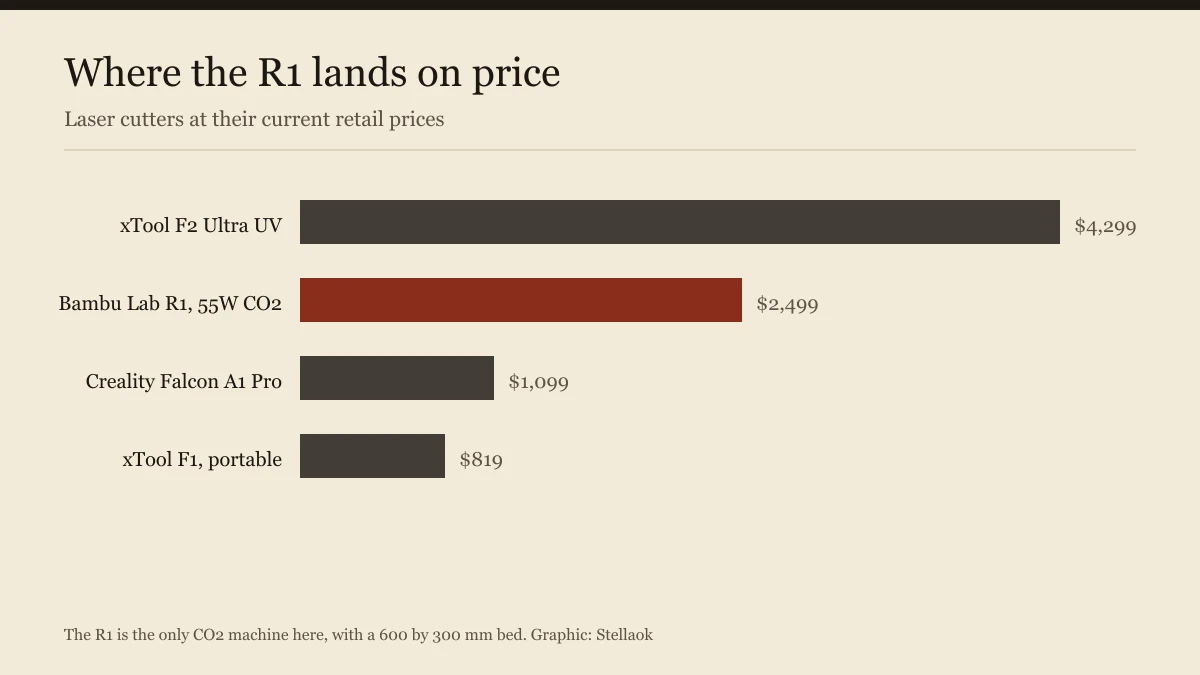
Put the R1 next to the alternatives and the positioning is obvious. A Creality Falcon A1 Pro is a capable 20W machine at $1,099. An xTool F1 is portable and $819. An xTool F2 Ultra UV, which is a cold laser suited to engraving glass without charring, runs $4,299.
The R1 sits at $2,499 with a CO2 tube and a work area that its price neighbours do not offer. That is the same play Bambu ran in 3D printing: take a category where hobby machines were cheap and professional machines were expensive, and put a well-built machine with decent software in the gap. Tom's Hardware's verdict is that if you are running a small business or seriously making things, the price is worth it, which is a narrower recommendation than the number alone suggests.
Software is where the review is most enthusiastic, and that is consistent with the company's record. Bambu Suite handles the job setup, and the reviewer's point is that this market routinely ships good hardware let down by bad software. The one gap is material presets, which are thinner than they should be.
It is a large object
The R1 measures 940 by 560 by 200 millimetres, or 37 by 22 by 7.8 inches, and weighs over 70 pounds. That needs a solid table and two people to position, and once it is placed you will not be moving it. Bambu put the controls, the frequently used ports and the safety key at the front for exactly that reason, with the colour touchscreen and start button on top.
The optional conveyor and riser base are the interesting extra. They extend the 300 millimetre axis to 3,000 millimetres, which is 9.8 feet of material through the machine. Anyone planning to use that needs the floor space in front of and behind it, which in practice means a workshop rather than a spare room.
Materials are wood, acrylic including clear acrylic, leather, fabric, paper, EVA foam and shell. It arrives fully assembled with the accessory pack inside the enclosure: tool kit, exhaust hose, ventilation fan, antifreeze, funnel, laser alignment sensor, calibration board, and a starter pack of basswood plywood and clear acrylic. You supply 1,500 millilitres of distilled water to dilute the antifreeze. The review unit also came with medium and long focus lenses, the conveyor and riser, an automatic fire extinguishing system and a smoke purifier, none of which are in the base price.
The one real complaint
Cutting thicker material means changing the focus lens by hand, and the process is six screws out and six screws back in, with the two on the toolhead cover described as ridiculously small.
The reviewer's comparison is apt: this is the same class of annoyance as early Bambu printer nozzles, which required detaching the heater and thermistor and reinstalling them with thermal paste. Bambu fixed that with a quick-release design eventually. A quick-release lens would fix this, and it does not exist yet.
None of that is disqualifying on a machine at this price. It is the kind of detail that decides whether you reach for the long lens when a job would benefit from it, or make do with the one already fitted.
The company is having an eventful week for other reasons. A Texas jury just found it liable for $27.6 million over Stratasys patents covering prime towers and bed levelling in its first-generation printers, a verdict that applies to US sales and not to the same machines in Europe. Nothing in that dispute touches the R1, which is a different product category, but it is the backdrop to a launch aimed squarely at the American maker market. The broader trend of putting sensors in charge of a process people used to judge by eye runs from industrial tooling down to toasters with optical doneness detection.