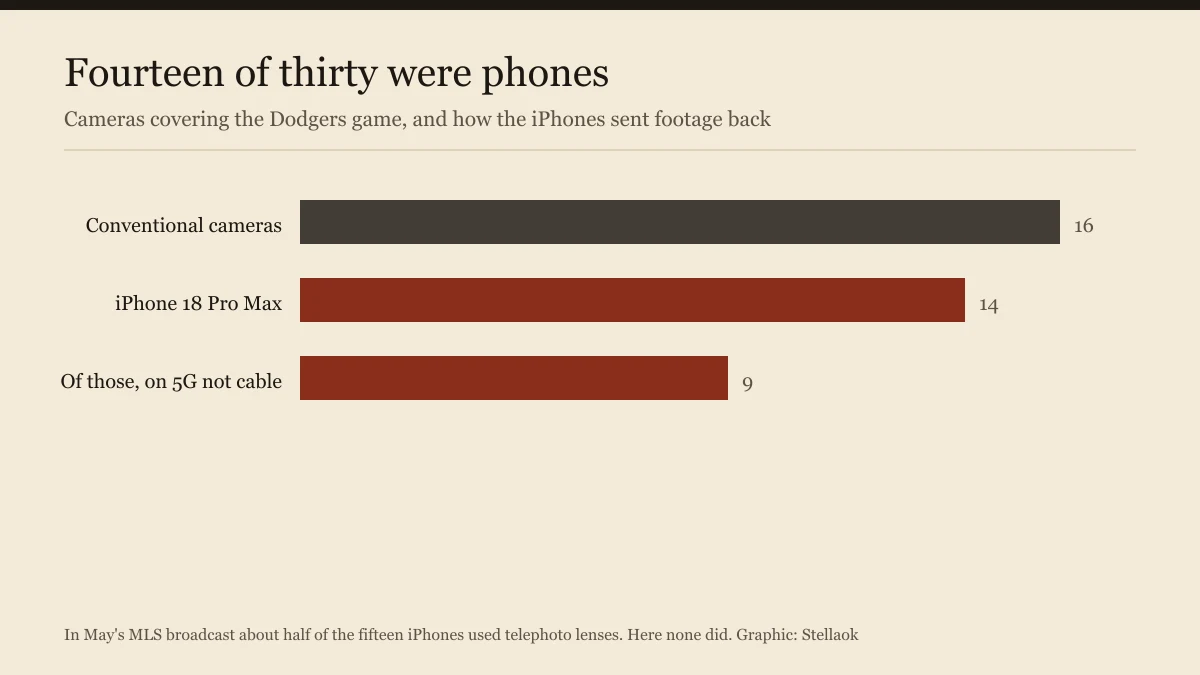
Apple put 14 iPhone 18 Pro Max units among the 30 cameras covering the Dodgers against the Giants, for what was Apple TV Plus's final Friday Night Baseball broadcast of the season. The phones had gone on sale that morning.
CNET was among the media Apple took to Dodger Stadium to see the rig before the game, and the detail that gives away how recent all of this was: the first phone they found, on a tripod just inside the dugout, was mounted in a case labelled iPhone 17 Pro Max.
Where the phones were and what they did
The placements were chosen for positions a broadcast camera cannot reach. Behind home plate the iPhones sat in custom heavy padding on the backstop and above the tower of pitch clock cameras. Others went in the visitors' dugout, on the right-field foul pole, and pointed at the field from both bullpens.
One on the wall above right-center field was mounted on a gimbal, nicknamed "the robo" and driven manually from the broadcast centre, framed to catch outfielders running at the wall and reaching over to take home runs away. Another was carried into the stands for live crowd reaction.
Apple did not detail the other 16 cameras, which were presumably conventional bodies on long telephoto glass doing the actual coverage of play.
The two numbers that make this more than a stunt
First, the lenses. Apple ran a live iPhone-shot broadcast of a Major League Soccer game back in May, and about half of the fifteen iPhone 17 Pro Max units used then were bolted onto professional-grade telephoto lenses. At Dodger Stadium none of them were. All 14 shot on the phone's own optics.
Dylan Ashbrook, director of content and brand development for Apple Sports, tied that to the hardware change. "The new 48MP Fusion Main camera gives us even more versatile video capabilities, and the variable aperture on the Main camera gives us another tool for managing exposure in-camera, giving us more control over the look of the game as conditions change," he said.
The conditions are the point. A night baseball game starts in daylight and finishes under stadium floodlights, which is a two or three stop swing during a single continuous event. Physical aperture blades let a camera ride that change without pushing everything into software, and that is the specific capability being demonstrated rather than raw resolution.
Second, and more interesting operationally: nine of the 14 iPhones were not cabled. They returned live footage to the broadcast centre over 5G, during the game, in a stadium full of people using the same spectrum.
Why the wireless part matters more than the camera
Broadcast video over a public mobile network is the thing outside broadcasters have historically refused to rely on for live sport. The failure mode is not degraded quality, it is a dropped feed at the moment something happens, and a full stadium is the worst possible environment for it.
Nine simultaneous wireless feeds holding up through a game is a stronger claim than any camera specification, and it is the one Apple did not put in a marketing line. If it is repeatable, the cost structure of covering an event changes: cameras can go where cable cannot be run, which is most of a stadium, and the number of angles stops being limited by cabling time.
The caveats are the usual ones for a controlled demonstration. This was Apple's own production, in a venue it had prepared, with its own engineers present and a clear commercial interest in the result. Nobody has yet tried this on a rig they did not design.
For anyone weighing the phone itself, the camera changes are the substance of this generation. Our review found the battery and camera carrying an otherwise familiar shell, and the comparison against the Pixel 11 Pro showed both companies raising prices by $100 while diverging on what they optimised. Apple is currently making the case for its silicon at both ends of the range, having also priced the M5 Ultra Mac Studio 51% higher for 33% more performance.