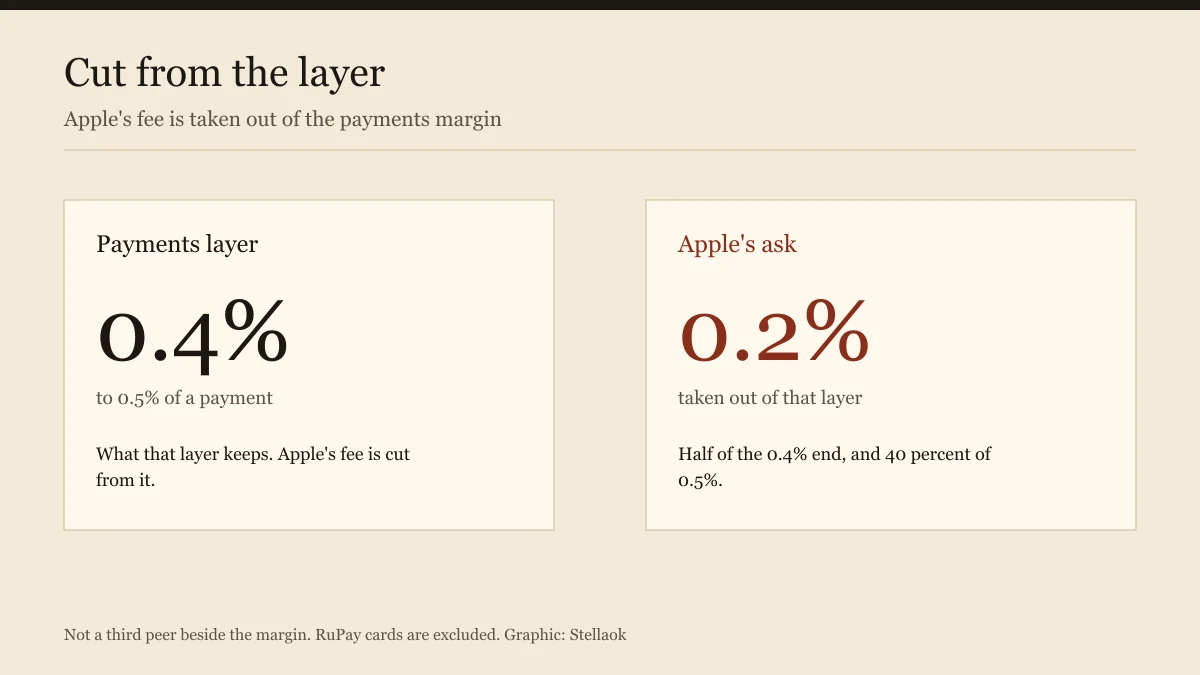
Apple wants about 0.2 percent of an Apple Pay transaction in India. The payments layer it would come out of is about 0.4 percent to 0.5 percent.
That fee is not in a press release. TechCrunch, which first reported the rollout, attributes it to people familiar with the talks, and says the structure matches Apple Pay in other countries. Zero point two divided by 0.4 is half the thin end of that margin. Divided by 0.5 it is 40 percent of the thick end. On those figures the fee is two-fifths to half of what the payments layer keeps.
Apple began the India rollout on Tuesday. The first bank is Axis, which TechCrunch calls the country's third-largest private lender. Eligible cards are Visa and Mastercard. RuPay, the domestic network, is not included. Acceptance is limited to merchants and terminals that have been switched on.
Three big card names are missing, and UPI is the thing this is not
HDFC Bank, ICICI Bank, and SBI Card are not in at launch. One of the people told TechCrunch that talks on commercial terms are still open. Apple, Axis, HDFC, ICICI, and SBI Card did not answer requests for comment. Earlier this month Reuters reported an October start on Axis credit cards. TechCrunch updated its story to say the launch is now underway.
UPI moves money from bank account to bank account, usually by QR code, and it is most of India's digital payments. Apple Pay is a card product. It needs each issuer and each terminal provider to integrate. Apple said "millions of merchants" would take it, and named Blinkit, Croma, Ixigo, Reliance brands, Tata 1mg, and Zomato. The providers enabling acceptance include Cashfree, JusPay, Mswipe, Paytm, PayU, Pine Labs, Razorpay, and Worldline.
A payment can work on a terminal whose provider has enabled Apple Pay and fail on the next terminal, if that acquirer's bank has not. Axis customers, the people said, can put a credit card in Wallet and pay online or with a tap where the terminal is ready.
Twenty-eight percent of the market by value is the phone, not the wallet
Counterpoint, in an earlier report TechCrunch cites, put Apple at 28 percent of India's smartphone market by value in 2025, up from 23 percent the year before. That is five points, and 28 divided by 23 is about 1.22, a rise of roughly a fifth in value share. Business Standard, citing an Indian government official, said India is already about a quarter of global iPhone production and could reach 30 percent to 35 percent within five years. From a quarter to 30 percent is five more points of output. To 35 percent is ten.
The people said iPhone owners in India tend to be more affluent and more likely to hold premium cards, which is why a niche card wallet can still matter to a bank that lives on UPI. They also said the fee is another way to make money from that base even if Apple Pay stays small.
Half the margin is why the other banks are still out
A fee that takes 40 to 50 percent of a 0.4 to 0.5 percent layer is large relative to the layer, and tiny relative to a purchase. On a 10,000-rupee card payment, 0.2 percent is 20 rupees. The argument inside the banks is not the rupees on one ticket. It is giving up about half the spread on every ticket, in a market where UPI already taught people to pay with no card at all.
The phone business is a separate pile of evidence. Apple shot half a live baseball broadcast on iPhones, a production bet on the same devices. Real wages are still losing where inflation outruns pay, which is the household side of a new fee at the till. The Counterpoint pair, 23 percent then 28, is the only market-share figure this launch story actually supplies.
The next names are HDFC, ICICI, and SBI Card. Until one of them signs, Apple Pay in India is Axis, Visa, Mastercard, and a 0.2 percent ask that the larger issuers have not accepted.