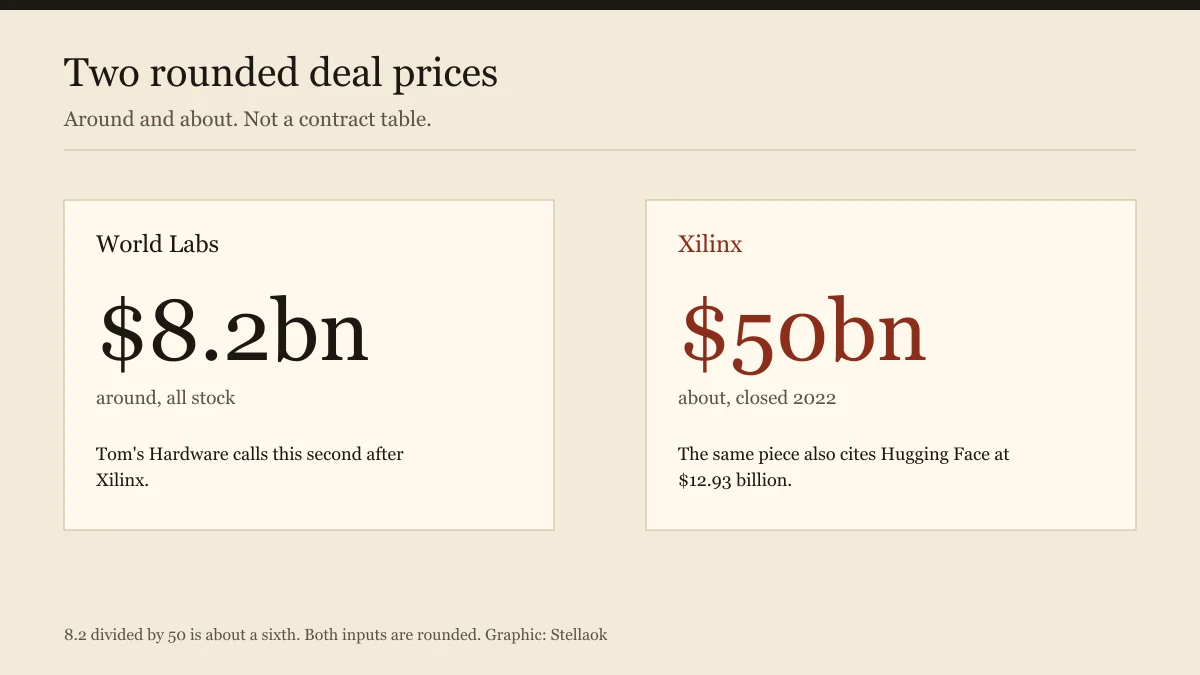
AMD has agreed to buy World Labs for around $8.2 billion in stock. Fei-Fei Li, who led the ImageNet project in the 2010s, becomes chief scientist.
Tom's Hardware is reporting an all-stock purchase, so "around $8.2 billion" is not a cash wire. Li has been chief scientist of AI at Google Cloud and director of the Stanford Artificial Intelligence Laboratory. World Labs says it builds spatial-intelligence models that "generate, reconstruct and simulate interactive 3D environments," for robotics and simulation rather than chat. Marble, the first commercial product, launched late last year and turns source material into persistent, downloadable 3D worlds.
Around $8.2 billion is about a sixth of about $50 billion
The companies already worked together on training and inference. AMD put money into World Labs' $1 billion round in February. Tom's Hardware says that made the lab a showcase customer. AMD says the purchase will "help shape its future technology roadmaps."
The outlet calls World Labs AMD's second-largest deal after Xilinx, which came to about $50 billion at the close in 2022. Divide 8.2 by 50 and you get 0.164, about a sixth. Both inputs wear a hedge, "around" and "about," so a sixth describes the ratio of two rounded prices. It is not a line in a purchase agreement. Other AMD deals in the same list are smaller: ATI at $5.4 billion in 2006, ZT Systems at $4.9 billion in 2025, Pensando at $1.9 billion in 2022. AMD clearing $1 trillion next to Nvidia near $5.4 trillion is a market value, not a deal price.
A $12.93 billion figure in the same piece breaks the ranking
Tom's Hardware also says AMD agreed earlier this month to buy Hugging Face for $12.93 billion. That number is larger than around $8.2 billion. If Hugging Face closes at $12.93 billion, World Labs is not the second-largest deal after Xilinx. If World Labs is second, the Hugging Face price is not a larger closed deal. The article states both and does not pick. Treating "second-largest" as a fact means ignoring $12.93 billion. Treating $12.93 billion as closed means ignoring the rank.
OpenAI's own chip runs DeepSeek and stays in-house. That is a lab keeping a model off the merchant silicon AMD sells.
Marble already exists. The title is new
The product a customer can already use is Marble. The thing the $8.2 billion buys, on top of a February investment, is Li's group inside AMD and a say in the roadmap. An all-stock price also moves with AMD's shares between announcement and close. "Around" covers that, and it covers the journalist's rounding.
A single closing table that lists Hugging Face and World Labs would end the contradiction. Until AMD publishes one, the story contains two orders for "what AMD just bought," and they do not sort.
Li's route into the building is specific enough to date without the price. ImageNet in the 2010s, Google Cloud, Stanford's lab, Marble late last year, a $1 billion round in February that AMD already joined. The February cheque and the "around $8.2 billion" are not the same instrument. One is an investment in a round. The other is an agreement to buy the company for stock. Adding them would double-count a relationship that was already underway. Xilinx at about $50 billion remains the comparison Tom's Hardware wants, and Hugging Face at $12.93 billion remains the comparison that unsettles it. ATI, ZT Systems, and Pensando are all smaller than both of those headlines. They show AMD has bought companies for less. They do not resolve which of the two new prices is larger in the end. Marble, already on sale, is the part of World Labs a customer can open without waiting for a closing. The spatial models are for 3D scenes, not for chat. That product distinction is why a GPU company wants the lab, and it does not depend on whether the cheque ranks second or third.