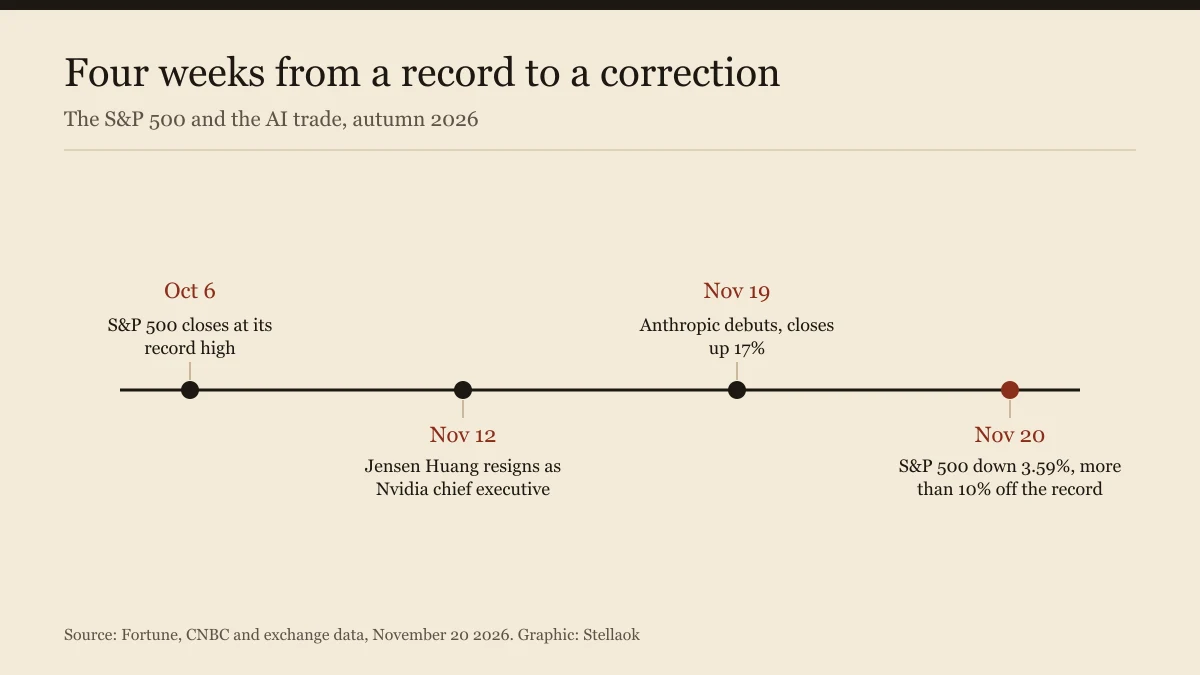
The S&P 500 closed in a correction on Friday, more than 10% below its October 6 record, after falling 3.59% to 6,918.45. It was the index's seventh straight losing session, its longest run since February 2020. The Dow also ended in correction territory, and the Nasdaq Composite gave back everything it had gained in 2026.
Benedicte Lowe, an equity derivatives strategist at BNP Paribas, told CNBC that investors were "panic selling" as they tried to work out whether enthusiasm for AI had peaked. The selling was concentrated in the companies that had done the most to create that enthusiasm. Micron, Broadcom, Nvidia and AMD each fell between roughly 12% and 14%.
Nvidia's losing streak reaches 2008
Nvidia dropped 14% on Friday, its seventh consecutive daily decline and its seventh consecutive lower week, the longest such stretch since 2008. The stock is 46% off its peak, a loss of about $2.6 trillion in market value, and now trades at roughly 8.4 times forward earnings while AMD trades at 29 times. The company once worth the most in the world sits fourth, behind Apple, Microsoft and Alphabet, at about $3 trillion.
Part of that is the aftermath of Jensen Huang's resignation as chief executive on November 12, which the new board chair, Harvey Jones, attributed to personal conduct inconsistent with company standards. The losing streak began before that. According to CNBC, investors were already questioning whether the buildout of AI data centers could keep paying for itself, and were watching Google and AMD close the gap in accelerators.
A better-than-expected earnings report did not stop the slide. Interim chief executive Colette Kress told analysts that revenue would grow 75% next fiscal year and that customers were not going anywhere. Reuters also reported that the Securities and Exchange Commission is looking into potential accounting issues at the company, which pushed the stock lower again.
Asia sold first and sold harder
The damage was not contained to New York. Taiwan's index fell 5.65% on Friday, its steepest weekly drop since October 1997. Japan's Nikkei and South Korea's Kospi each lost about 5%. SoftBank closed 14.48% lower, its worst day since August 2024, and is down 31% this month after losing 30% in October, a swing that traces back to its $64.6 billion stake in OpenAI and its ownership of Arm.
In Seoul, SK Hynix fell 5.92% and Samsung Electronics 7.01%. Tokyo Electron lost 7.06%, Lasertec 9.21% and Renesas 7.02%. TSMC closed 4.76% lower in Taipei.
Anthropic set the tone. The company raised $81.34 billion in an IPO that valued it at $1.414 trillion, then fell about 9% on its second day of trading, giving back much of the 17% gain it made on debut. The listing itself was the largest on record, and its immediate fade told investors that even a landmark deal could not hold a price.
Credit is tightening at the edges
Beneath the index moves, the cost of money for AI projects is rising. SpaceX had to lift the yield on a $32 billion debt sale to 8.3%, which the analyst Luke Lango read as the capital spigot closing for weaker borrowers such as CoreWeave and Nebius. Lango's note to clients was blunt about where the money went: "Money is leaving tech, not the market," he wrote, pointing out that the Dow and the equal-weight S&P were higher at the time.
Washington added its own weight. President Donald Trump threatened a "tremendous tax" on U.S. companies that build data centers abroad, a policy aimed at keeping capacity onshore that also introduces a cost nobody had modeled into overseas projects.
Not everyone reads the drop as the start of a bear market. Chris Larkin of E*Trade noted that only five of the past 15 corrections since 1983 turned into bear markets. Deutsche Bank's Binky Chadha called the market very oversold, and JPMorgan Asset Management's David Kelly said a tech correction was overdue. The case that this is a bubble has been building for weeks, and the people making it now have a chart to point at.
The Fed meets in three weeks
The macro backdrop removes the easy explanation. Philadelphia Fed president Anna Paulson said on Thursday that the central bank will need to raise rates again because inflation is too high. Futures put the odds of a December increase at about 95%, and the 10-year Treasury yield is near 5%.
Higher rates compress the present value of profits that arrive years from now, which is precisely the shape of an AI infrastructure bet. The University of Michigan's November survey, which ran through November 16, found households with the largest stock holdings reporting a decline in personal finances, a shift its director, Joanne Hsu, tied to continued agitation in the market.
The Fed meets on December 9. Between now and then, the question is whether Friday was panic or simply early. The median total decline in the 14 corrections since 1983 that E*Trade studied was 19.9% from the record, and the S&P has traveled about half of that.