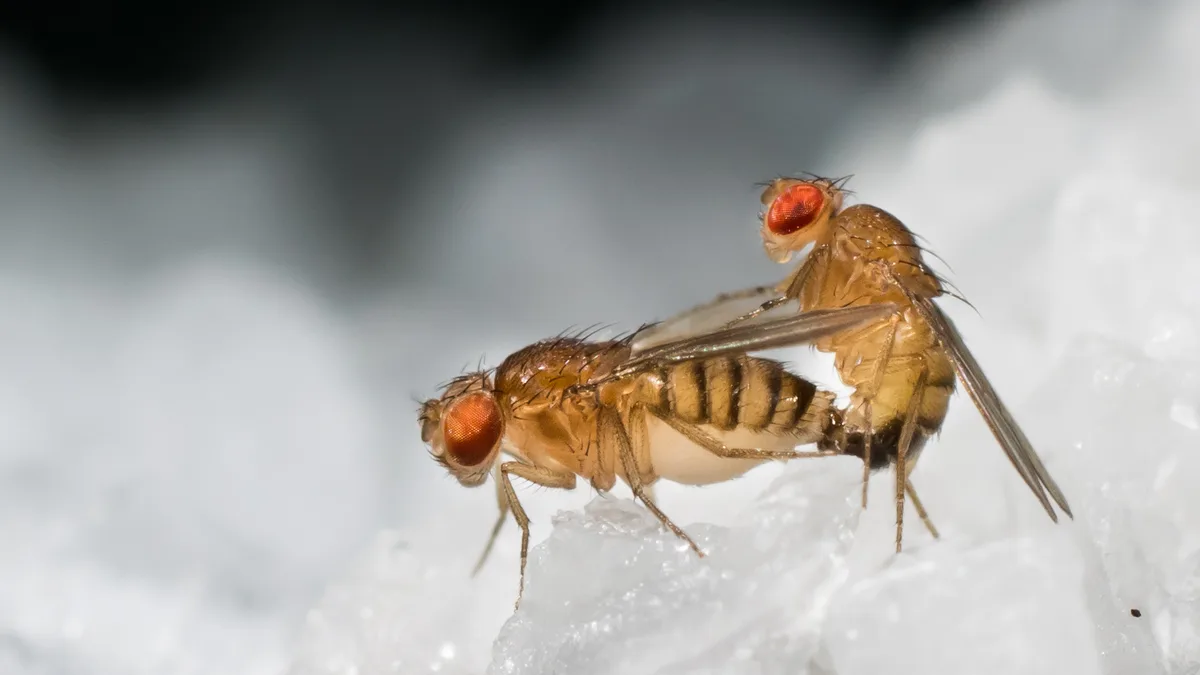
FutureBit has taken Google's freshly published map of a fruit fly brain and pointed it at Bitcoin. The result, a browser demo called HashFly, renders a slowly rotating fly connectome and lights up neuron traces as it grinds through block headers. Anyone can open it and press Mine.
What happens next is not mining in any sense your electricity bill would recognise. The simulation borrows the photoreceptors that would normally sense light in the fly's eye and feeds them a block header instead. Cells labelled PPL101 fire when a double SHA-256 target comes out right. A difficulty slider lets you add or remove leading zeros. At the demo's hardest setting, level six, the puzzle is still orders of magnitude easier than a real Bitcoin hash, and an hour of running it clears something like eighty blocks.
The numbers do not survive contact with a real miner
Tom's Hardware clocked the web app at roughly 100 kH/s. FutureBit's own Apollo III, a five-inch cube that sits on a desk, is rated at up to 18 TH/s. That is a gap of about 180 million times, achieved by a product the same company will happily sell you today.
The demo is also running a fraction of the available brain. The overlay reports around 2,914 traces firing. Google's MaleCNS v1.0 connectome contains 165,122 reconstructed neurons. FutureBit says it is working on simulating the whole dataset against SHA-256 and will publish what it finds, which at least turns the stunt into something with a result attached.
One watt per terahash, with a large asterisk
The line doing the real work in FutureBit's posts is the efficiency guess. If this could be scaled on actual organic neurons, the company says, it would hash at roughly one watt per terahash, about ten times better than the best silicon 3nm ASICs.
Read the assumptions before the headline. The figure is derived from the total power a fruit fly consumes, then divided as though every neuron in the animal could be recruited to compute SHA-256 and kept firing continuously. A fly does not work that way. Most of that brain is busy flying the fly. Nobody has built the interface that would let a wet neuron accept a block header, and nobody has shown that biological tissue can be clocked and cooled the way a mining farm needs.
That does not make the comparison useless. Efficiency is the only axis mining hardware competes on any more, and the industry has spent a decade squeezing it out of process nodes. The same pressure shows up everywhere power budgets bind, from Micron's 512GB DDR5 modules drawing 16 watts to the data centre buildouts that now dominate the AI conversation. A claim that biology could beat 3nm by an order of magnitude is worth hearing even when the path to it is missing.
Google published a brain and the internet did what it does
HashFly is not the only thing built on this dataset in the past week. Almost as soon as Google released the complete brain and central nervous system of an adult male fruit fly, people started asking whether it could run Doom, whether it could day trade, and how many other pointless jobs it could be handed. A rival mining project called FlyMiner puts the same connectome under the control of an ASIC miner and concedes on its own site that the odds of finding a block are almost zero.
This is the usual fate of an open scientific dataset, and it is not a waste. Google's research arm has spent years arguing that publishing the raw material matters more than controlling what gets done with it, an argument the company is now formalising through a new institute built to host disagreements rather than settle them. A week of browser toys is what open publication looks like before the serious work starts.
The thing to watch is FutureBit's follow-up. Simulating all 165,122 neurons against a hash function will produce an actual number for how much computation this architecture can do per notional watt. That number will almost certainly be worse than the press-release estimate. It will also be the first version of this claim that anyone can check.